

180
DYNAMICAL OCEANOGRAPHY
ǫ
Dv
dt
+ u(1 + βǫy)+
∂p
∂y
(1 + ǫF ρ)
−1 = E H ∇
2
H v + E V
∂ 2 v
∂z 2 , (8.20b)
0=−
∂p
∂z
− ρ,
(8.20c)
∂u
∂x
+
∂v
∂y
+
∂w
∂z
=0 ,
(8.20d)
ǫF
Dρ
dt
+(1+ǫF ρ)
w
¯
ρ ∗
d¯ ρ ∗
dz
= H ρ ,
(8.20e)
D
dt
=
∂
∂t
+ u
∂
∂x
+ v
∂
∂y
+ w
∂
∂z
.
(8.20f)
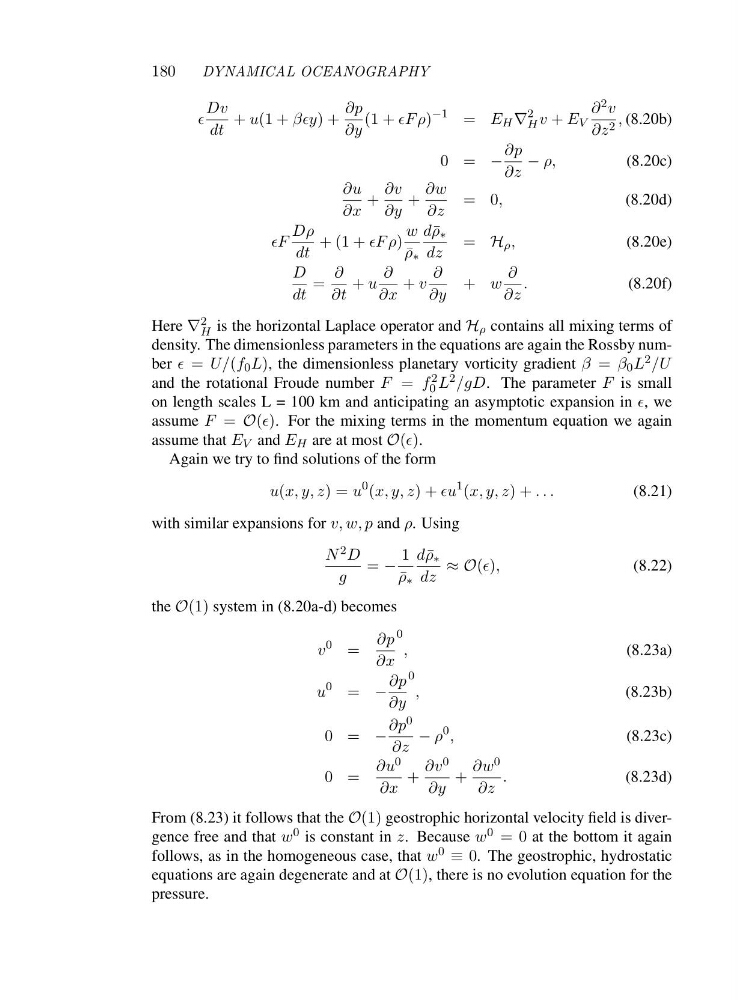
Here ∇ 2
H is the horizontal Laplace operator and H ρ contains all mixing terms of
density. The dimensionless parameters in the equations are again the Rossby number ǫ = U/(f 0 L), the dimensionless planetary vorticity gradient β = β 0 L 2 /U
and the rotational Froude number F = f 2
0 L 2 /gD. The parameter F is small
on length scales L = 100 km and anticipating an asymptotic expansion in ǫ,w e
assume F = O(ǫ). For the mixing terms in the momentum equation we again
assume that E V and E H are at most O(ǫ).
Again we try to find solutions of the form
u(x, y, z)=u
0 (x, y, z)+ǫu
1 (x, y, z)+...
(8.21)
with similar expansions for v, w, p and ρ.U s i n g
N 2 D
g
= −
1
¯
ρ ∗
d¯ ρ ∗
dz
≈O(ǫ),
(8.22)
the O(1) system in (8.20a-d) becomes
v
0 =
∂p
∂x
0
,
(8.23a)
u
0 = −
∂p
∂y
0
,
(8.23b)
0=−
∂p 0
∂z
− ρ
0 ,
(8.23c)
0=
∂u 0
∂x
+
∂v 0
∂y
+
∂w 0
∂z
.
(8.23d)
From (8.23) it follows that the O(1) geostrophic horizontal velocity field is divergence free and that w 0 is constant in z. Because w 0 =0at the bottom it again
follows, as in the homogeneous case, that w 0 ≡ 0. The geostrophic, hydrostatic
equations are again degenerate and at O(1), there is no evolution equation for the
pressure.
DYNAMICAL OCEANOGRAPHY
ǫ
Dv
dt
+ u(1 + βǫy)+
∂p
∂y
(1 + ǫF ρ)
−1 = E H ∇
2
H v + E V
∂ 2 v
∂z 2 , (8.20b)
0=−
∂p
∂z
− ρ,
(8.20c)
∂u
∂x
+
∂v
∂y
+
∂w
∂z
=0 ,
(8.20d)
ǫF
Dρ
dt
+(1+ǫF ρ)
w
¯
ρ ∗
d¯ ρ ∗
dz
= H ρ ,
(8.20e)
D
dt
=
∂
∂t
+ u
∂
∂x
+ v
∂
∂y
+ w
∂
∂z
.
(8.20f)
Here ∇ 2
H is the horizontal Laplace operator and H ρ contains all mixing terms of
density. The dimensionless parameters in the equations are again the Rossby number ǫ = U/(f 0 L), the dimensionless planetary vorticity gradient β = β 0 L 2 /U
and the rotational Froude number F = f 2
0 L 2 /gD. The parameter F is small
on length scales L = 100 km and anticipating an asymptotic expansion in ǫ,w e
assume F = O(ǫ). For the mixing terms in the momentum equation we again
assume that E V and E H are at most O(ǫ).
Again we try to find solutions of the form
u(x, y, z)=u
0 (x, y, z)+ǫu
1 (x, y, z)+...
(8.21)
with similar expansions for v, w, p and ρ.U s i n g
N 2 D
g
= −
1
¯
ρ ∗
d¯ ρ ∗
dz
≈O(ǫ),
(8.22)
the O(1) system in (8.20a-d) becomes
v
0 =
∂p
∂x
0
,
(8.23a)
u
0 = −
∂p
∂y
0
,
(8.23b)
0=−
∂p 0
∂z
− ρ
0 ,
(8.23c)
0=
∂u 0
∂x
+
∂v 0
∂y
+
∂w 0
∂z
.
(8.23d)
From (8.23) it follows that the O(1) geostrophic horizontal velocity field is divergence free and that w 0 is constant in z. Because w 0 =0at the bottom it again
follows, as in the homogeneous case, that w 0 ≡ 0. The geostrophic, hydrostatic
equations are again degenerate and at O(1), there is no evolution equation for the
pressure.