

174
DYNAMICAL OCEANOGRAPHY
In this chapter we will extend the theory so far to include stratification.
In section 8.1 a heuristic introduction is given why the internal Rossby
deformation radius L D is such an important scale of motion. The formulation and use of potential vorticity in a stratified rotating liquid is presented in section 8.2. In section 8.3 we then proceed with the derivation
of the continuously stratified quasi-geostrophic model. Finally, Rossby
waves in a stratified, rotating liquid in a domain with bottom topography
are discussed of section 8.4.
8.1. Rotation versus Stratification
Suppose we have flow with a stratification ρ = ρ 0 +¯ ρ(z) where ¯
ρ(z) is called
the background stratification and ρ 0 is a reference density. The effect of stratification on a flow with a horizontal length scale L is determined by the value of the
buoyancy frequency N [s −1 ], defined by
N
2 = −
g
ρ
dρ
dz
≈−
g
ρ 0
d¯ ρ
dz
,
(8.1)
as ρ 0 +¯ ρ(z) ≈ ρ 0 . We assume that this stratification is present over the length
scale L.
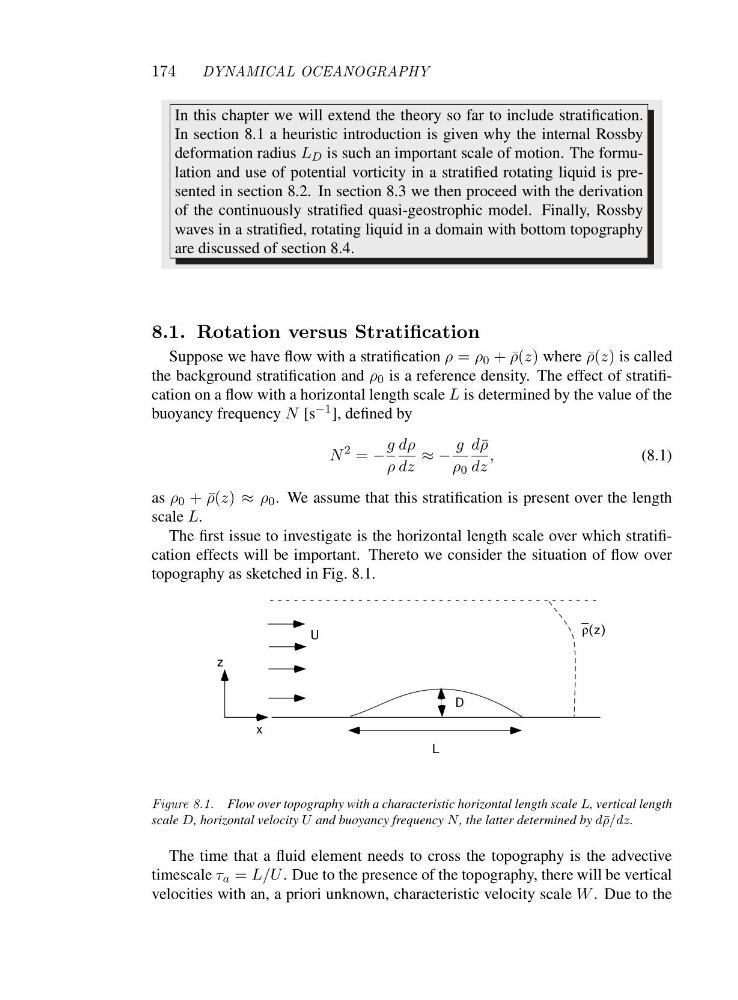
The first issue to investigate is the horizontal length scale over which stratification effects will be important. Thereto we consider the situation of flow over
topography as sketched in Fig. 8.1.
U
D
ρ(z)
_
L
z
x
Figure 8.1. Flow over topography with a characteristic horizontal length scale L, vertical length
scale D, horizontal velocity U and buoyancy frequency N , the latter determined by d¯ ρ/dz.
The time that a fluid element needs to cross the topography is the advective
timescale τ a = L/U . Due to the presence of the topography, there will be vertical
velocities with an, a priori unknown, characteristic velocity scale W . Due to the
DYNAMICAL OCEANOGRAPHY
In this chapter we will extend the theory so far to include stratification.
In section 8.1 a heuristic introduction is given why the internal Rossby
deformation radius L D is such an important scale of motion. The formulation and use of potential vorticity in a stratified rotating liquid is presented in section 8.2. In section 8.3 we then proceed with the derivation
of the continuously stratified quasi-geostrophic model. Finally, Rossby
waves in a stratified, rotating liquid in a domain with bottom topography
are discussed of section 8.4.
8.1. Rotation versus Stratification
Suppose we have flow with a stratification ρ = ρ 0 +¯ ρ(z) where ¯
ρ(z) is called
the background stratification and ρ 0 is a reference density. The effect of stratification on a flow with a horizontal length scale L is determined by the value of the
buoyancy frequency N [s −1 ], defined by
N
2 = −
g
ρ
dρ
dz
≈−
g
ρ 0
d¯ ρ
dz
,
(8.1)
as ρ 0 +¯ ρ(z) ≈ ρ 0 . We assume that this stratification is present over the length
scale L.
The first issue to investigate is the horizontal length scale over which stratification effects will be important. Thereto we consider the situation of flow over
topography as sketched in Fig. 8.1.
U
D
ρ(z)
_
L
z
x
Figure 8.1. Flow over topography with a characteristic horizontal length scale L, vertical length
scale D, horizontal velocity U and buoyancy frequency N , the latter determined by d¯ ρ/dz.
The time that a fluid element needs to cross the topography is the advective
timescale τ a = L/U . Due to the presence of the topography, there will be vertical
velocities with an, a priori unknown, characteristic velocity scale W . Due to the