

122
DYNAMICAL OCEANOGRAPHY
Summary
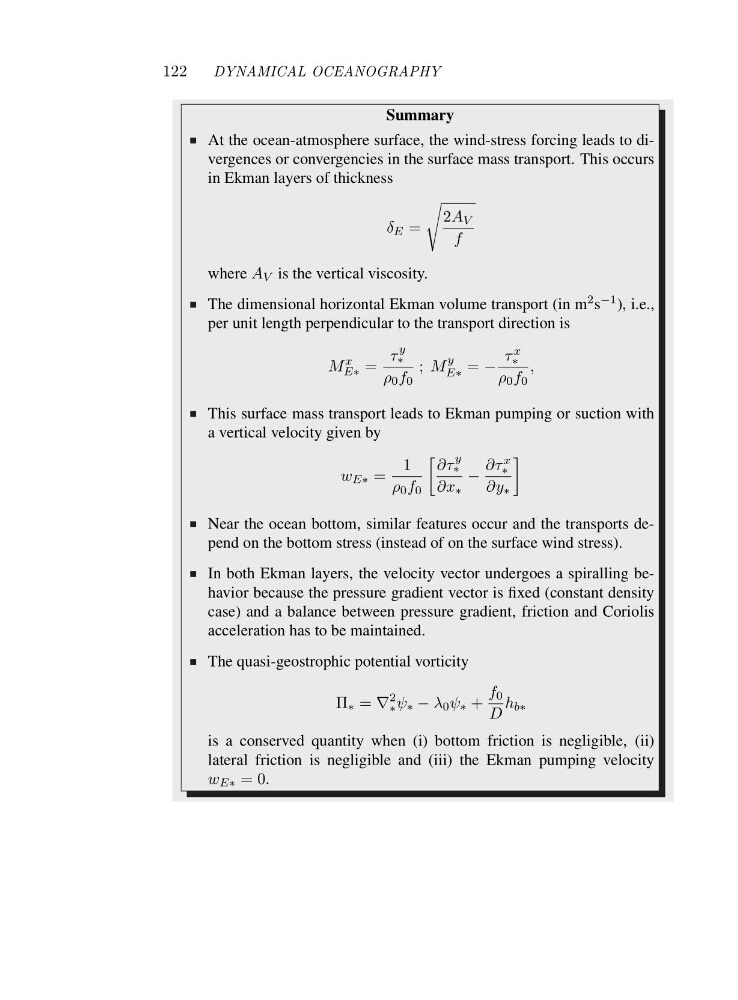
At the ocean-atmosphere surface, the wind-stress forcing leads to divergences or convergencies in the surface mass transport. This occurs
in Ekman layers of thickness
δ E =
2A V
f
where A V is the vertical viscosity.
The dimensional horizontal Ekman volume transport (in m 2 s −1 ), i.e.,
per unit length perpendicular to the transport direction is
M
x
E∗ =
τ
y
∗
ρ 0 f 0
; M
y
E∗ = −
τ x
∗
ρ 0 f 0
,
This surface mass transport leads to Ekman pumping or suction with
a vertical velocity given by
w E∗ =
1
ρ 0 f 0
∂τ
y
∗
∂x ∗
−
∂τ x
∗
∂y ∗
Near the ocean bottom, similar features occur and the transports depend on the bottom stress (instead of on the surface wind stress).
In both Ekman layers, the velocity vector undergoes a spiralling behavior because the pressure gradient vector is fixed (constant density
case) and a balance between pressure gradient, friction and Coriolis
acceleration has to be maintained.
The quasi-geostrophic potential vorticity
Π ∗ = ∇
2
∗ ψ ∗ − λ 0 ψ ∗ +
f 0
D
h b∗
is a conserved quantity when (i) bottom friction is negligible, (ii)
lateral friction is negligible and (iii) the Ekman pumping velocity
w E∗ =0.
DYNAMICAL OCEANOGRAPHY
Summary
At the ocean-atmosphere surface, the wind-stress forcing leads to divergences or convergencies in the surface mass transport. This occurs
in Ekman layers of thickness
δ E =
2A V
f
where A V is the vertical viscosity.
The dimensional horizontal Ekman volume transport (in m 2 s −1 ), i.e.,
per unit length perpendicular to the transport direction is
M
x
E∗ =
τ
y
∗
ρ 0 f 0
; M
y
E∗ = −
τ x
∗
ρ 0 f 0
,
This surface mass transport leads to Ekman pumping or suction with
a vertical velocity given by
w E∗ =
1
ρ 0 f 0
∂τ
y
∗
∂x ∗
−
∂τ x
∗
∂y ∗
Near the ocean bottom, similar features occur and the transports depend on the bottom stress (instead of on the surface wind stress).
In both Ekman layers, the velocity vector undergoes a spiralling behavior because the pressure gradient vector is fixed (constant density
case) and a balance between pressure gradient, friction and Coriolis
acceleration has to be maintained.
The quasi-geostrophic potential vorticity
Π ∗ = ∇
2
∗ ψ ∗ − λ 0 ψ ∗ +
f 0
D
h b∗
is a conserved quantity when (i) bottom friction is negligible, (ii)
lateral friction is negligible and (iii) the Ekman pumping velocity
w E∗ =0.