

92
V. Liapidevskii and N. Gavrilov
with the ordinate y chosen in the vertical direction. So the bottom and the lid of the
tank had the same angles of inclination to the horizon. The length of the compartment
with the mixed fluid of density ̄
í µí¼ = 0.5(í µí¼
−
+ í µí¼
+
) was chosen so that the only one
solitary wave at the interface was produced. It was also symmetric relative to the
undisturbed interface. Due to the flow symmetry, the corresponding component of
the Reynolds stress at y = H 1 vanished. The velocities generated in the homogeneous
layers by the intrusion were small enough and the friction at the bottom could be
neglected too, but the friction between the surrounding fluid and the intrusion should
be included in the mathematical model to describe properly the decay rate of solitary
waves propagating along the interface. We do not specify in the paper all details of
the experiments on the decay of symmetric solitary waves. Some approaches to the
problem are discussed in [7] and is illustrated below.
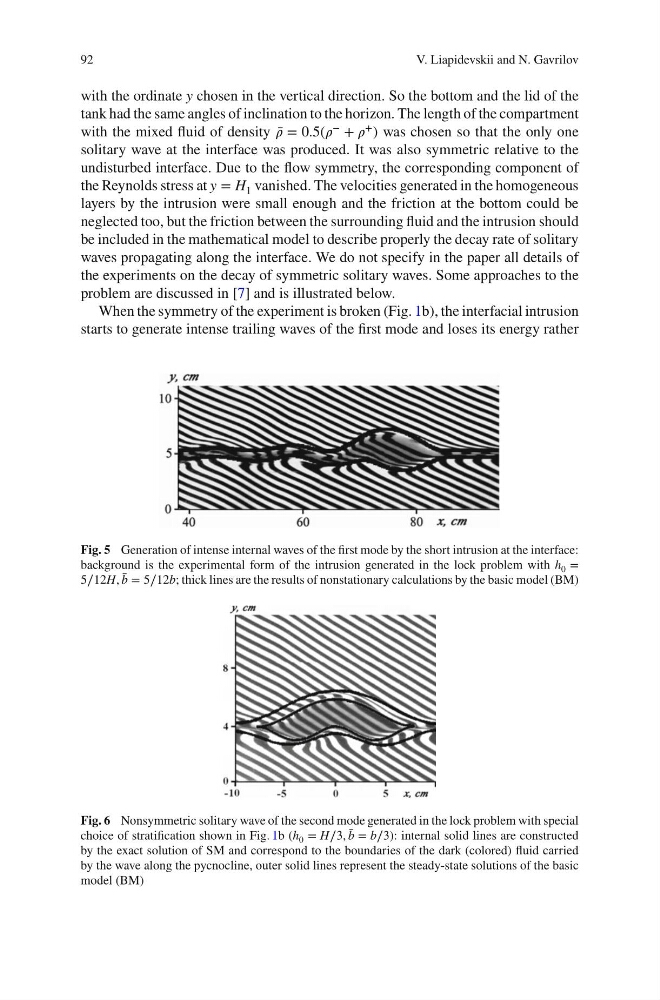
When the symmetry of the experiment is broken (Fig. 1b), the interfacial intrusion
starts to generate intense trailing waves of the first mode and loses its energy rather
Fig. 5 Generation of intense internal waves of the first mode by the short intrusion at the interface:
background is the experimental form of the intrusion generated in the lock problem with h 0 =
5∕12H, ̄
b = 5∕12b; thick lines are the results of nonstationary calculations by the basic model (BM)
Fig. 6 Nonsymmetric solitary wave of the second mode generated in the lock problem with special
choice of stratification shown in Fig. 1b (h 0 = H∕3, ̄
b = b∕3): internal solid lines are constructed
by the exact solution of SM and correspond to the boundaries of the dark (colored) fluid carried
by the wave along the pycnocline, outer solid lines represent the steady-state solutions of the basic
model (BM)
V. Liapidevskii and N. Gavrilov
with the ordinate y chosen in the vertical direction. So the bottom and the lid of the
tank had the same angles of inclination to the horizon. The length of the compartment
with the mixed fluid of density ̄
í µí¼ = 0.5(í µí¼
−
+ í µí¼
+
) was chosen so that the only one
solitary wave at the interface was produced. It was also symmetric relative to the
undisturbed interface. Due to the flow symmetry, the corresponding component of
the Reynolds stress at y = H 1 vanished. The velocities generated in the homogeneous
layers by the intrusion were small enough and the friction at the bottom could be
neglected too, but the friction between the surrounding fluid and the intrusion should
be included in the mathematical model to describe properly the decay rate of solitary
waves propagating along the interface. We do not specify in the paper all details of
the experiments on the decay of symmetric solitary waves. Some approaches to the
problem are discussed in [7] and is illustrated below.
When the symmetry of the experiment is broken (Fig. 1b), the interfacial intrusion
starts to generate intense trailing waves of the first mode and loses its energy rather
Fig. 5 Generation of intense internal waves of the first mode by the short intrusion at the interface:
background is the experimental form of the intrusion generated in the lock problem with h 0 =
5∕12H, ̄
b = 5∕12b; thick lines are the results of nonstationary calculations by the basic model (BM)
Fig. 6 Nonsymmetric solitary wave of the second mode generated in the lock problem with special
choice of stratification shown in Fig. 1b (h 0 = H∕3, ̄
b = b∕3): internal solid lines are constructed
by the exact solution of SM and correspond to the boundaries of the dark (colored) fluid carried
by the wave along the pycnocline, outer solid lines represent the steady-state solutions of the basic
model (BM)