

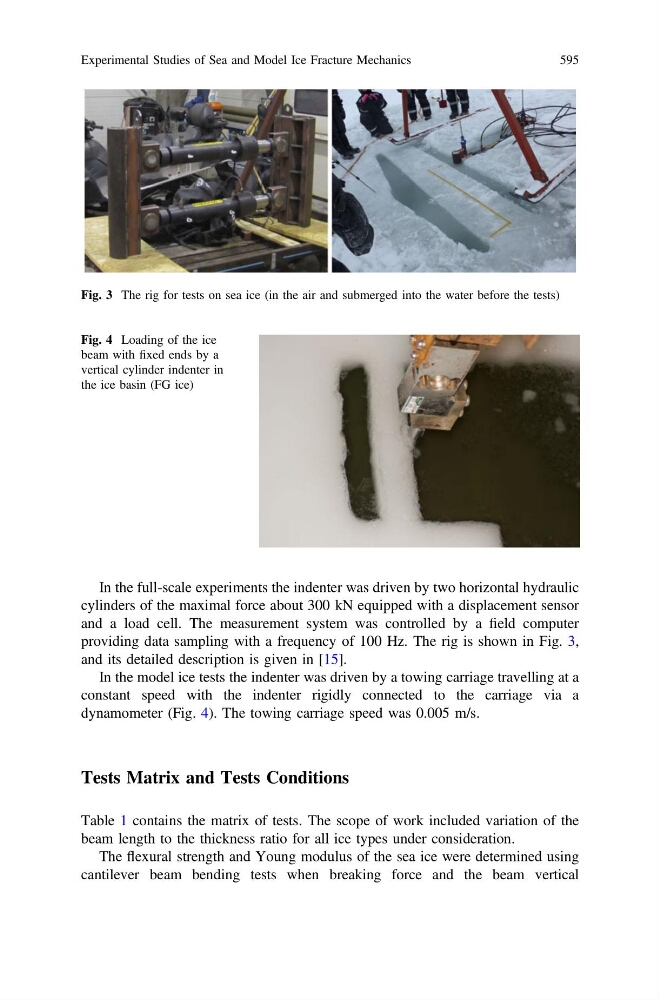
In the full-scale experiments the indenter was driven by two horizontal hydraulic
cylinders of the maximal force about 300 kN equipped with a displacement sensor
and a load cell. The measurement system was controlled by a field computer
providing data sampling with a frequency of 100 Hz. The rig is shown in Fig. 3,
and its detailed description is given in [15].
In the model ice tests the indenter was driven by a towing carriage travelling at a
constant speed with the indenter rigidly connected to the carriage via a
dynamometer (Fig. 4). The towing carriage speed was 0.005 m/s.
Tests Matrix and Tests Conditions
Table 1 contains the matrix of tests. The scope of work included variation of the
beam length to the thickness ratio for all ice types under consideration.
The flexural strength and Young modulus of the sea ice were determined using
cantilever beam bending tests when breaking force and the beam vertical
Fig. 3 The rig for tests on sea ice (in the air and submerged into the water before the tests)
Fig. 4 Loading of the ice
beam with fixed ends by a
vertical cylinder indenter in
the ice basin (FG ice)
Experimental Studies of Sea and Model Ice Fracture Mechanics
595