

to reproduce the eddy induced transport of temperature and salinity, and other
tracers correctly [7].
It is quite possible that namely the small Rossby radius (eddy effective diameter)
is the cause of the fact that refining of the model resolution over some interval will
not lead to the expected improvement in the transport of heat and salt (or other
conservative tracers) by narrow jets [1]. If the model resolution is about 5 km, the
model spectrum is truncated on the scale of the individual eddy, thus the energy and
enstrophy fluxes are treated incorrectly. Thus, an increase in the resolution from 20
to 5 km may lead to even worse results, because the jets are disintegrated into the
chains of eddies with poorly approximated dynamics. Finally, on the climate time
scales, it leads to the wrong reproduction of the mean large-scale state of the ocean.
In the case of low resolution, when the statistical approach for an ensemble of
eddies is valid, some of parameterizations of the so-called “eddy transport of scalar”
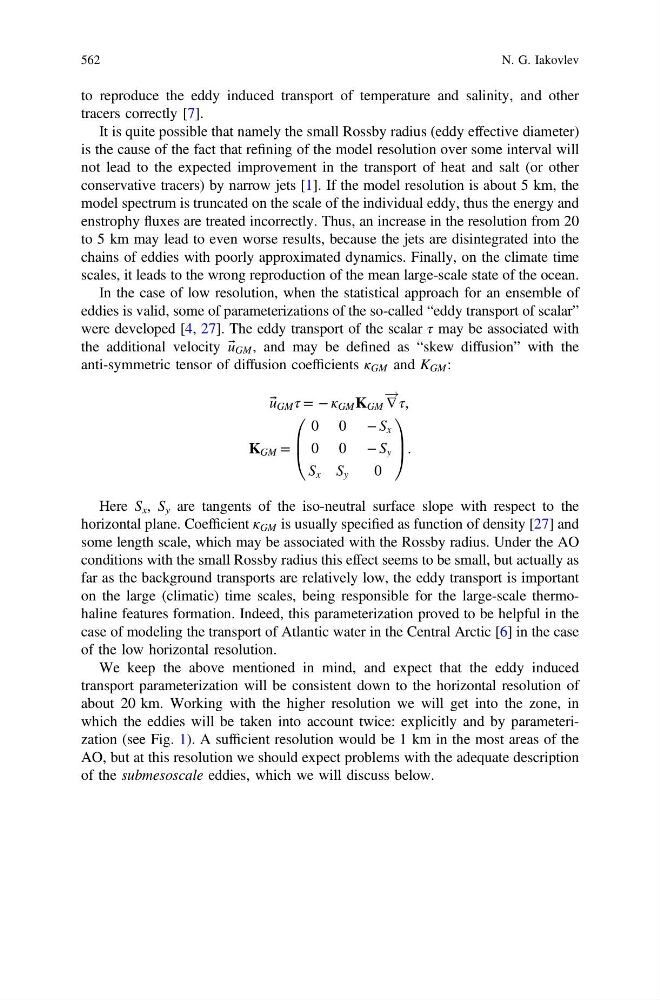
were developed [4, 27]. The eddy transport of the scalar τ may be associated with
the additional velocity u⃗ GM , and may be defined as “skew diffusion” with the
anti-symmetric tensor of diffusion coefficients κ GM and K GM :
u⃗ GM τ = − κ GM K GM ∇
!
τ,
K GM =
0 0 − S x
0 0 − S y
S x S y
0
0
B
@
1
C
A.
Here S x , S y are tangents of the iso-neutral surface slope with respect to the
horizontal plane. Coefficient κ GM is usually specified as function of density [27] and
some length scale, which may be associated with the Rossby radius. Under the AO
conditions with the small Rossby radius this effect seems to be small, but actually as
far as the background transports are relatively low, the eddy transport is important
on the large (climatic) time scales, being responsible for the large-scale thermohaline features formation. Indeed, this parameterization proved to be helpful in the
case of modeling the transport of Atlantic water in the Central Arctic [6] in the case
of the low horizontal resolution.
We keep the above mentioned in mind, and expect that the eddy induced
transport parameterization will be consistent down to the horizontal resolution of
about 20 km. Working with the higher resolution we will get into the zone, in
which the eddies will be taken into account twice: explicitly and by parameterization (see Fig. 1). A sufficient resolution would be 1 km in the most areas of the
AO, but at this resolution we should expect problems with the adequate description
of the submesoscale eddies, which we will discuss below.
562
N. G. Iakovlev
tracers correctly [7].
It is quite possible that namely the small Rossby radius (eddy effective diameter)
is the cause of the fact that refining of the model resolution over some interval will
not lead to the expected improvement in the transport of heat and salt (or other
conservative tracers) by narrow jets [1]. If the model resolution is about 5 km, the
model spectrum is truncated on the scale of the individual eddy, thus the energy and
enstrophy fluxes are treated incorrectly. Thus, an increase in the resolution from 20
to 5 km may lead to even worse results, because the jets are disintegrated into the
chains of eddies with poorly approximated dynamics. Finally, on the climate time
scales, it leads to the wrong reproduction of the mean large-scale state of the ocean.
In the case of low resolution, when the statistical approach for an ensemble of
eddies is valid, some of parameterizations of the so-called “eddy transport of scalar”
were developed [4, 27]. The eddy transport of the scalar τ may be associated with
the additional velocity u⃗ GM , and may be defined as “skew diffusion” with the
anti-symmetric tensor of diffusion coefficients κ GM and K GM :
u⃗ GM τ = − κ GM K GM ∇
!
τ,
K GM =
0 0 − S x
0 0 − S y
S x S y
0
0
B
@
1
C
A.
Here S x , S y are tangents of the iso-neutral surface slope with respect to the
horizontal plane. Coefficient κ GM is usually specified as function of density [27] and
some length scale, which may be associated with the Rossby radius. Under the AO
conditions with the small Rossby radius this effect seems to be small, but actually as
far as the background transports are relatively low, the eddy transport is important
on the large (climatic) time scales, being responsible for the large-scale thermohaline features formation. Indeed, this parameterization proved to be helpful in the
case of modeling the transport of Atlantic water in the Central Arctic [6] in the case
of the low horizontal resolution.
We keep the above mentioned in mind, and expect that the eddy induced
transport parameterization will be consistent down to the horizontal resolution of
about 20 km. Working with the higher resolution we will get into the zone, in
which the eddies will be taken into account twice: explicitly and by parameterization (see Fig. 1). A sufficient resolution would be 1 km in the most areas of the
AO, but at this resolution we should expect problems with the adequate description
of the submesoscale eddies, which we will discuss below.
562
N. G. Iakovlev