

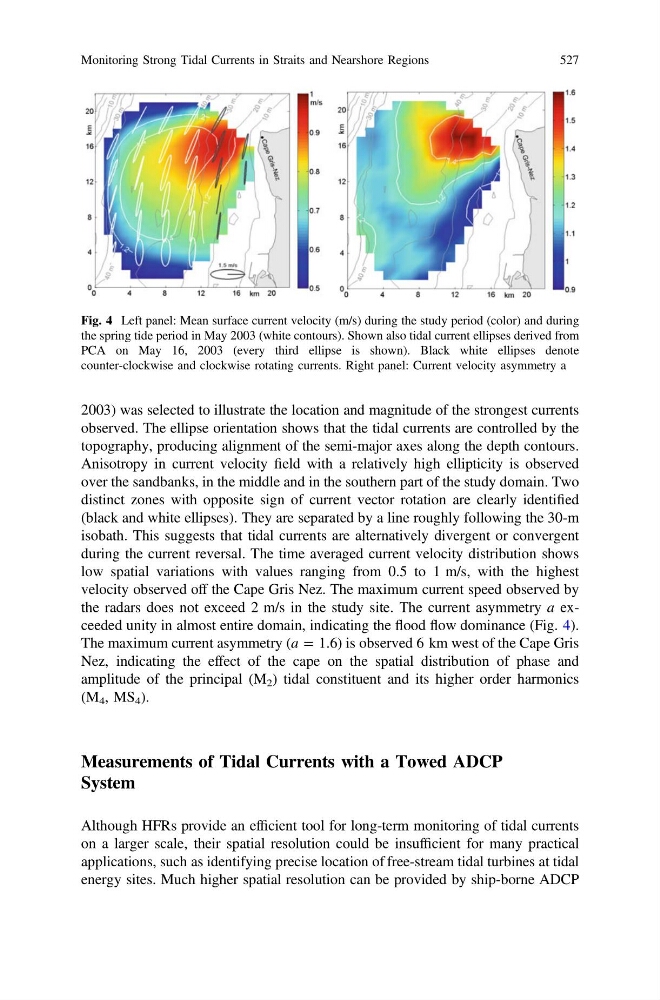
2003) was selected to illustrate the location and magnitude of the strongest currents
observed. The ellipse orientation shows that the tidal currents are controlled by the
topography, producing alignment of the semi-major axes along the depth contours.
Anisotropy in current velocity field with a relatively high ellipticity is observed
over the sandbanks, in the middle and in the southern part of the study domain. Two
distinct zones with opposite sign of current vector rotation are clearly identified
(black and white ellipses). They are separated by a line roughly following the 30-m
isobath. This suggests that tidal currents are alternatively divergent or convergent
during the current reversal. The time averaged current velocity distribution shows
low spatial variations with values ranging from 0.5 to 1 m/s, with the highest
velocity observed off the Cape Gris Nez. The maximum current speed observed by
the radars does not exceed 2 m/s in the study site. The current asymmetry a exceeded unity in almost entire domain, indicating the flood flow dominance (Fig. 4).
The maximum current asymmetry (a = 1.6) is observed 6 km west of the Cape Gris
Nez, indicating the effect of the cape on the spatial distribution of phase and
amplitude of the principal (M 2 ) tidal constituent and its higher order harmonics
(M 4 , MS 4 ).
Measurements of Tidal Currents with a Towed ADCP
System
Although HFRs provide an efficient tool for long-term monitoring of tidal currents
on a larger scale, their spatial resolution could be insufficient for many practical
applications, such as identifying precise location of free-stream tidal turbines at tidal
energy sites. Much higher spatial resolution can be provided by ship-borne ADCP
Fig. 4 Left panel: Mean surface current velocity (m/s) during the study period (color) and during
the spring tide period in May 2003 (white contours). Shown also tidal current ellipses derived from
PCA on May 16, 2003 (every third ellipse is shown). Black white ellipses denote
counter-clockwise and clockwise rotating currents. Right panel: Current velocity asymmetry a
Monitoring Strong Tidal Currents in Straits and Nearshore Regions
527
observed. The ellipse orientation shows that the tidal currents are controlled by the
topography, producing alignment of the semi-major axes along the depth contours.
Anisotropy in current velocity field with a relatively high ellipticity is observed
over the sandbanks, in the middle and in the southern part of the study domain. Two
distinct zones with opposite sign of current vector rotation are clearly identified
(black and white ellipses). They are separated by a line roughly following the 30-m
isobath. This suggests that tidal currents are alternatively divergent or convergent
during the current reversal. The time averaged current velocity distribution shows
low spatial variations with values ranging from 0.5 to 1 m/s, with the highest
velocity observed off the Cape Gris Nez. The maximum current speed observed by
the radars does not exceed 2 m/s in the study site. The current asymmetry a exceeded unity in almost entire domain, indicating the flood flow dominance (Fig. 4).
The maximum current asymmetry (a = 1.6) is observed 6 km west of the Cape Gris
Nez, indicating the effect of the cape on the spatial distribution of phase and
amplitude of the principal (M 2 ) tidal constituent and its higher order harmonics
(M 4 , MS 4 ).
Measurements of Tidal Currents with a Towed ADCP
System
Although HFRs provide an efficient tool for long-term monitoring of tidal currents
on a larger scale, their spatial resolution could be insufficient for many practical
applications, such as identifying precise location of free-stream tidal turbines at tidal
energy sites. Much higher spatial resolution can be provided by ship-borne ADCP
Fig. 4 Left panel: Mean surface current velocity (m/s) during the study period (color) and during
the spring tide period in May 2003 (white contours). Shown also tidal current ellipses derived from
PCA on May 16, 2003 (every third ellipse is shown). Black white ellipses denote
counter-clockwise and clockwise rotating currents. Right panel: Current velocity asymmetry a
Monitoring Strong Tidal Currents in Straits and Nearshore Regions
527