

of 22 m indicate that this current occupied the entire upper layer up to the surface.
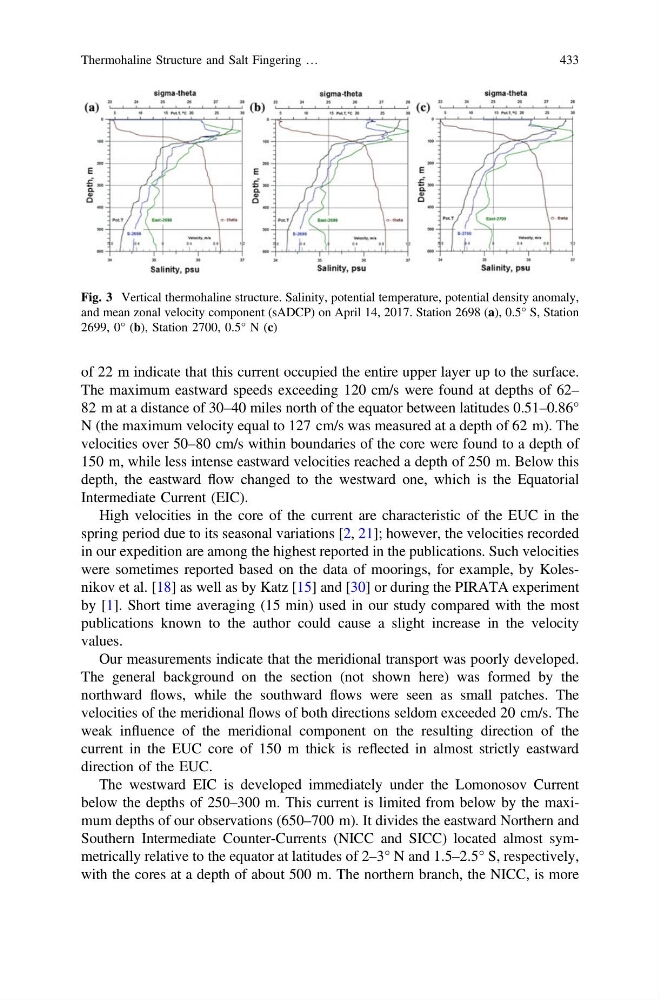
The maximum eastward speeds exceeding 120 cm/s were found at depths of 62–
82 m at a distance of 30–40 miles north of the equator between latitudes 0.51–0.86°
N (the maximum velocity equal to 127 cm/s was measured at a depth of 62 m). The
velocities over 50–80 cm/s within boundaries of the core were found to a depth of
150 m, while less intense eastward velocities reached a depth of 250 m. Below this
depth, the eastward flow changed to the westward one, which is the Equatorial
Intermediate Current (EIC).
High velocities in the core of the current are characteristic of the EUC in the
spring period due to its seasonal variations [2, 21]; however, the velocities recorded
in our expedition are among the highest reported in the publications. Such velocities
were sometimes reported based on the data of moorings, for example, by Kolesnikov et al. [18] as well as by Katz [15] and [30] or during the PIRATA experiment
by [1]. Short time averaging (15 min) used in our study compared with the most
publications known to the author could cause a slight increase in the velocity
values.
Our measurements indicate that the meridional transport was poorly developed.
The general background on the section (not shown here) was formed by the
northward flows, while the southward flows were seen as small patches. The
velocities of the meridional flows of both directions seldom exceeded 20 cm/s. The
weak influence of the meridional component on the resulting direction of the
current in the EUC core of 150 m thick is reflected in almost strictly eastward
direction of the EUC.
The westward EIC is developed immediately under the Lomonosov Current
below the depths of 250–300 m. This current is limited from below by the maximum depths of our observations (650–700 m). It divides the eastward Northern and
Southern Intermediate Counter-Currents (NICC and SICC) located almost symmetrically relative to the equator at latitudes of 2–3° N and 1.5–2.5° S, respectively,
with the cores at a depth of about 500 m. The northern branch, the NICC, is more
Fig. 3 Vertical thermohaline structure. Salinity, potential temperature, potential density anomaly,
and mean zonal velocity component (sADCP) on April 14, 2017. Station 2698 (a), 0.5° S, Station
2699, 0° (b), Station 2700, 0.5° N (c)
Thermohaline Structure and Salt Fingering …
433
The maximum eastward speeds exceeding 120 cm/s were found at depths of 62–
82 m at a distance of 30–40 miles north of the equator between latitudes 0.51–0.86°
N (the maximum velocity equal to 127 cm/s was measured at a depth of 62 m). The
velocities over 50–80 cm/s within boundaries of the core were found to a depth of
150 m, while less intense eastward velocities reached a depth of 250 m. Below this
depth, the eastward flow changed to the westward one, which is the Equatorial
Intermediate Current (EIC).
High velocities in the core of the current are characteristic of the EUC in the
spring period due to its seasonal variations [2, 21]; however, the velocities recorded
in our expedition are among the highest reported in the publications. Such velocities
were sometimes reported based on the data of moorings, for example, by Kolesnikov et al. [18] as well as by Katz [15] and [30] or during the PIRATA experiment
by [1]. Short time averaging (15 min) used in our study compared with the most
publications known to the author could cause a slight increase in the velocity
values.
Our measurements indicate that the meridional transport was poorly developed.
The general background on the section (not shown here) was formed by the
northward flows, while the southward flows were seen as small patches. The
velocities of the meridional flows of both directions seldom exceeded 20 cm/s. The
weak influence of the meridional component on the resulting direction of the
current in the EUC core of 150 m thick is reflected in almost strictly eastward
direction of the EUC.
The westward EIC is developed immediately under the Lomonosov Current
below the depths of 250–300 m. This current is limited from below by the maximum depths of our observations (650–700 m). It divides the eastward Northern and
Southern Intermediate Counter-Currents (NICC and SICC) located almost symmetrically relative to the equator at latitudes of 2–3° N and 1.5–2.5° S, respectively,
with the cores at a depth of about 500 m. The northern branch, the NICC, is more
Fig. 3 Vertical thermohaline structure. Salinity, potential temperature, potential density anomaly,
and mean zonal velocity component (sADCP) on April 14, 2017. Station 2698 (a), 0.5° S, Station
2699, 0° (b), Station 2700, 0.5° N (c)
Thermohaline Structure and Salt Fingering …
433