

Figure 12 demonstrates an example of co-existing of submesoscale and
mesoscale eddies. The mesoscale dipole A1–C1 with an eddy diameter of about 10–
12 km is seen in the lower left corner of the image. Anticyclone A2 with diameter
of about 10 km forms a package of three dipoles with cyclones of a lesser size (3–
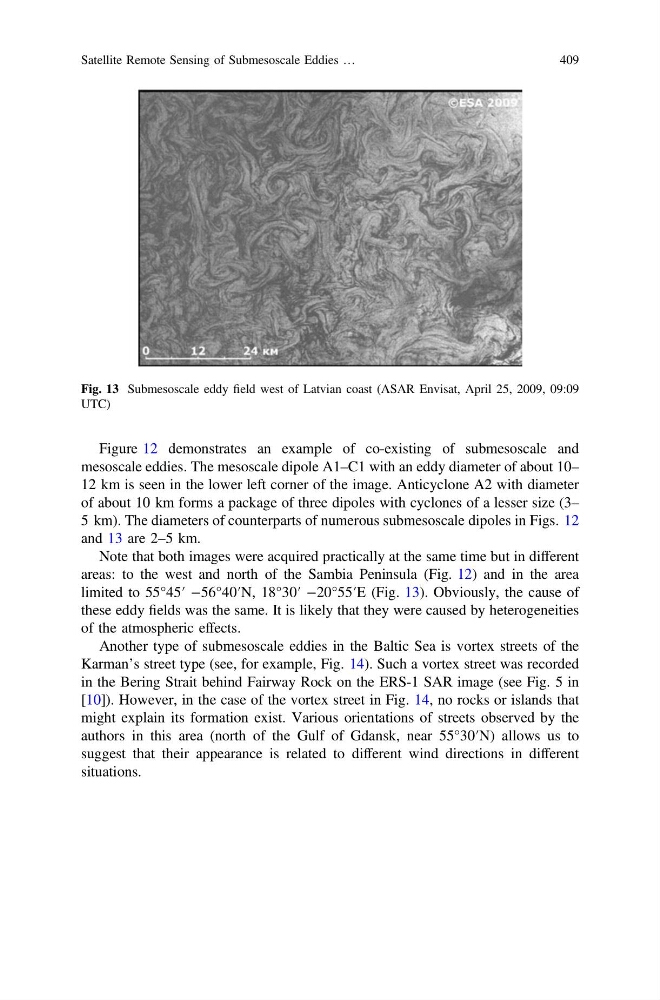
5 km). The diameters of counterparts of numerous submesoscale dipoles in Figs. 12
and 13 are 2–5 km.
Note that both images were acquired practically at the same time but in different
areas: to the west and north of the Sambia Peninsula (Fig. 12) and in the area
limited to 55°45′ −56°40′N, 18°30′ −20°55′E (Fig. 13). Obviously, the cause of
these eddy fields was the same. It is likely that they were caused by heterogeneities
of the atmospheric effects.
Another type of submesoscale eddies in the Baltic Sea is vortex streets of the
Karman’s street type (see, for example, Fig. 14). Such a vortex street was recorded
in the Bering Strait behind Fairway Rock on the ERS-1 SAR image (see Fig. 5 in
[10]). However, in the case of the vortex street in Fig. 14, no rocks or islands that
might explain its formation exist. Various orientations of streets observed by the
authors in this area (north of the Gulf of Gdansk, near 55°30′N) allows us to
suggest that their appearance is related to different wind directions in different
situations.
Fig. 13 Submesoscale eddy field west of Latvian coast (ASAR Envisat, April 25, 2009, 09:09
UTC)
Satellite Remote Sensing of Submesoscale Eddies …
409
mesoscale eddies. The mesoscale dipole A1–C1 with an eddy diameter of about 10–
12 km is seen in the lower left corner of the image. Anticyclone A2 with diameter
of about 10 km forms a package of three dipoles with cyclones of a lesser size (3–
5 km). The diameters of counterparts of numerous submesoscale dipoles in Figs. 12
and 13 are 2–5 km.
Note that both images were acquired practically at the same time but in different
areas: to the west and north of the Sambia Peninsula (Fig. 12) and in the area
limited to 55°45′ −56°40′N, 18°30′ −20°55′E (Fig. 13). Obviously, the cause of
these eddy fields was the same. It is likely that they were caused by heterogeneities
of the atmospheric effects.
Another type of submesoscale eddies in the Baltic Sea is vortex streets of the
Karman’s street type (see, for example, Fig. 14). Such a vortex street was recorded
in the Bering Strait behind Fairway Rock on the ERS-1 SAR image (see Fig. 5 in
[10]). However, in the case of the vortex street in Fig. 14, no rocks or islands that
might explain its formation exist. Various orientations of streets observed by the
authors in this area (north of the Gulf of Gdansk, near 55°30′N) allows us to
suggest that their appearance is related to different wind directions in different
situations.
Fig. 13 Submesoscale eddy field west of Latvian coast (ASAR Envisat, April 25, 2009, 09:09
UTC)
Satellite Remote Sensing of Submesoscale Eddies …
409