

The Caspian Sea
Large-scale circulation of the enclosed Caspian Sea is well studied on the basis of
hydrological measurements and modeling, whereas the representation of the
mesoscale dynamics of the sea in the warm season (period of less cloud cover) is
provided mainly by satellite images in the visible and IR bands [20]. Mesoscale
eddies in the Middle and Southern Caspian have a wide range of spatial scales from
about 10 km to about 80 km (R d in the open Caspian Sea is equal to 17–22 km, in
the shelf zone it is 3–8 km [1]). The greatest number of submesoscale eddies are
found along the western coast of the Middle Caspian and to the south of the
Absheron Peninsula, which is connected, apparently, with a high concentration of
the surface films due to river runoff and petroleum products [14]. Examples of
submesoscale eddies manifestation south of the Absheron Peninsula and in the
souteastern part of the sea are given in Figs. 10 and 11, respectively. Vortex dipole
in the Northern Caspian (south of the Volga River Delta) manifested on the ERS-2
SAR image is shown in Fig. 13 in [10].
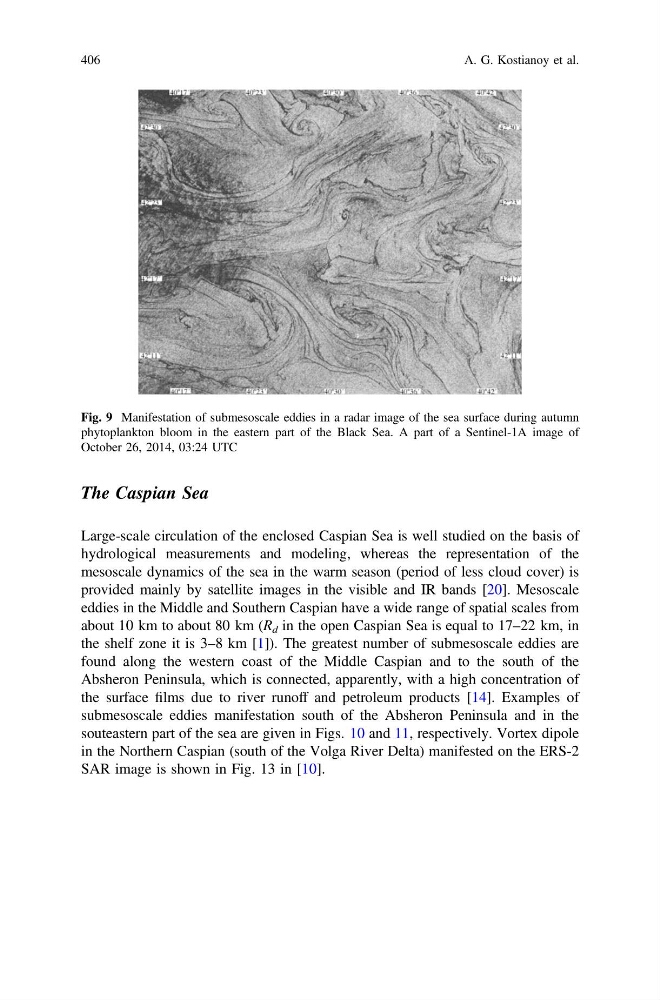
Fig. 9 Manifestation of submesoscale eddies in a radar image of the sea surface during autumn
phytoplankton bloom in the eastern part of the Black Sea. A part of a Sentinel-1A image of
October 26, 2014, 03:24 UTC
406
A. G. Kostianoy et al.
Large-scale circulation of the enclosed Caspian Sea is well studied on the basis of
hydrological measurements and modeling, whereas the representation of the
mesoscale dynamics of the sea in the warm season (period of less cloud cover) is
provided mainly by satellite images in the visible and IR bands [20]. Mesoscale
eddies in the Middle and Southern Caspian have a wide range of spatial scales from
about 10 km to about 80 km (R d in the open Caspian Sea is equal to 17–22 km, in
the shelf zone it is 3–8 km [1]). The greatest number of submesoscale eddies are
found along the western coast of the Middle Caspian and to the south of the
Absheron Peninsula, which is connected, apparently, with a high concentration of
the surface films due to river runoff and petroleum products [14]. Examples of
submesoscale eddies manifestation south of the Absheron Peninsula and in the
souteastern part of the sea are given in Figs. 10 and 11, respectively. Vortex dipole
in the Northern Caspian (south of the Volga River Delta) manifested on the ERS-2
SAR image is shown in Fig. 13 in [10].
Fig. 9 Manifestation of submesoscale eddies in a radar image of the sea surface during autumn
phytoplankton bloom in the eastern part of the Black Sea. A part of a Sentinel-1A image of
October 26, 2014, 03:24 UTC
406
A. G. Kostianoy et al.