

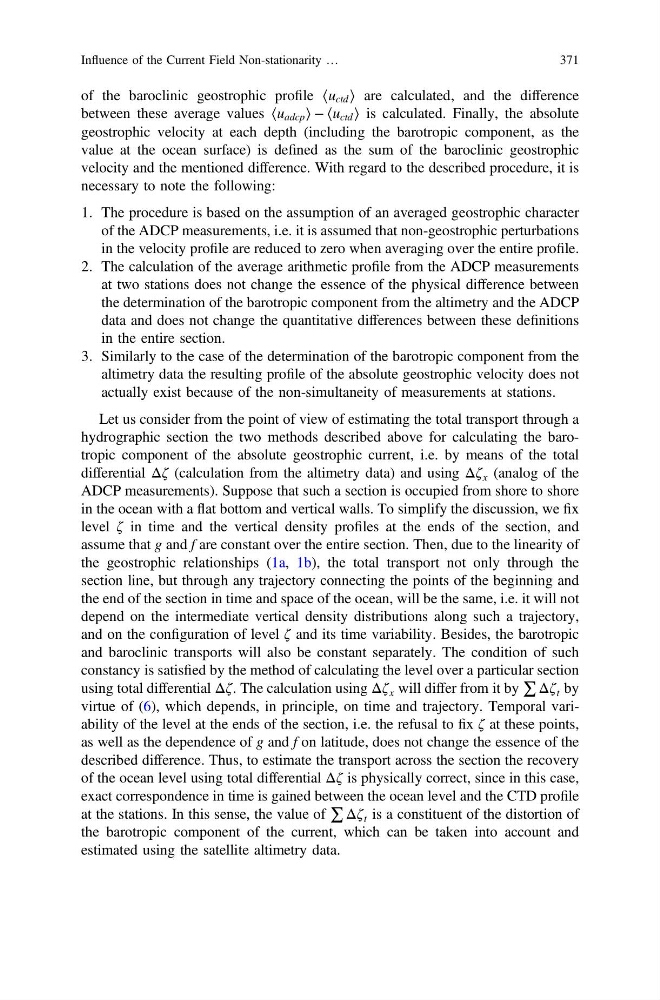
of the baroclinic geostrophic profile ⟨u ctd ⟩ are calculated, and the difference
between these average values ⟨u adcp ⟩ − ⟨u ctd ⟩ is calculated. Finally, the absolute
geostrophic velocity at each depth (including the barotropic component, as the
value at the ocean surface) is defined as the sum of the baroclinic geostrophic
velocity and the mentioned difference. With regard to the described procedure, it is
necessary to note the following:
1. The procedure is based on the assumption of an averaged geostrophic character
of the ADCP measurements, i.e. it is assumed that non-geostrophic perturbations
in the velocity profile are reduced to zero when averaging over the entire profile.
2. The calculation of the average arithmetic profile from the ADCP measurements
at two stations does not change the essence of the physical difference between
the determination of the barotropic component from the altimetry and the ADCP
data and does not change the quantitative differences between these definitions
in the entire section.
3. Similarly to the case of the determination of the barotropic component from the
altimetry data the resulting profile of the absolute geostrophic velocity does not
actually exist because of the non-simultaneity of measurements at stations.
Let us consider from the point of view of estimating the total transport through a
hydrographic section the two methods described above for calculating the barotropic component of the absolute geostrophic current, i.e. by means of the total
differential Δζ (calculation from the altimetry data) and using Δζ x (analog of the
ADCP measurements). Suppose that such a section is occupied from shore to shore
in the ocean with a flat bottom and vertical walls. To simplify the discussion, we fix
level ζ in time and the vertical density profiles at the ends of the section, and
assume that g and f are constant over the entire section. Then, due to the linearity of
the geostrophic relationships (1a, 1b), the total transport not only through the
section line, but through any trajectory connecting the points of the beginning and
the end of the section in time and space of the ocean, will be the same, i.e. it will not
depend on the intermediate vertical density distributions along such a trajectory,
and on the configuration of level ζ and its time variability. Besides, the barotropic
and baroclinic transports will also be constant separately. The condition of such
constancy is satisfied by the method of calculating the level over a particular section
using total differential Δζ. The calculation using Δζ x will differ from it by ∑ Δζ t by
virtue of (6), which depends, in principle, on time and trajectory. Temporal variability of the level at the ends of the section, i.e. the refusal to fix ζ at these points,
as well as the dependence of g and f on latitude, does not change the essence of the
described difference. Thus, to estimate the transport across the section the recovery
of the ocean level using total differential Δζ is physically correct, since in this case,
exact correspondence in time is gained between the ocean level and the CTD profile
at the stations. In this sense, the value of ∑ Δζ t is a constituent of the distortion of
the barotropic component of the current, which can be taken into account and
estimated using the satellite altimetry data.
Influence of the Current Field Non-stationarity …
371
between these average values ⟨u adcp ⟩ − ⟨u ctd ⟩ is calculated. Finally, the absolute
geostrophic velocity at each depth (including the barotropic component, as the
value at the ocean surface) is defined as the sum of the baroclinic geostrophic
velocity and the mentioned difference. With regard to the described procedure, it is
necessary to note the following:
1. The procedure is based on the assumption of an averaged geostrophic character
of the ADCP measurements, i.e. it is assumed that non-geostrophic perturbations
in the velocity profile are reduced to zero when averaging over the entire profile.
2. The calculation of the average arithmetic profile from the ADCP measurements
at two stations does not change the essence of the physical difference between
the determination of the barotropic component from the altimetry and the ADCP
data and does not change the quantitative differences between these definitions
in the entire section.
3. Similarly to the case of the determination of the barotropic component from the
altimetry data the resulting profile of the absolute geostrophic velocity does not
actually exist because of the non-simultaneity of measurements at stations.
Let us consider from the point of view of estimating the total transport through a
hydrographic section the two methods described above for calculating the barotropic component of the absolute geostrophic current, i.e. by means of the total
differential Δζ (calculation from the altimetry data) and using Δζ x (analog of the
ADCP measurements). Suppose that such a section is occupied from shore to shore
in the ocean with a flat bottom and vertical walls. To simplify the discussion, we fix
level ζ in time and the vertical density profiles at the ends of the section, and
assume that g and f are constant over the entire section. Then, due to the linearity of
the geostrophic relationships (1a, 1b), the total transport not only through the
section line, but through any trajectory connecting the points of the beginning and
the end of the section in time and space of the ocean, will be the same, i.e. it will not
depend on the intermediate vertical density distributions along such a trajectory,
and on the configuration of level ζ and its time variability. Besides, the barotropic
and baroclinic transports will also be constant separately. The condition of such
constancy is satisfied by the method of calculating the level over a particular section
using total differential Δζ. The calculation using Δζ x will differ from it by ∑ Δζ t by
virtue of (6), which depends, in principle, on time and trajectory. Temporal variability of the level at the ends of the section, i.e. the refusal to fix ζ at these points,
as well as the dependence of g and f on latitude, does not change the essence of the
described difference. Thus, to estimate the transport across the section the recovery
of the ocean level using total differential Δζ is physically correct, since in this case,
exact correspondence in time is gained between the ocean level and the CTD profile
at the stations. In this sense, the value of ∑ Δζ t is a constituent of the distortion of
the barotropic component of the current, which can be taken into account and
estimated using the satellite altimetry data.
Influence of the Current Field Non-stationarity …
371