

Internal Undular Bores in the Coastal Ocean
Roger Grimshaw and Chunxin Yuan
Variable-Coefficient Korteweg-de Vries Equation
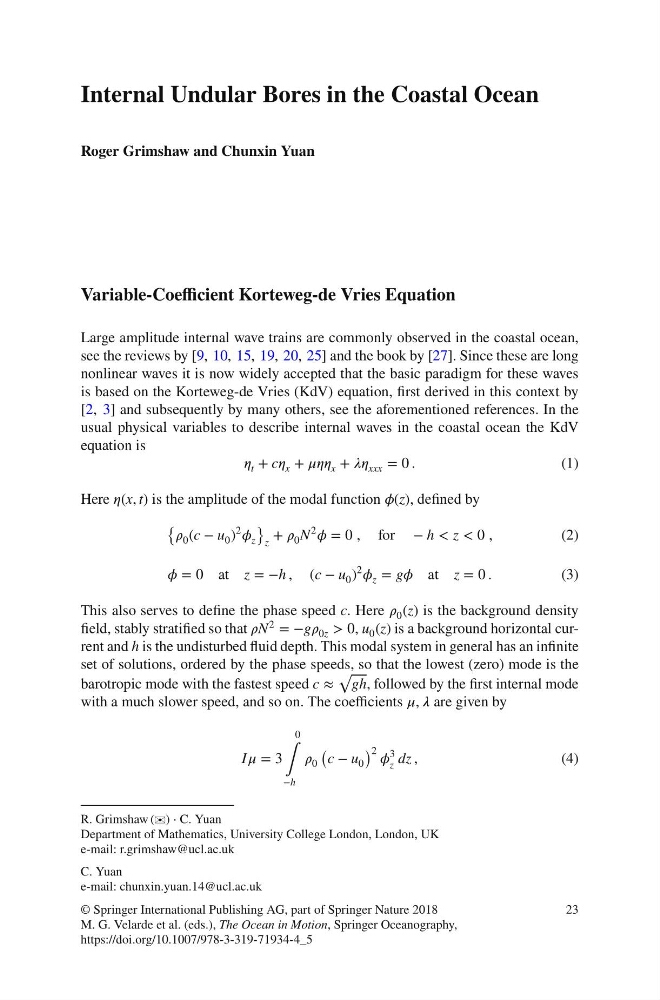
Large amplitude internal wave trains are commonly observed in the coastal ocean,
see the reviews by [9, 10, 15, 19, 20, 25] and the book by [27]. Since these are long
nonlinear waves it is now widely accepted that the basic paradigm for these waves
is based on the Korteweg-de Vries (KdV) equation, first derived in this context by
[2, 3] and subsequently by many others, see the aforementioned references. In the
usual physical variables to describe internal waves in the coastal ocean the KdV
equation is
í µí¼ t + cí µí¼ x + í µí¼í µí¼í µí¼ x + í µí¼í µí¼ xxx = 0 .
(1)
Here í µí¼(x, t) is the amplitude of the modal function í µí¼(z), defined by
{
í µí¼ 0 (c − u 0 )
2
í µí¼ z
}
z
+ í µí¼ 0 N
2
í µí¼ = 0 , for − h < z < 0 ,
(2)
í µí¼ = 0 at z = −h , (c − u 0 )
2
í µí¼ z = gí µí¼ at z = 0 .
(3)
This also serves to define the phase speed c. Here í µí¼ 0 (z) is the background density
field, stably stratified so that í µí¼N
2
= −gí µí¼ 0z > 0, u 0 (z) is a background horizontal current and h is the undisturbed fluid depth. This modal system in general has an infinite
set of solutions, ordered by the phase speeds, so that the lowest (zero) mode is the
barotropic mode with the fastest speed c ≈
√
gh, followed by the first internal mode
with a much slower speed, and so on. The coefficients í µí¼, í µí¼ are given by
Ií µí¼ = 3
0
∫
−h
í µí¼ 0
(
c − u 0
) 2 í µí¼
3
z dz ,
(4)
R. Grimshaw ( ✉ ) ⋅ C. Yuan
Department of Mathematics, University College London, London, UK
e-mail: r.grimshaw@ucl.ac.uk
C. Yuan
e-mail: chunxin.yuan.14@ucl.ac.uk
© Springer International Publishing AG, part of Springer Nature 2018
M. G. Velarde et al. (eds.), The Ocean in Motion, Springer Oceanography,
https://doi.org/10.1007/978-3-319-71934-4_5
23
Roger Grimshaw and Chunxin Yuan
Variable-Coefficient Korteweg-de Vries Equation
Large amplitude internal wave trains are commonly observed in the coastal ocean,
see the reviews by [9, 10, 15, 19, 20, 25] and the book by [27]. Since these are long
nonlinear waves it is now widely accepted that the basic paradigm for these waves
is based on the Korteweg-de Vries (KdV) equation, first derived in this context by
[2, 3] and subsequently by many others, see the aforementioned references. In the
usual physical variables to describe internal waves in the coastal ocean the KdV
equation is
í µí¼ t + cí µí¼ x + í µí¼í µí¼í µí¼ x + í µí¼í µí¼ xxx = 0 .
(1)
Here í µí¼(x, t) is the amplitude of the modal function í µí¼(z), defined by
{
í µí¼ 0 (c − u 0 )
2
í µí¼ z
}
z
+ í µí¼ 0 N
2
í µí¼ = 0 , for − h < z < 0 ,
(2)
í µí¼ = 0 at z = −h , (c − u 0 )
2
í µí¼ z = gí µí¼ at z = 0 .
(3)
This also serves to define the phase speed c. Here í µí¼ 0 (z) is the background density
field, stably stratified so that í µí¼N
2
= −gí µí¼ 0z > 0, u 0 (z) is a background horizontal current and h is the undisturbed fluid depth. This modal system in general has an infinite
set of solutions, ordered by the phase speeds, so that the lowest (zero) mode is the
barotropic mode with the fastest speed c ≈
√
gh, followed by the first internal mode
with a much slower speed, and so on. The coefficients í µí¼, í µí¼ are given by
Ií µí¼ = 3
0
∫
−h
í µí¼ 0
(
c − u 0
) 2 í µí¼
3
z dz ,
(4)
R. Grimshaw ( ✉ ) ⋅ C. Yuan
Department of Mathematics, University College London, London, UK
e-mail: r.grimshaw@ucl.ac.uk
C. Yuan
e-mail: chunxin.yuan.14@ucl.ac.uk
© Springer International Publishing AG, part of Springer Nature 2018
M. G. Velarde et al. (eds.), The Ocean in Motion, Springer Oceanography,
https://doi.org/10.1007/978-3-319-71934-4_5
23