

η 1, 2 t + η 1, 2 u 1, 2
À
Á
x
= 0;
ρ 1, 2 ðu 1, 2 t + u 1, 2 u 1, 2 x + gξ x Þ = − p x +
1
3η 1, 2
η
3
1, 2
∂
∂t
+ u 1, 2
∂
∂x
2
ξ
!
x
,
ð8Þ
where η 1, 2 = h 1, 2 ∓ ξ, h 1, 2 are the perturbed and unperturbed thicknesses of
the upper and lower liquid layers, ξ is the vertical shift of the interface, u 1, 2 are the
average (over the vertical coordinate) values of the horizontal velocities of the
liquid in the layers, ρ 1, 2 are the liquid densities, g is acceleration of gravity, and p is
pressure. The family of stationary solutions of system (8) is qualitatively similar to
the family of solitary waves of the Gardner equation (Fig. 2).
However, the asymptotic forms of the kinks of model (8) have different speed of
field decay (exponents) at x → ±∝, whereas the asymptotic forms of kinks of the
Gardner equation are identical. Nonsymmetry of soliton field jumps affects significantly the process of soliton collisions and changes the form of the equations for
kink coordinates:
dS i
dt
= I τ, ρ
ð Þ− 2
M 0 e
− Λ 0 S i − S i − 1
ð
Þ + M m e
− Λ m S i + 1 − S i
ð
Þ , i − odd
M m e
− Λ m S i − S i − 1
ð
Þ + M 0 e
− Λ 0 S i + 1 − S i
ð
Þ , i − even
(
)
ð9Þ
Equations (9) may be reduced to the integrable Langmuir chain system mentioned above, so that the interaction of the solitons of Eq. (8) persists to be elastic
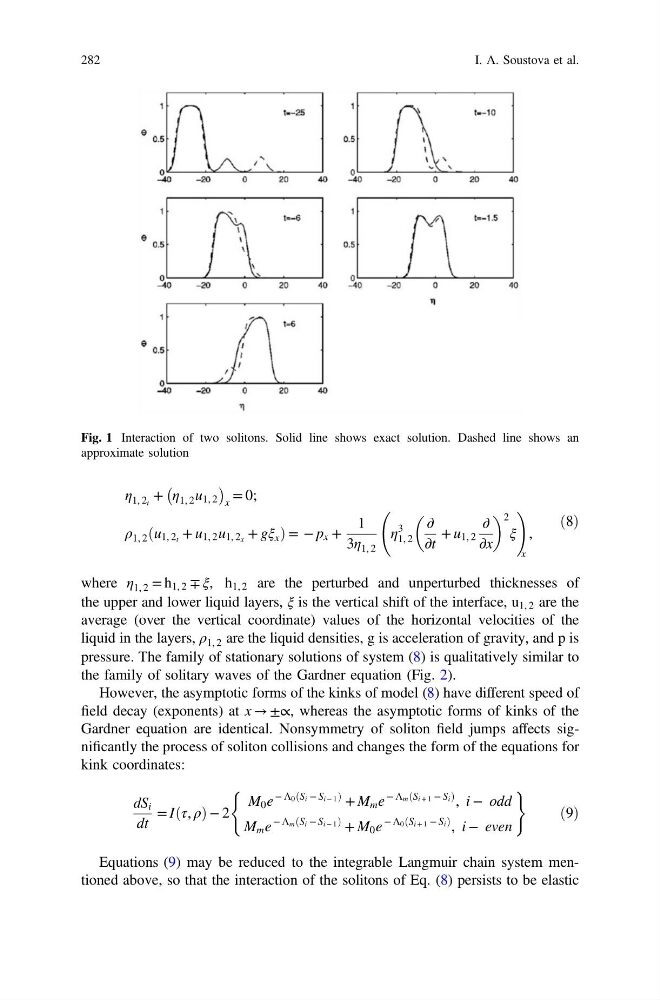
Fig. 1 Interaction of two solitons. Solid line shows exact solution. Dashed line shows an
approximate solution
282
I. A. Soustova et al.
À
Á
x
= 0;
ρ 1, 2 ðu 1, 2 t + u 1, 2 u 1, 2 x + gξ x Þ = − p x +
1
3η 1, 2
η
3
1, 2
∂
∂t
+ u 1, 2
∂
∂x
2
ξ
!
x
,
ð8Þ
where η 1, 2 = h 1, 2 ∓ ξ, h 1, 2 are the perturbed and unperturbed thicknesses of
the upper and lower liquid layers, ξ is the vertical shift of the interface, u 1, 2 are the
average (over the vertical coordinate) values of the horizontal velocities of the
liquid in the layers, ρ 1, 2 are the liquid densities, g is acceleration of gravity, and p is
pressure. The family of stationary solutions of system (8) is qualitatively similar to
the family of solitary waves of the Gardner equation (Fig. 2).
However, the asymptotic forms of the kinks of model (8) have different speed of
field decay (exponents) at x → ±∝, whereas the asymptotic forms of kinks of the
Gardner equation are identical. Nonsymmetry of soliton field jumps affects significantly the process of soliton collisions and changes the form of the equations for
kink coordinates:
dS i
dt
= I τ, ρ
ð Þ− 2
M 0 e
− Λ 0 S i − S i − 1
ð
Þ + M m e
− Λ m S i + 1 − S i
ð
Þ , i − odd
M m e
− Λ m S i − S i − 1
ð
Þ + M 0 e
− Λ 0 S i + 1 − S i
ð
Þ , i − even
(
)
ð9Þ
Equations (9) may be reduced to the integrable Langmuir chain system mentioned above, so that the interaction of the solitons of Eq. (8) persists to be elastic
Fig. 1 Interaction of two solitons. Solid line shows exact solution. Dashed line shows an
approximate solution
282
I. A. Soustova et al.