

270
I. Gankevich and A. Degtyarev
The experiment showed that velocity potential fields produced by formula (19)
for finite depth fluid and formula (20) from linear wave theory are qualitatively different (Fig. 4). First, velocity potential contours have sinusoidal shape, which is different from oval shape described by linear wave theory. Second, velocity potential
decays more rapidly than in linear wave theory as getting closer to the bottom, and
the region where the majority of wave energy is concentrated is closer to the wave
crest. Similar numerical experiment, in which all terms of (19) that are neglected in
the framework of linear wave theory are eliminated, shows no difference (as much
as machine precision allows) in resulting velocity potential fields.
The Difference with Small-Amplitude Wave Theory
0
2 0
4 0
6 0
8 0
-2
-1
0
1
2
x
u(x)
u 1 (x)
u 2 (x)
0
2 0
4 0
6 0
8 0
-2
-1
0
1
2
x
u(x)
u 1 (x)
u 2 (x)
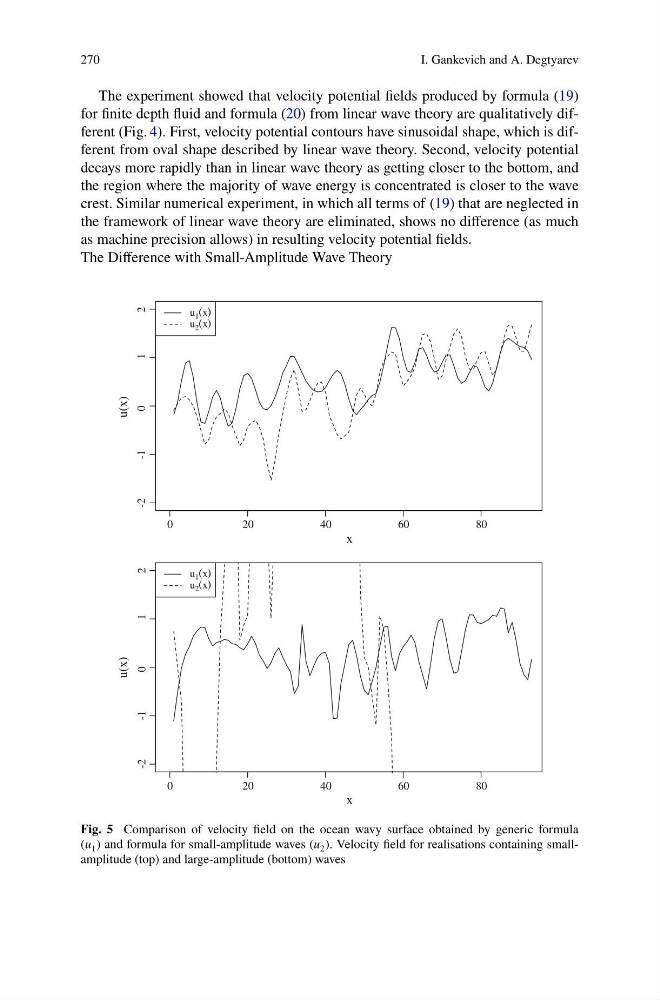
Fig. 5 Comparison of velocity field on the ocean wavy surface obtained by generic formula
(u 1 ) and formula for small-amplitude waves (u 2 ). Velocity field for realisations containing smallamplitude (top) and large-amplitude (bottom) waves
I. Gankevich and A. Degtyarev
The experiment showed that velocity potential fields produced by formula (19)
for finite depth fluid and formula (20) from linear wave theory are qualitatively different (Fig. 4). First, velocity potential contours have sinusoidal shape, which is different from oval shape described by linear wave theory. Second, velocity potential
decays more rapidly than in linear wave theory as getting closer to the bottom, and
the region where the majority of wave energy is concentrated is closer to the wave
crest. Similar numerical experiment, in which all terms of (19) that are neglected in
the framework of linear wave theory are eliminated, shows no difference (as much
as machine precision allows) in resulting velocity potential fields.
The Difference with Small-Amplitude Wave Theory
0
2 0
4 0
6 0
8 0
-2
-1
0
1
2
x
u(x)
u 1 (x)
u 2 (x)
0
2 0
4 0
6 0
8 0
-2
-1
0
1
2
x
u(x)
u 1 (x)
u 2 (x)
Fig. 5 Comparison of velocity field on the ocean wavy surface obtained by generic formula
(u 1 ) and formula for small-amplitude waves (u 2 ). Velocity field for realisations containing smallamplitude (top) and large-amplitude (bottom) waves