

Simulation of Standing and Propagating Sea Waves . . .
261
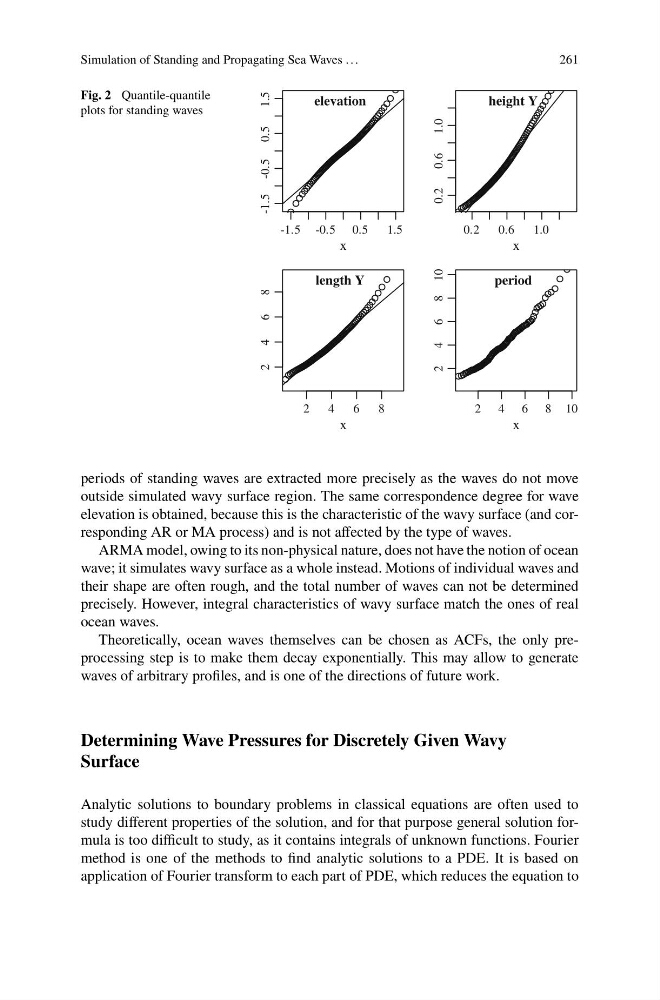
Fig. 2 Quantile-quantile
plots for standing waves
x
elevation
x
height Y
x
length Y
-1.5 -0.5 0.5
1.5
-1.5 -0.5 0.5
1.5
0.2
0.6
1.0
0.2
0.6
1.0
2
4
6
8
2
8
4
6
2 4 6 8 10
2 4 6 8 10
x
period
periods of standing waves are extracted more precisely as the waves do not move
outside simulated wavy surface region. The same correspondence degree for wave
elevation is obtained, because this is the characteristic of the wavy surface (and corresponding AR or MA process) and is not affected by the type of waves.
ARMA model, owing to its non-physical nature, does not have the notion of ocean
wave; it simulates wavy surface as a whole instead. Motions of individual waves and
their shape are often rough, and the total number of waves can not be determined
precisely. However, integral characteristics of wavy surface match the ones of real
ocean waves.
Theoretically, ocean waves themselves can be chosen as ACFs, the only preprocessing step is to make them decay exponentially. This may allow to generate
waves of arbitrary profiles, and is one of the directions of future work.
Determining Wave Pressures for Discretely Given Wavy
Surface
Analytic solutions to boundary problems in classical equations are often used to
study different properties of the solution, and for that purpose general solution formula is too difficult to study, as it contains integrals of unknown functions. Fourier
method is one of the methods to find analytic solutions to a PDE. It is based on
application of Fourier transform to each part of PDE, which reduces the equation to
261
Fig. 2 Quantile-quantile
plots for standing waves
x
elevation
x
height Y
x
length Y
-1.5 -0.5 0.5
1.5
-1.5 -0.5 0.5
1.5
0.2
0.6
1.0
0.2
0.6
1.0
2
4
6
8
2
8
4
6
2 4 6 8 10
2 4 6 8 10
x
period
periods of standing waves are extracted more precisely as the waves do not move
outside simulated wavy surface region. The same correspondence degree for wave
elevation is obtained, because this is the characteristic of the wavy surface (and corresponding AR or MA process) and is not affected by the type of waves.
ARMA model, owing to its non-physical nature, does not have the notion of ocean
wave; it simulates wavy surface as a whole instead. Motions of individual waves and
their shape are often rough, and the total number of waves can not be determined
precisely. However, integral characteristics of wavy surface match the ones of real
ocean waves.
Theoretically, ocean waves themselves can be chosen as ACFs, the only preprocessing step is to make them decay exponentially. This may allow to generate
waves of arbitrary profiles, and is one of the directions of future work.
Determining Wave Pressures for Discretely Given Wavy
Surface
Analytic solutions to boundary problems in classical equations are often used to
study different properties of the solution, and for that purpose general solution formula is too difficult to study, as it contains integrals of unknown functions. Fourier
method is one of the methods to find analytic solutions to a PDE. It is based on
application of Fourier transform to each part of PDE, which reduces the equation to