

250
I. Gankevich and A. Degtyarev
Longuet-Higgins showed that under the above conditions, the function í µí¼ (x, y, t)
is a three-dimensional steady-state homogeneous ergodic Gaussian field, defined by
2E í µí¼ (u, v)dudv =
∑
n
c
2
n
,
where E í µí¼ (u, v) is two-dimensional spectral density of wave energy.
Formula (1) is derived from equation of continuity and equation of motion for
incompressible inviscid fluid. For ocean waves incompressibility and isotropy of a
fluid is assumed; since the motion of ocean waves is due to gravitational forces,
irrotational motion of the fluid is assumed which let us introduce the velocity
potential í µí¼. Under these assumptions the equation of continuity reduces to Laplace
equation:
í µí»¥í µí¼ =
í µí¼
2
í µí¼ x
í µí¼x 2 +
í µí¼ 2 í µí¼ y
í µí¼y 2 +
í µí¼
2
í µí¼ z
í µí¼z 2 = 0.
The Laplace equation is linear and its solution can be found using Fourier transforms. Thus, for plane waves a well-known solution is given in the form of a definite
integral [5]:
í µí¼(x, z, t) =
∞
∫
0
e
kz
[A(k, t) cos kx + B(k, t) sin kx] dk.
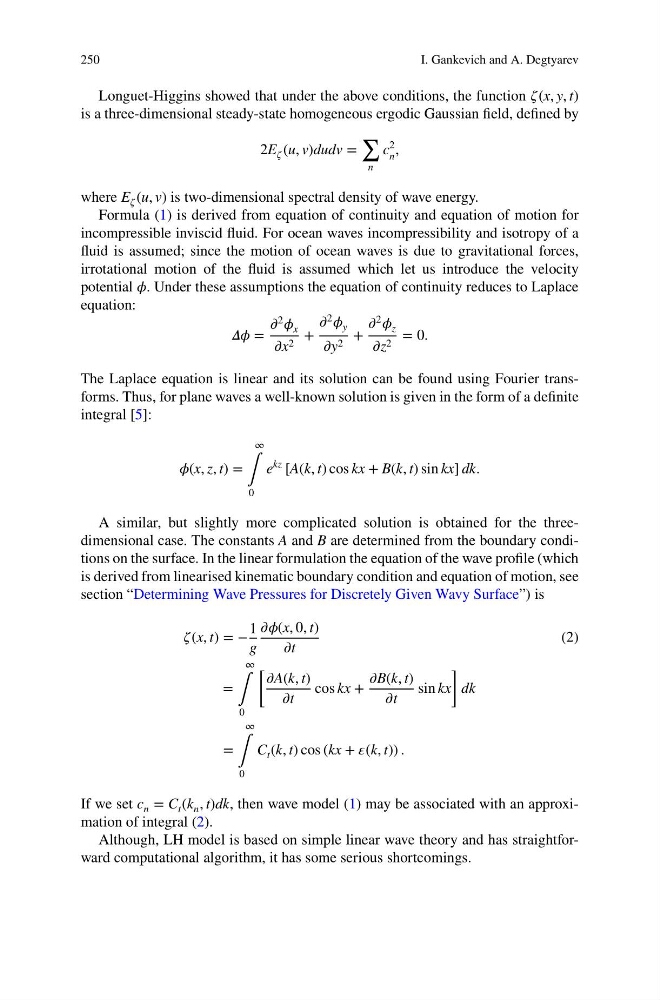
A similar, but slightly more complicated solution is obtained for the threedimensional case. The constants A and B are determined from the boundary conditions on the surface. In the linear formulation the equation of the wave profile (which
is derived from linearised kinematic boundary condition and equation of motion, see
section “Determining Wave Pressures for Discretely Given Wavy Surface”) is
í µí¼ (x, t) = −
1
g
í µí¼í µí¼(x, 0, t)
í µí¼t
(2)
=
∞
∫
0
[ í µí¼A(k, t)
í µí¼t
cos kx +
í µí¼B(k, t)
í µí¼t
sin kx
]
dk
=
∞
∫
0
C t (k, t) cos (kx + í µí¼(k, t)) .
If we set c n = C t (k n , t)dk, then wave model (1) may be associated with an approximation of integral (2).
Although, LH model is based on simple linear wave theory and has straightforward computational algorithm, it has some serious shortcomings.
I. Gankevich and A. Degtyarev
Longuet-Higgins showed that under the above conditions, the function í µí¼ (x, y, t)
is a three-dimensional steady-state homogeneous ergodic Gaussian field, defined by
2E í µí¼ (u, v)dudv =
∑
n
c
2
n
,
where E í µí¼ (u, v) is two-dimensional spectral density of wave energy.
Formula (1) is derived from equation of continuity and equation of motion for
incompressible inviscid fluid. For ocean waves incompressibility and isotropy of a
fluid is assumed; since the motion of ocean waves is due to gravitational forces,
irrotational motion of the fluid is assumed which let us introduce the velocity
potential í µí¼. Under these assumptions the equation of continuity reduces to Laplace
equation:
í µí»¥í µí¼ =
í µí¼
2
í µí¼ x
í µí¼x 2 +
í µí¼ 2 í µí¼ y
í µí¼y 2 +
í µí¼
2
í µí¼ z
í µí¼z 2 = 0.
The Laplace equation is linear and its solution can be found using Fourier transforms. Thus, for plane waves a well-known solution is given in the form of a definite
integral [5]:
í µí¼(x, z, t) =
∞
∫
0
e
kz
[A(k, t) cos kx + B(k, t) sin kx] dk.
A similar, but slightly more complicated solution is obtained for the threedimensional case. The constants A and B are determined from the boundary conditions on the surface. In the linear formulation the equation of the wave profile (which
is derived from linearised kinematic boundary condition and equation of motion, see
section “Determining Wave Pressures for Discretely Given Wavy Surface”) is
í µí¼ (x, t) = −
1
g
í µí¼í µí¼(x, 0, t)
í µí¼t
(2)
=
∞
∫
0
[ í µí¼A(k, t)
í µí¼t
cos kx +
í µí¼B(k, t)
í µí¼t
sin kx
]
dk
=
∞
∫
0
C t (k, t) cos (kx + í µí¼(k, t)) .
If we set c n = C t (k n , t)dk, then wave model (1) may be associated with an approximation of integral (2).
Although, LH model is based on simple linear wave theory and has straightforward computational algorithm, it has some serious shortcomings.