

240
K. Trulsen
0
200
400
600
800
1000
1200
time (s)
-10
-5
0
5
10
15
20
surface elevation (m)
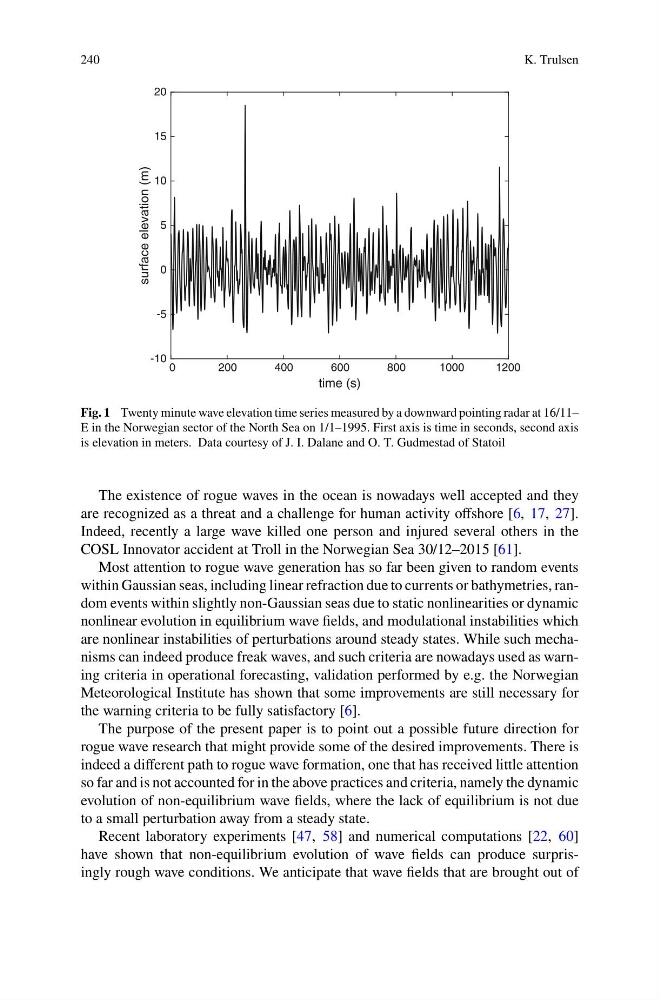
Fig. 1 Twenty minute wave elevation time series measured by a downward pointing radar at 16/11–
E in the Norwegian sector of the North Sea on 1/1–1995. First axis is time in seconds, second axis
is elevation in meters. Data courtesy of J. I. Dalane and O. T. Gudmestad of Statoil
The existence of rogue waves in the ocean is nowadays well accepted and they
are recognized as a threat and a challenge for human activity offshore [6, 17, 27].
Indeed, recently a large wave killed one person and injured several others in the
COSL Innovator accident at Troll in the Norwegian Sea 30/12–2015 [61].
Most attention to rogue wave generation has so far been given to random events
within Gaussian seas, including linear refraction due to currents or bathymetries, random events within slightly non-Gaussian seas due to static nonlinearities or dynamic
nonlinear evolution in equilibrium wave fields, and modulational instabilities which
are nonlinear instabilities of perturbations around steady states. While such mechanisms can indeed produce freak waves, and such criteria are nowadays used as warning criteria in operational forecasting, validation performed by e.g. the Norwegian
Meteorological Institute has shown that some improvements are still necessary for
the warning criteria to be fully satisfactory [6].
The purpose of the present paper is to point out a possible future direction for
rogue wave research that might provide some of the desired improvements. There is
indeed a different path to rogue wave formation, one that has received little attention
so far and is not accounted for in the above practices and criteria, namely the dynamic
evolution of non-equilibrium wave fields, where the lack of equilibrium is not due
to a small perturbation away from a steady state.
Recent laboratory experiments [47, 58] and numerical computations [22, 60]
have shown that non-equilibrium evolution of wave fields can produce surprisingly rough wave conditions. We anticipate that wave fields that are brought out of
K. Trulsen
0
200
400
600
800
1000
1200
time (s)
-10
-5
0
5
10
15
20
surface elevation (m)
Fig. 1 Twenty minute wave elevation time series measured by a downward pointing radar at 16/11–
E in the Norwegian sector of the North Sea on 1/1–1995. First axis is time in seconds, second axis
is elevation in meters. Data courtesy of J. I. Dalane and O. T. Gudmestad of Statoil
The existence of rogue waves in the ocean is nowadays well accepted and they
are recognized as a threat and a challenge for human activity offshore [6, 17, 27].
Indeed, recently a large wave killed one person and injured several others in the
COSL Innovator accident at Troll in the Norwegian Sea 30/12–2015 [61].
Most attention to rogue wave generation has so far been given to random events
within Gaussian seas, including linear refraction due to currents or bathymetries, random events within slightly non-Gaussian seas due to static nonlinearities or dynamic
nonlinear evolution in equilibrium wave fields, and modulational instabilities which
are nonlinear instabilities of perturbations around steady states. While such mechanisms can indeed produce freak waves, and such criteria are nowadays used as warning criteria in operational forecasting, validation performed by e.g. the Norwegian
Meteorological Institute has shown that some improvements are still necessary for
the warning criteria to be fully satisfactory [6].
The purpose of the present paper is to point out a possible future direction for
rogue wave research that might provide some of the desired improvements. There is
indeed a different path to rogue wave formation, one that has received little attention
so far and is not accounted for in the above practices and criteria, namely the dynamic
evolution of non-equilibrium wave fields, where the lack of equilibrium is not due
to a small perturbation away from a steady state.
Recent laboratory experiments [47, 58] and numerical computations [22, 60]
have shown that non-equilibrium evolution of wave fields can produce surprisingly rough wave conditions. We anticipate that wave fields that are brought out of