

Abyssal Mixing in the Laboratory
235
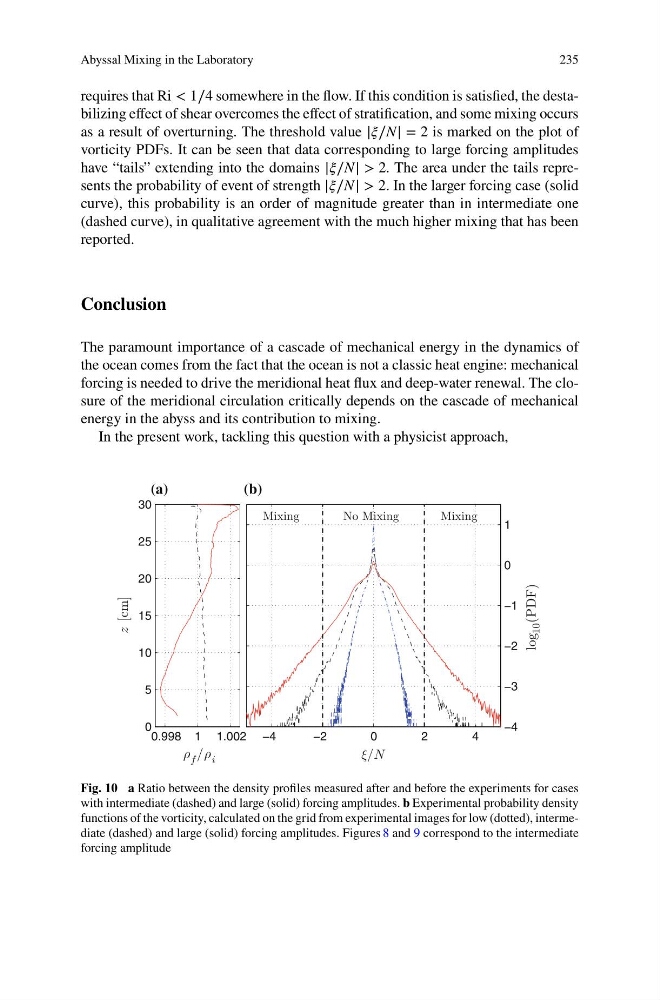
requires that Ri < 1∕4 somewhere in the flow. If this condition is satisfied, the destabilizing effect of shear overcomes the effect of stratification, and some mixing occurs
as a result of overturning. The threshold value |í µí¼∕N| = 2 is marked on the plot of
vorticity PDFs. It can be seen that data corresponding to large forcing amplitudes
have “tails” extending into the domains |í µí¼∕N| > 2. The area under the tails represents the probability of event of strength |í µí¼∕N| > 2. In the larger forcing case (solid
curve), this probability is an order of magnitude greater than in intermediate one
(dashed curve), in qualitative agreement with the much higher mixing that has been
reported.
Conclusion
The paramount importance of a cascade of mechanical energy in the dynamics of
the ocean comes from the fact that the ocean is not a classic heat engine: mechanical
forcing is needed to drive the meridional heat flux and deep-water renewal. The closure of the meridional circulation critically depends on the cascade of mechanical
energy in the abyss and its contribution to mixing.
In the present work, tackling this question with a physicist approach,
−4
−2
0
2
4
−4
−3
−2
−1
0
1
ξ/N
log (PDF)
10
0.998 1 1.002
0
5
10
15
20
25
30
ρ f /ρ i
z [cm]
Mixing
Mixing
No Mixing
(a)
(b)
Fig. 10 a Ratio between the density profiles measured after and before the experiments for cases
with intermediate (dashed) and large (solid) forcing amplitudes. b Experimental probability density
functions of the vorticity, calculated on the grid from experimental images for low (dotted), intermediate (dashed) and large (solid) forcing amplitudes. Figures 8 and 9 correspond to the intermediate
forcing amplitude
235
requires that Ri < 1∕4 somewhere in the flow. If this condition is satisfied, the destabilizing effect of shear overcomes the effect of stratification, and some mixing occurs
as a result of overturning. The threshold value |í µí¼∕N| = 2 is marked on the plot of
vorticity PDFs. It can be seen that data corresponding to large forcing amplitudes
have “tails” extending into the domains |í µí¼∕N| > 2. The area under the tails represents the probability of event of strength |í µí¼∕N| > 2. In the larger forcing case (solid
curve), this probability is an order of magnitude greater than in intermediate one
(dashed curve), in qualitative agreement with the much higher mixing that has been
reported.
Conclusion
The paramount importance of a cascade of mechanical energy in the dynamics of
the ocean comes from the fact that the ocean is not a classic heat engine: mechanical
forcing is needed to drive the meridional heat flux and deep-water renewal. The closure of the meridional circulation critically depends on the cascade of mechanical
energy in the abyss and its contribution to mixing.
In the present work, tackling this question with a physicist approach,
−4
−2
0
2
4
−4
−3
−2
−1
0
1
ξ/N
log (PDF)
10
0.998 1 1.002
0
5
10
15
20
25
30
ρ f /ρ i
z [cm]
Mixing
Mixing
No Mixing
(a)
(b)
Fig. 10 a Ratio between the density profiles measured after and before the experiments for cases
with intermediate (dashed) and large (solid) forcing amplitudes. b Experimental probability density
functions of the vorticity, calculated on the grid from experimental images for low (dotted), intermediate (dashed) and large (solid) forcing amplitudes. Figures 8 and 9 correspond to the intermediate
forcing amplitude