

224
T. Dauxois et al.
Note that for the two specific cases of a wall being vertical or horizontal (í µí»¼ = 0 or
í µí¼∕2), the reflection of an internal wave is similar to a classical Descartes reflection,
without any focusing effect.
The Focusing Parameter
It is of course possible to get more quantitative results. The linear theory of internal
wave reflection has been developed first by Phillips [10] and is based on a well-known
incident wave reflecting at a sloping boundary. Let assume that the incident wave is
bi-dimensional (in the vertical plane) and can be described by the stream function
í µí¼ i (x, z, t) = í µí¼ 0,i exp
[
i
( í µí¼ i t − í µí°¤ i ⋅ í µí°«
)] .
(2)
The index i refers to the incident wave field, while í µí¼ i and í µí°¤ i are the pulsation and
wave vector of the incident wave and satisfy the dispersion relation (1). With u and w
the horizontal and vertical velocity fields, the kinetic energy density is defined as
E c,i =
1
2
̄
í µí¼
(
|u|
2 + |w|
2
)
=
1
2
̄
í µí¼
(
|í µí¼ z í µí¼ i |
2 + |í µí¼ x í µí¼ i |
2
)
=
1
2
̄
í µí¼k
2
i |í µí¼ 0,i |
2
.
(3)
When the incident wave hits the sloping boundary, a reflected wave is generated and
can be expressed as follows
í µí¼ r (x, z, t) = í µí¼ 0,r exp
[
i
( í µí¼ r t − í µí°¤ r ⋅ í µí°«
)] ,
(4)
α
x
x s
z
z s
θ
θ
α
x
x s
z
z s
θ
θ
(a)
(b)
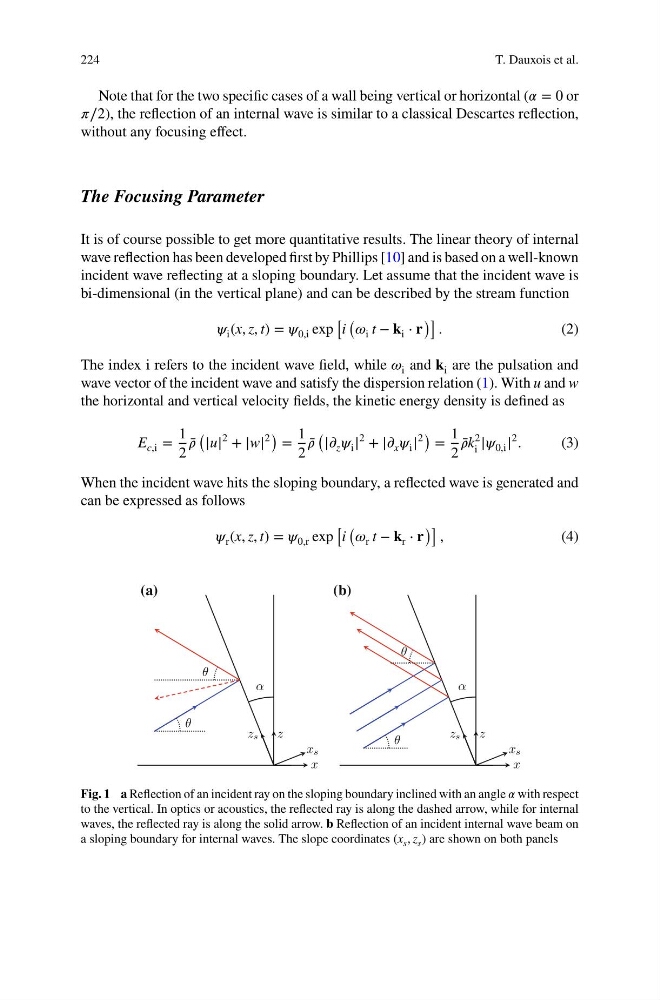
Fig. 1 a Reflection of an incident ray on the sloping boundary inclined with an angle í µí»¼ with respect
to the vertical. In optics or acoustics, the reflected ray is along the dashed arrow, while for internal
waves, the reflected ray is along the solid arrow. b Reflection of an incident internal wave beam on
a sloping boundary for internal waves. The slope coordinates (x s , z s ) are shown on both panels
T. Dauxois et al.
Note that for the two specific cases of a wall being vertical or horizontal (í µí»¼ = 0 or
í µí¼∕2), the reflection of an internal wave is similar to a classical Descartes reflection,
without any focusing effect.
The Focusing Parameter
It is of course possible to get more quantitative results. The linear theory of internal
wave reflection has been developed first by Phillips [10] and is based on a well-known
incident wave reflecting at a sloping boundary. Let assume that the incident wave is
bi-dimensional (in the vertical plane) and can be described by the stream function
í µí¼ i (x, z, t) = í µí¼ 0,i exp
[
i
( í µí¼ i t − í µí°¤ i ⋅ í µí°«
)] .
(2)
The index i refers to the incident wave field, while í µí¼ i and í µí°¤ i are the pulsation and
wave vector of the incident wave and satisfy the dispersion relation (1). With u and w
the horizontal and vertical velocity fields, the kinetic energy density is defined as
E c,i =
1
2
̄
í µí¼
(
|u|
2 + |w|
2
)
=
1
2
̄
í µí¼
(
|í µí¼ z í µí¼ i |
2 + |í µí¼ x í µí¼ i |
2
)
=
1
2
̄
í µí¼k
2
i |í µí¼ 0,i |
2
.
(3)
When the incident wave hits the sloping boundary, a reflected wave is generated and
can be expressed as follows
í µí¼ r (x, z, t) = í µí¼ 0,r exp
[
i
( í µí¼ r t − í µí°¤ r ⋅ í µí°«
)] ,
(4)
α
x
x s
z
z s
θ
θ
α
x
x s
z
z s
θ
θ
(a)
(b)
Fig. 1 a Reflection of an incident ray on the sloping boundary inclined with an angle í µí»¼ with respect
to the vertical. In optics or acoustics, the reflected ray is along the dashed arrow, while for internal
waves, the reflected ray is along the solid arrow. b Reflection of an incident internal wave beam on
a sloping boundary for internal waves. The slope coordinates (x s , z s ) are shown on both panels