

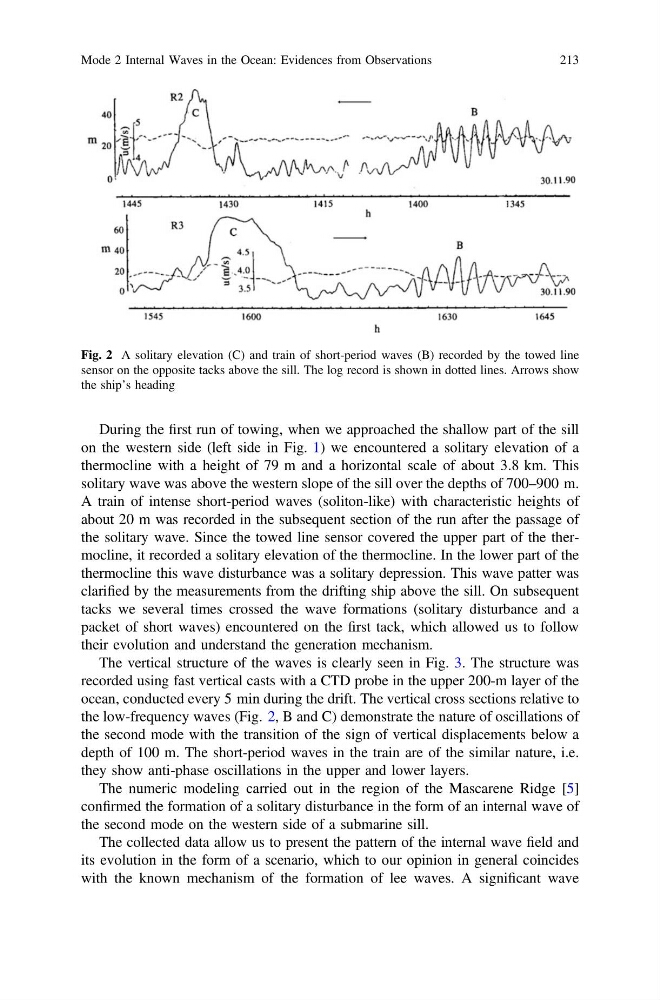
During the first run of towing, when we approached the shallow part of the sill
on the western side (left side in Fig. 1) we encountered a solitary elevation of a
thermocline with a height of 79 m and a horizontal scale of about 3.8 km. This
solitary wave was above the western slope of the sill over the depths of 700–900 m.
A train of intense short-period waves (soliton-like) with characteristic heights of
about 20 m was recorded in the subsequent section of the run after the passage of
the solitary wave. Since the towed line sensor covered the upper part of the thermocline, it recorded a solitary elevation of the thermocline. In the lower part of the
thermocline this wave disturbance was a solitary depression. This wave patter was
clarified by the measurements from the drifting ship above the sill. On subsequent
tacks we several times crossed the wave formations (solitary disturbance and a
packet of short waves) encountered on the first tack, which allowed us to follow
their evolution and understand the generation mechanism.
The vertical structure of the waves is clearly seen in Fig. 3. The structure was
recorded using fast vertical casts with a CTD probe in the upper 200-m layer of the
ocean, conducted every 5 min during the drift. The vertical cross sections relative to
the low-frequency waves (Fig. 2, B and C) demonstrate the nature of oscillations of
the second mode with the transition of the sign of vertical displacements below a
depth of 100 m. The short-period waves in the train are of the similar nature, i.e.
they show anti-phase oscillations in the upper and lower layers.
The numeric modeling carried out in the region of the Mascarene Ridge [5]
confirmed the formation of a solitary disturbance in the form of an internal wave of
the second mode on the western side of a submarine sill.
The collected data allow us to present the pattern of the internal wave field and
its evolution in the form of a scenario, which to our opinion in general coincides
with the known mechanism of the formation of lee waves. A significant wave
Fig. 2 A solitary elevation (C) and train of short-period waves (B) recorded by the towed line
sensor on the opposite tacks above the sill. The log record is shown in dotted lines. Arrows show
the ship’s heading
Mode 2 Internal Waves in the Ocean: Evidences from Observations
213
on the western side (left side in Fig. 1) we encountered a solitary elevation of a
thermocline with a height of 79 m and a horizontal scale of about 3.8 km. This
solitary wave was above the western slope of the sill over the depths of 700–900 m.
A train of intense short-period waves (soliton-like) with characteristic heights of
about 20 m was recorded in the subsequent section of the run after the passage of
the solitary wave. Since the towed line sensor covered the upper part of the thermocline, it recorded a solitary elevation of the thermocline. In the lower part of the
thermocline this wave disturbance was a solitary depression. This wave patter was
clarified by the measurements from the drifting ship above the sill. On subsequent
tacks we several times crossed the wave formations (solitary disturbance and a
packet of short waves) encountered on the first tack, which allowed us to follow
their evolution and understand the generation mechanism.
The vertical structure of the waves is clearly seen in Fig. 3. The structure was
recorded using fast vertical casts with a CTD probe in the upper 200-m layer of the
ocean, conducted every 5 min during the drift. The vertical cross sections relative to
the low-frequency waves (Fig. 2, B and C) demonstrate the nature of oscillations of
the second mode with the transition of the sign of vertical displacements below a
depth of 100 m. The short-period waves in the train are of the similar nature, i.e.
they show anti-phase oscillations in the upper and lower layers.
The numeric modeling carried out in the region of the Mascarene Ridge [5]
confirmed the formation of a solitary disturbance in the form of an internal wave of
the second mode on the western side of a submarine sill.
The collected data allow us to present the pattern of the internal wave field and
its evolution in the form of a scenario, which to our opinion in general coincides
with the known mechanism of the formation of lee waves. A significant wave
Fig. 2 A solitary elevation (C) and train of short-period waves (B) recorded by the towed line
sensor on the opposite tacks above the sill. The log record is shown in dotted lines. Arrows show
the ship’s heading
Mode 2 Internal Waves in the Ocean: Evidences from Observations
213