

hydraulic control and the subsequent internal bore release, as well as on the very
intensity of the bore, which can even not be released [15].
The time evolution of the internal wave train has been addressed in Vlasenko
et al. [16] using a simplified numerical model, whereas the generation mechanism
was investigated in detail in Sánchez-Garrido et al. [13] by means of a high-spatial
resolution numerical model implemented in a domain of very accurate topography.
The model reproduces the generation and eastward propagation of the wave train
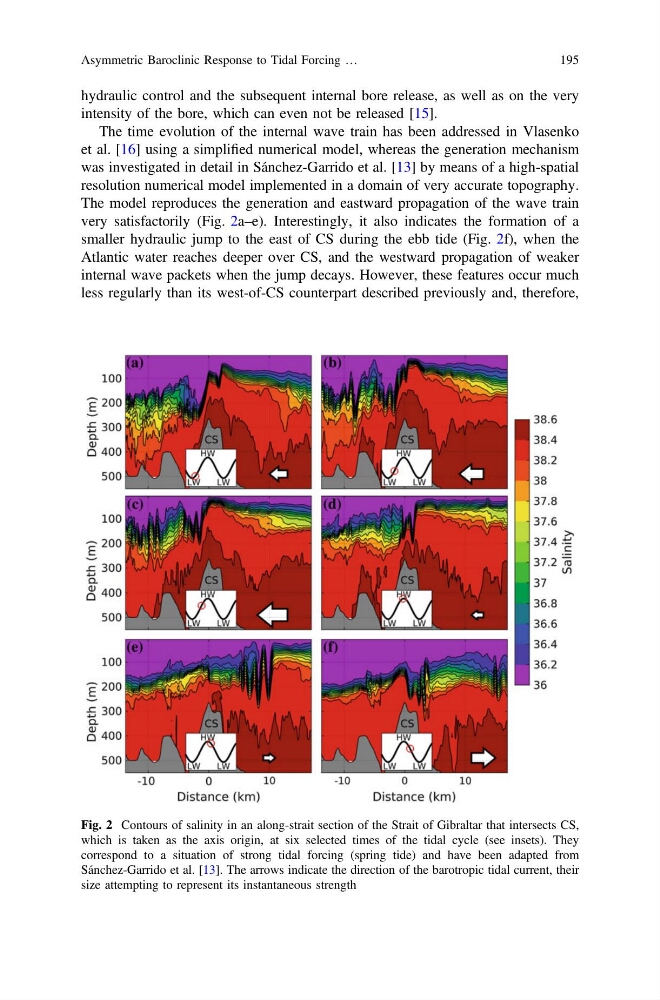
very satisfactorily (Fig. 2a–e). Interestingly, it also indicates the formation of a
smaller hydraulic jump to the east of CS during the ebb tide (Fig. 2f), when the
Atlantic water reaches deeper over CS, and the westward propagation of weaker
internal wave packets when the jump decays. However, these features occur much
less regularly than its west-of-CS counterpart described previously and, therefore,
Fig. 2 Contours of salinity in an along-strait section of the Strait of Gibraltar that intersects CS,
which is taken as the axis origin, at six selected times of the tidal cycle (see insets). They
correspond to a situation of strong tidal forcing (spring tide) and have been adapted from
Sánchez-Garrido et al. [13]. The arrows indicate the direction of the barotropic tidal current, their
size attempting to represent its instantaneous strength
Asymmetric Baroclinic Response to Tidal Forcing …
195
intensity of the bore, which can even not be released [15].
The time evolution of the internal wave train has been addressed in Vlasenko
et al. [16] using a simplified numerical model, whereas the generation mechanism
was investigated in detail in Sánchez-Garrido et al. [13] by means of a high-spatial
resolution numerical model implemented in a domain of very accurate topography.
The model reproduces the generation and eastward propagation of the wave train
very satisfactorily (Fig. 2a–e). Interestingly, it also indicates the formation of a
smaller hydraulic jump to the east of CS during the ebb tide (Fig. 2f), when the
Atlantic water reaches deeper over CS, and the westward propagation of weaker
internal wave packets when the jump decays. However, these features occur much
less regularly than its west-of-CS counterpart described previously and, therefore,
Fig. 2 Contours of salinity in an along-strait section of the Strait of Gibraltar that intersects CS,
which is taken as the axis origin, at six selected times of the tidal cycle (see insets). They
correspond to a situation of strong tidal forcing (spring tide) and have been adapted from
Sánchez-Garrido et al. [13]. The arrows indicate the direction of the barotropic tidal current, their
size attempting to represent its instantaneous strength
Asymmetric Baroclinic Response to Tidal Forcing …
195