

174
L. R. M. Maas et al.
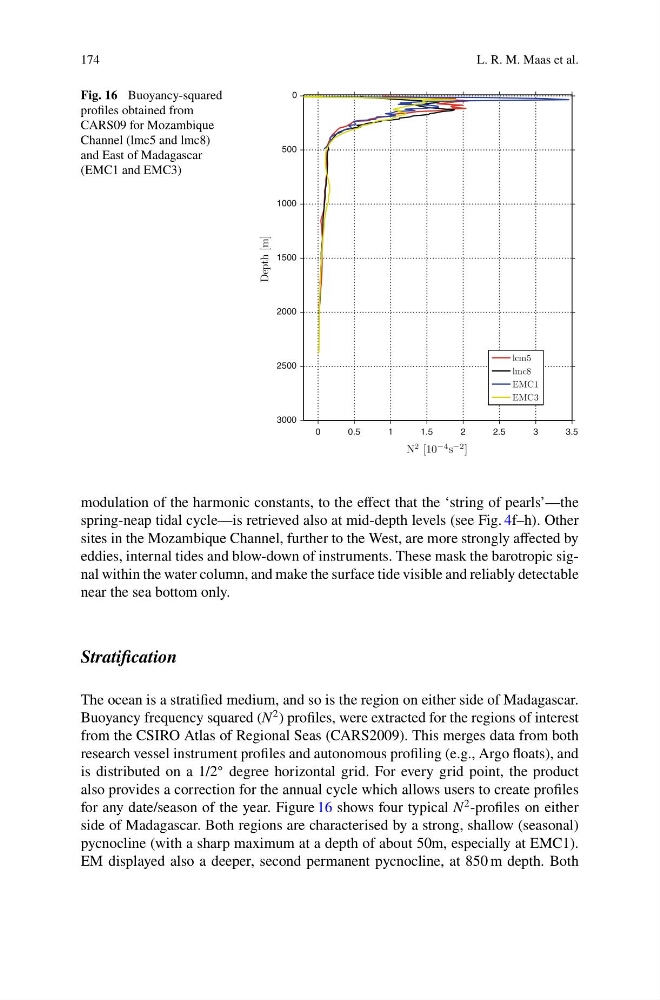
Fig. 16 Buoyancy-squared
profiles obtained from
CARS09 for Mozambique
Channel (lmc5 and lmc8)
and East of Madagascar
(EMC1 and EMC3)
0
0.5
1
1.5
2
2.5
3
3.5
0
500
1000
1500
2000
2500
3000
N
2 [10
−4 s
−2 ]
Depth [m]
lcm5
lmc8
EMC1
EMC3
modulation of the harmonic constants, to the effect that the ‘string of pearls’—the
spring-neap tidal cycle—is retrieved also at mid-depth levels (see Fig. 4f–h). Other
sites in the Mozambique Channel, further to the West, are more strongly affected by
eddies, internal tides and blow-down of instruments. These mask the barotropic signal within the water column, and make the surface tide visible and reliably detectable
near the sea bottom only.
Stratification
The ocean is a stratified medium, and so is the region on either side of Madagascar.
Buoyancy frequency squared (N 2 ) profiles, were extracted for the regions of interest
from the CSIRO Atlas of Regional Seas (CARS2009). This merges data from both
research vessel instrument profiles and autonomous profiling (e.g., Argo floats), and
is distributed on a 1/2 ◦ degree horizontal grid. For every grid point, the product
also provides a correction for the annual cycle which allows users to create profiles
for any date/season of the year. Figure 16 shows four typical N 2 -profiles on either
side of Madagascar. Both regions are characterised by a strong, shallow (seasonal)
pycnocline (with a sharp maximum at a depth of about 50m, especially at EMC1).
EM displayed also a deeper, second permanent pycnocline, at 850 m depth. Both
L. R. M. Maas et al.
Fig. 16 Buoyancy-squared
profiles obtained from
CARS09 for Mozambique
Channel (lmc5 and lmc8)
and East of Madagascar
(EMC1 and EMC3)
0
0.5
1
1.5
2
2.5
3
3.5
0
500
1000
1500
2000
2500
3000
N
2 [10
−4 s
−2 ]
Depth [m]
lcm5
lmc8
EMC1
EMC3
modulation of the harmonic constants, to the effect that the ‘string of pearls’—the
spring-neap tidal cycle—is retrieved also at mid-depth levels (see Fig. 4f–h). Other
sites in the Mozambique Channel, further to the West, are more strongly affected by
eddies, internal tides and blow-down of instruments. These mask the barotropic signal within the water column, and make the surface tide visible and reliably detectable
near the sea bottom only.
Stratification
The ocean is a stratified medium, and so is the region on either side of Madagascar.
Buoyancy frequency squared (N 2 ) profiles, were extracted for the regions of interest
from the CSIRO Atlas of Regional Seas (CARS2009). This merges data from both
research vessel instrument profiles and autonomous profiling (e.g., Argo floats), and
is distributed on a 1/2 ◦ degree horizontal grid. For every grid point, the product
also provides a correction for the annual cycle which allows users to create profiles
for any date/season of the year. Figure 16 shows four typical N 2 -profiles on either
side of Madagascar. Both regions are characterised by a strong, shallow (seasonal)
pycnocline (with a sharp maximum at a depth of about 50m, especially at EMC1).
EM displayed also a deeper, second permanent pycnocline, at 850 m depth. Both