

Deep-Ocean Tides in the South-West Indian Ocean . . .
169
0
30
60
90
120
150
180
210
240
270
300
330
0
1
2
3
0
30
60
90
120
150
180
210
240
270
300
330
0
1
2
3
0
30
60
90
120
150
180
210
240
270
300
330
0
1
2
3
0
30
60
90
120
150
180
210
240
270
300
330
0
1
2
3
0
30
60
90
120
150
180
210
240
270
300
330
0
5
10
15
0
30
60
90
120
150
180
210
240
270
300
330
0
5
10
15
0
30
60
90
120
150
180
210
240
270
300
330
0
5
10
15
0
30
60
90
120
150
180
210
240
270
300
330
0
5
10
15
0
30
60
90
120
150
180
210
240
270
300
330
0
5
10
15
20
0
30
60
90
120
150
180
210
240
270
300
330
0
5
10
15
20
0
30
60
90
120
150
180
210
240
270
300
330
0
5
10
15
20
0
30
60
90
120
150
180
210
240
270
300
330
0
5
10
15
20
0
30
60
90
120
150
180
210
240
270
300
330
0
20
40
60
0
30
60
90
120
150
180
210
240
270
300
330
0
20
40
60
0
30
60
90
120
150
180
210
240
270
300
330
0
20
40
60
0
30
60
90
120
150
180
210
240
270
300
330
0
20
40
60
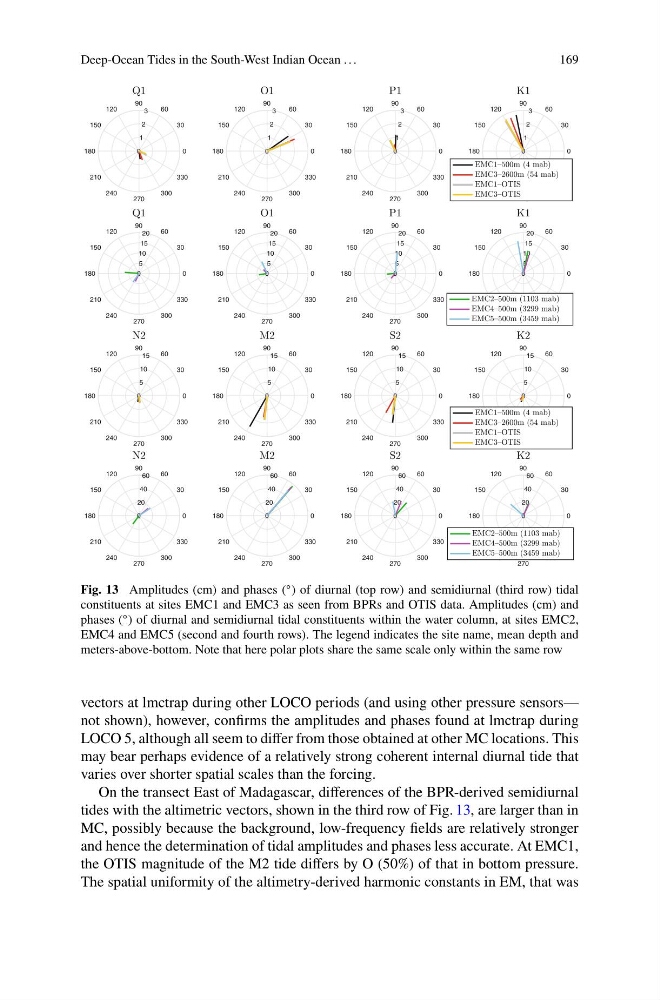
Fig. 13 Amplitudes (cm) and phases ( ◦ ) of diurnal (top row) and semidiurnal (third row) tidal
constituents at sites EMC1 and EMC3 as seen from BPRs and OTIS data. Amplitudes (cm) and
phases ( ◦ ) of diurnal and semidiurnal tidal constituents within the water column, at sites EMC2,
EMC4 and EMC5 (second and fourth rows). The legend indicates the site name, mean depth and
meters-above-bottom. Note that here polar plots share the same scale only within the same row
vectors at lmctrap during other LOCO periods (and using other pressure sensors—
not shown), however, confirms the amplitudes and phases found at lmctrap during
LOCO 5, although all seem to differ from those obtained at other MC locations. This
may bear perhaps evidence of a relatively strong coherent internal diurnal tide that
varies over shorter spatial scales than the forcing.
On the transect East of Madagascar, differences of the BPR-derived semidiurnal
tides with the altimetric vectors, shown in the third row of Fig. 13, are larger than in
MC, possibly because the background, low-frequency fields are relatively stronger
and hence the determination of tidal amplitudes and phases less accurate. At EMC1,
the OTIS magnitude of the M2 tide differs by O (50%) of that in bottom pressure.
The spatial uniformity of the altimetry-derived harmonic constants in EM, that was
169
0
30
60
90
120
150
180
210
240
270
300
330
0
1
2
3
0
30
60
90
120
150
180
210
240
270
300
330
0
1
2
3
0
30
60
90
120
150
180
210
240
270
300
330
0
1
2
3
0
30
60
90
120
150
180
210
240
270
300
330
0
1
2
3
0
30
60
90
120
150
180
210
240
270
300
330
0
5
10
15
0
30
60
90
120
150
180
210
240
270
300
330
0
5
10
15
0
30
60
90
120
150
180
210
240
270
300
330
0
5
10
15
0
30
60
90
120
150
180
210
240
270
300
330
0
5
10
15
0
30
60
90
120
150
180
210
240
270
300
330
0
5
10
15
20
0
30
60
90
120
150
180
210
240
270
300
330
0
5
10
15
20
0
30
60
90
120
150
180
210
240
270
300
330
0
5
10
15
20
0
30
60
90
120
150
180
210
240
270
300
330
0
5
10
15
20
0
30
60
90
120
150
180
210
240
270
300
330
0
20
40
60
0
30
60
90
120
150
180
210
240
270
300
330
0
20
40
60
0
30
60
90
120
150
180
210
240
270
300
330
0
20
40
60
0
30
60
90
120
150
180
210
240
270
300
330
0
20
40
60
Fig. 13 Amplitudes (cm) and phases ( ◦ ) of diurnal (top row) and semidiurnal (third row) tidal
constituents at sites EMC1 and EMC3 as seen from BPRs and OTIS data. Amplitudes (cm) and
phases ( ◦ ) of diurnal and semidiurnal tidal constituents within the water column, at sites EMC2,
EMC4 and EMC5 (second and fourth rows). The legend indicates the site name, mean depth and
meters-above-bottom. Note that here polar plots share the same scale only within the same row
vectors at lmctrap during other LOCO periods (and using other pressure sensors—
not shown), however, confirms the amplitudes and phases found at lmctrap during
LOCO 5, although all seem to differ from those obtained at other MC locations. This
may bear perhaps evidence of a relatively strong coherent internal diurnal tide that
varies over shorter spatial scales than the forcing.
On the transect East of Madagascar, differences of the BPR-derived semidiurnal
tides with the altimetric vectors, shown in the third row of Fig. 13, are larger than in
MC, possibly because the background, low-frequency fields are relatively stronger
and hence the determination of tidal amplitudes and phases less accurate. At EMC1,
the OTIS magnitude of the M2 tide differs by O (50%) of that in bottom pressure.
The spatial uniformity of the altimetry-derived harmonic constants in EM, that was