

Deep-Ocean Tides in the South-West Indian Ocean . . .
151
tide—the internal tide that stays phase-locked to the surface tide over the analysed
period—can be estimated by subtracting the surface tidal amplitudes and phases,
found at BPRs along the same mooring. Incoherent internal tides change amplitude
and phase due to changing environmental conditions (stratification and mean-flow
structure). Low frequency features as eddies and currents, apart from being responsible for blow-down of mid-water column instruments, also make the determination
of long-period tides difficult, which can therefore not be reliably extracted. It is for
this reason that we here focus on the eight most prominent diurnal and semidiurnal
tidal components only. Conclusions are drawn in section “Conclusions”.
Measurement Sites and Instrumentation
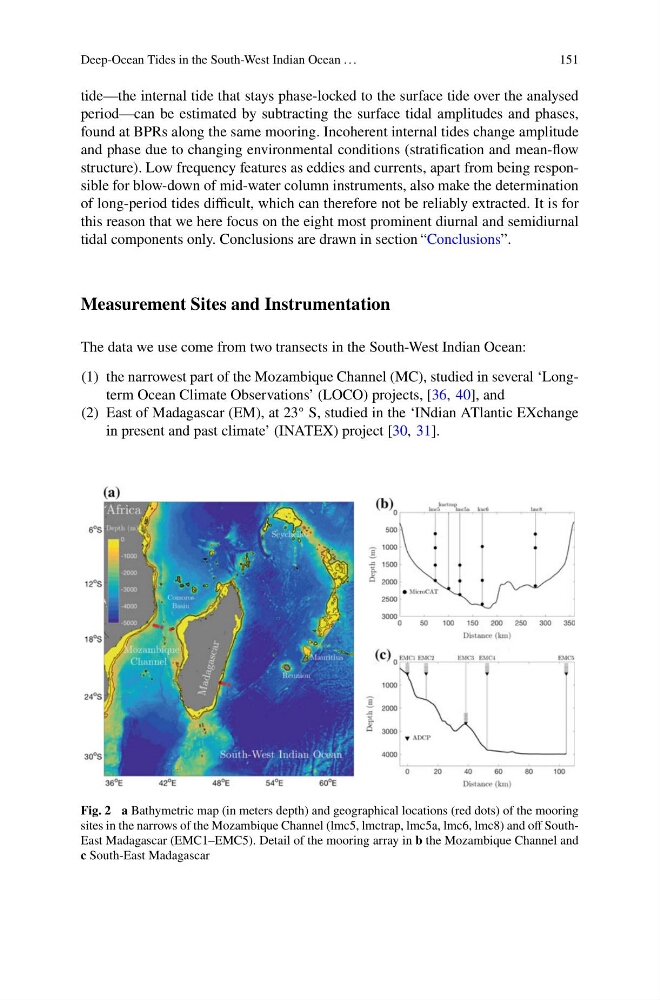
The data we use come from two transects in the South-West Indian Ocean:
(1) the narrowest part of the Mozambique Channel (MC), studied in several ‘Longterm Ocean Climate Observations’ (LOCO) projects, [36, 40], and
(2) East of Madagascar (EM), at 23
◦ S, studied in the ‘INdian ATlantic EXchange
in present and past climate’ (INATEX) project [30, 31].
Fig. 2 a Bathymetric map (in meters depth) and geographical locations (red dots) of the mooring
sites in the narrows of the Mozambique Channel (lmc5, lmctrap, lmc5a, lmc6, lmc8) and off SouthEast Madagascar (EMC1–EMC5). Detail of the mooring array in b the Mozambique Channel and
c South-East Madagascar
151
tide—the internal tide that stays phase-locked to the surface tide over the analysed
period—can be estimated by subtracting the surface tidal amplitudes and phases,
found at BPRs along the same mooring. Incoherent internal tides change amplitude
and phase due to changing environmental conditions (stratification and mean-flow
structure). Low frequency features as eddies and currents, apart from being responsible for blow-down of mid-water column instruments, also make the determination
of long-period tides difficult, which can therefore not be reliably extracted. It is for
this reason that we here focus on the eight most prominent diurnal and semidiurnal
tidal components only. Conclusions are drawn in section “Conclusions”.
Measurement Sites and Instrumentation
The data we use come from two transects in the South-West Indian Ocean:
(1) the narrowest part of the Mozambique Channel (MC), studied in several ‘Longterm Ocean Climate Observations’ (LOCO) projects, [36, 40], and
(2) East of Madagascar (EM), at 23
◦ S, studied in the ‘INdian ATlantic EXchange
in present and past climate’ (INATEX) project [30, 31].
Fig. 2 a Bathymetric map (in meters depth) and geographical locations (red dots) of the mooring
sites in the narrows of the Mozambique Channel (lmc5, lmctrap, lmc5a, lmc6, lmc8) and off SouthEast Madagascar (EMC1–EMC5). Detail of the mooring array in b the Mozambique Channel and
c South-East Madagascar