

North Sea [4]. Such values are still 100 times larger than molecular diffusivity
values and sufficient to explain, at least for shallow seas, the gradual warming of the
near-bottom waters and the flux of nutrients into the photic zone to entirely support
the late-summer phytoplankton bloom. This was found to be due to the stratification
being marginally stable, with gradient Richardson number Ri = N
2 /|S|
2 values of
about Ri = 0.5, where the shear magnitude |S| was composed of a quasi-permanent
large inertial/tidal shear across largest stratification added with occasional
small-scale internal wave shear. These turbulence values are also typical for a
saturated internal wave field allowing for sparsely distributed turbulence [56],
similar to surface wave white capping of a puff here and a puff there. However,
according to Munk [24] they are insufficient to maintain the ocean stratification.
Above Sloping Topography
When internal waves reach underwater topography like seamounts or ridges, the
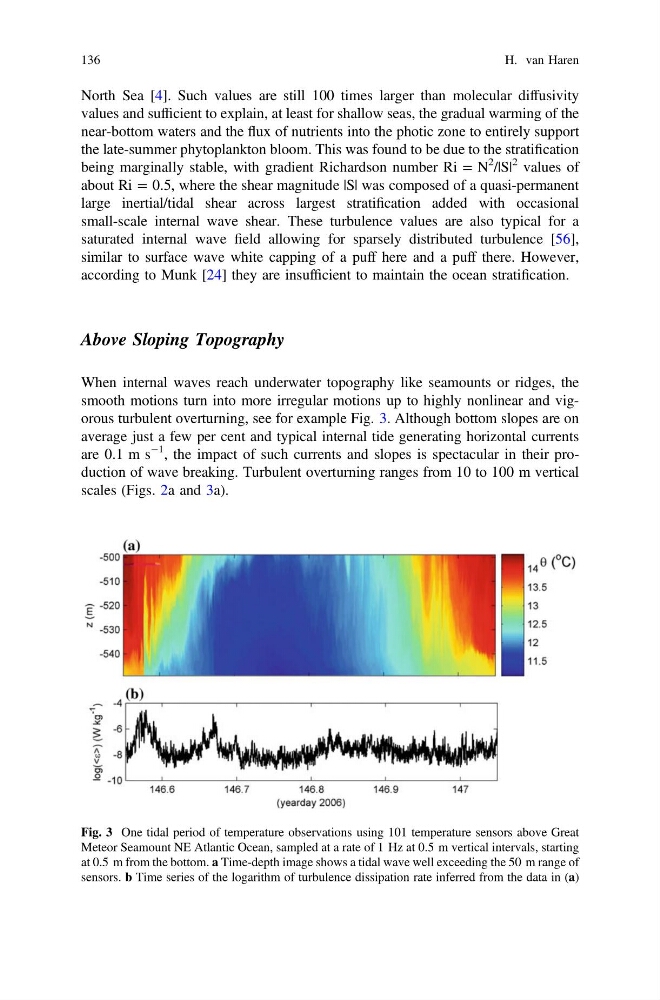
smooth motions turn into more irregular motions up to highly nonlinear and vigorous turbulent overturning, see for example Fig. 3. Although bottom slopes are on
average just a few per cent and typical internal tide generating horizontal currents
are 0.1 m s
−1 , the impact of such currents and slopes is spectacular in their production of wave breaking. Turbulent overturning ranges from 10 to 100 m vertical
scales (Figs. 2a and 3a).
Fig. 3 One tidal period of temperature observations using 101 temperature sensors above Great
Meteor Seamount NE Atlantic Ocean, sampled at a rate of 1 Hz at 0.5 m vertical intervals, starting
at 0.5 m from the bottom. a Time-depth image shows a tidal wave well exceeding the 50 m range of
sensors. b Time series of the logarithm of turbulence dissipation rate inferred from the data in (a)
136
H. van Haren
values and sufficient to explain, at least for shallow seas, the gradual warming of the
near-bottom waters and the flux of nutrients into the photic zone to entirely support
the late-summer phytoplankton bloom. This was found to be due to the stratification
being marginally stable, with gradient Richardson number Ri = N
2 /|S|
2 values of
about Ri = 0.5, where the shear magnitude |S| was composed of a quasi-permanent
large inertial/tidal shear across largest stratification added with occasional
small-scale internal wave shear. These turbulence values are also typical for a
saturated internal wave field allowing for sparsely distributed turbulence [56],
similar to surface wave white capping of a puff here and a puff there. However,
according to Munk [24] they are insufficient to maintain the ocean stratification.
Above Sloping Topography
When internal waves reach underwater topography like seamounts or ridges, the
smooth motions turn into more irregular motions up to highly nonlinear and vigorous turbulent overturning, see for example Fig. 3. Although bottom slopes are on
average just a few per cent and typical internal tide generating horizontal currents
are 0.1 m s
−1 , the impact of such currents and slopes is spectacular in their production of wave breaking. Turbulent overturning ranges from 10 to 100 m vertical
scales (Figs. 2a and 3a).
Fig. 3 One tidal period of temperature observations using 101 temperature sensors above Great
Meteor Seamount NE Atlantic Ocean, sampled at a rate of 1 Hz at 0.5 m vertical intervals, starting
at 0.5 m from the bottom. a Time-depth image shows a tidal wave well exceeding the 50 m range of
sensors. b Time series of the logarithm of turbulence dissipation rate inferred from the data in (a)
136
H. van Haren