

Large Internal Solitary Waves in Shallow Waters
99
í µí¼ 0 ∕H and Fr. The particular case of BM corresponding to the symmetric solitary
waves of the second mode (SM) is considered in section “Solitary Waves in SM”.
An interesting example of a nonsymmetric solitary wave was found experimentally for special initial data in the lock problem shown in Fig. 1b, namely, for
h 0 = H∕3, ̄
b = b∕3, í µí¼ 0 ≪ H. The length of the left compartment has been chosen
so that the only one wave moving on the right was generated. The experimental
photo is shown in Fig. 6. From the symmetry consideration of the flow in the regions
0 ≤ y ≤ h 0 and h 0 ≤ y ≤ H, it may be concluded that the intrusion from the compartment (the wave core with dark fluid) consist of the wave of elevation and two
waves of depression. Such waves have been found as solutions of SM for the case
í µí¼ 0 ≪ H in [11] (Fig. 4).
Here we consider the case í µí¼ 0 > 0. To construct a soliton-like solution, we must
start with the data h = h 0 , í µí¼ = í µí¼ 0 , u = u 0 , w = u 0 , u ′ = 0, w ′ = 0 for x → −∞ and use
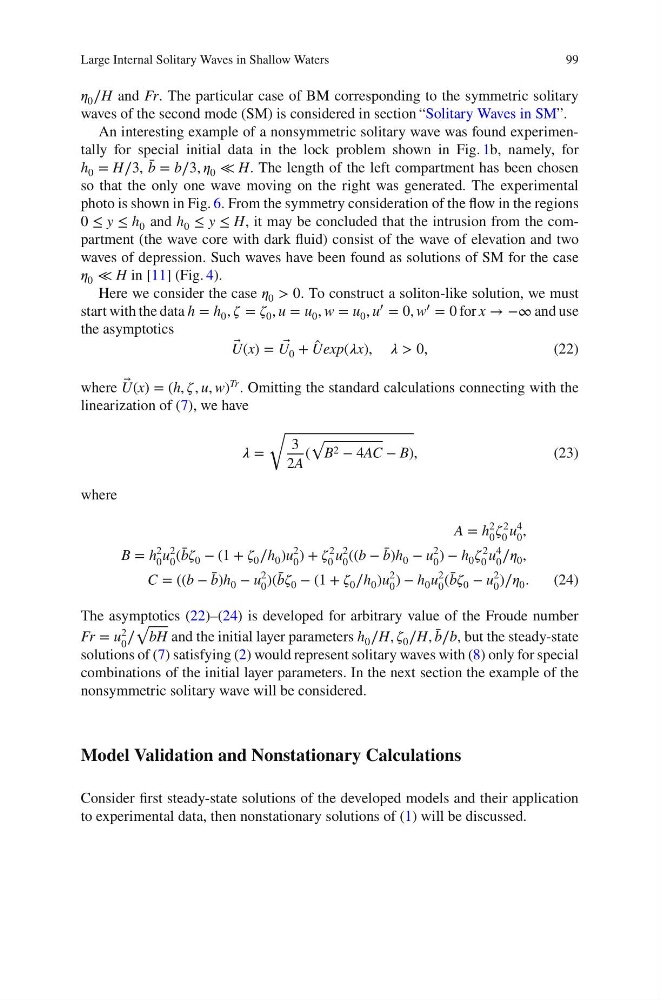
the asymptotics
⃗
U(x) = ⃗
U 0 + ̂
Uexp(í µí¼x), í µí¼ > 0,
(22)
where ⃗
U(x) = (h, í µí¼, u, w)
Tr . Omitting the standard calculations connecting with the
linearization of (7), we have
í µí¼ =
√
3
2A
(
√
B 2 − 4AC − B),
(23)
where
A = h
2
0
í µí¼
2
0
u
4
0
,
B = h
2
0 u
2
0 ( ̄
bí µí¼ 0 − (1 + í µí¼ 0 ∕h 0 )u
2
0 ) + í µí¼
2
0 u
2
0 ((b − ̄
b)h 0 − u
2
0 ) − h 0 í µí¼
2
0 u
4
0 ∕í µí¼ 0 ,
C = ((b − ̄
b)h 0 − u
2
0
)( ̄
bí µí¼ 0 − (1 + í µí¼ 0 ∕h 0 )u
2
0
) − h 0 u
2
0
( ̄
bí µí¼ 0 − u
2
0
)∕í µí¼ 0 .
(24)
The asymptotics (22)–(24) is developed for arbitrary value of the Froude number
Fr = u
2
0
∕
√
bH and the initial layer parameters h 0 ∕H, í µí¼ 0 ∕H, ̄
b∕b, but the steady-state
solutions of (7) satisfying (2) would represent solitary waves with (8) only for special
combinations of the initial layer parameters. In the next section the example of the
nonsymmetric solitary wave will be considered.
Model Validation and Nonstationary Calculations
Consider first steady-state solutions of the developed models and their application
to experimental data, then nonstationary solutions of (1) will be discussed.
99
í µí¼ 0 ∕H and Fr. The particular case of BM corresponding to the symmetric solitary
waves of the second mode (SM) is considered in section “Solitary Waves in SM”.
An interesting example of a nonsymmetric solitary wave was found experimentally for special initial data in the lock problem shown in Fig. 1b, namely, for
h 0 = H∕3, ̄
b = b∕3, í µí¼ 0 ≪ H. The length of the left compartment has been chosen
so that the only one wave moving on the right was generated. The experimental
photo is shown in Fig. 6. From the symmetry consideration of the flow in the regions
0 ≤ y ≤ h 0 and h 0 ≤ y ≤ H, it may be concluded that the intrusion from the compartment (the wave core with dark fluid) consist of the wave of elevation and two
waves of depression. Such waves have been found as solutions of SM for the case
í µí¼ 0 ≪ H in [11] (Fig. 4).
Here we consider the case í µí¼ 0 > 0. To construct a soliton-like solution, we must
start with the data h = h 0 , í µí¼ = í µí¼ 0 , u = u 0 , w = u 0 , u ′ = 0, w ′ = 0 for x → −∞ and use
the asymptotics
⃗
U(x) = ⃗
U 0 + ̂
Uexp(í µí¼x), í µí¼ > 0,
(22)
where ⃗
U(x) = (h, í µí¼, u, w)
Tr . Omitting the standard calculations connecting with the
linearization of (7), we have
í µí¼ =
√
3
2A
(
√
B 2 − 4AC − B),
(23)
where
A = h
2
0
í µí¼
2
0
u
4
0
,
B = h
2
0 u
2
0 ( ̄
bí µí¼ 0 − (1 + í µí¼ 0 ∕h 0 )u
2
0 ) + í µí¼
2
0 u
2
0 ((b − ̄
b)h 0 − u
2
0 ) − h 0 í µí¼
2
0 u
4
0 ∕í µí¼ 0 ,
C = ((b − ̄
b)h 0 − u
2
0
)( ̄
bí µí¼ 0 − (1 + í µí¼ 0 ∕h 0 )u
2
0
) − h 0 u
2
0
( ̄
bí µí¼ 0 − u
2
0
)∕í µí¼ 0 .
(24)
The asymptotics (22)–(24) is developed for arbitrary value of the Froude number
Fr = u
2
0
∕
√
bH and the initial layer parameters h 0 ∕H, í µí¼ 0 ∕H, ̄
b∕b, but the steady-state
solutions of (7) satisfying (2) would represent solitary waves with (8) only for special
combinations of the initial layer parameters. In the next section the example of the
nonsymmetric solitary wave will be considered.
Model Validation and Nonstationary Calculations
Consider first steady-state solutions of the developed models and their application
to experimental data, then nonstationary solutions of (1) will be discussed.