

Chapter 2: SEA SURFACE MICROLAYER
of the next cycle by the formation of the unstably stratified thermal sublayer
due to the molecular heat diffusion.
The observations shown in Figure 2-6 and Figure 2-7 provide an insight
into the renewal process near the surface in convectively unstable conditions.
In particular, the data is consistent with the concept of intermittent
convection in the near-surface layer, which has found its application for the
modeling of the aqueous molecular sublayers.
2.2.2 Microscale wave breaking
Microscale wave breaking has been the subject of several theoretical,
laboratory, and modeling studies. Laboratory wind-wave studies of Okuda
(1982) and Ebuchi et al. (1987) revealed a high-vorticity region near the
crests of gravity waves with capillary ripples generated ahead of the crests.
Longuet-Higgins (1992) identified the origin of vorticity within this surface
roller as accompanying parasitic capillaries, which themselves generate fluid
rotation (i.e., vorticity) via the surface tension effect (Yeh, 1992; 1995).
Rollers (Longuet-Higgins, 1992), breaking wavelets (Csanady, 1990), steep
wind waves accompanied by a high-vorticity layer near the crest (Okuda,
1982), and microscale breaking (Banner and Phillips, 1974) appear to be
descriptions of the same phenomena.
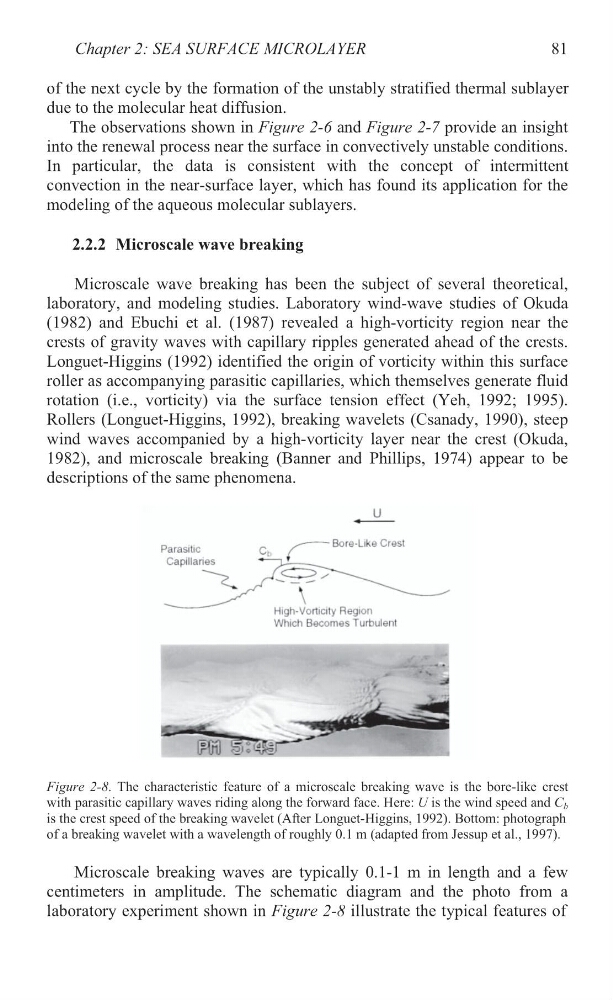
Figure 2-8. The characteristic feature of a microscale breaking wave is the bore-like crest
with parasitic capillary waves riding along the forward face. Here: U is the wind speed and C b
is the crest speed of the breaking wavelet (After Longuet-Higgins, 1992). Bottom: photograph
of a breaking wavelet with a wavelength of roughly 0.1 m (adapted from Jessup et al., 1997).
Microscale breaking waves are typically 0.1-1 m in length and a few
centimeters in amplitude. The schematic diagram and the photo from a
laboratory experiment shown in Figure 2-8 illustrate the typical features of
81
of the next cycle by the formation of the unstably stratified thermal sublayer
due to the molecular heat diffusion.
The observations shown in Figure 2-6 and Figure 2-7 provide an insight
into the renewal process near the surface in convectively unstable conditions.
In particular, the data is consistent with the concept of intermittent
convection in the near-surface layer, which has found its application for the
modeling of the aqueous molecular sublayers.
2.2.2 Microscale wave breaking
Microscale wave breaking has been the subject of several theoretical,
laboratory, and modeling studies. Laboratory wind-wave studies of Okuda
(1982) and Ebuchi et al. (1987) revealed a high-vorticity region near the
crests of gravity waves with capillary ripples generated ahead of the crests.
Longuet-Higgins (1992) identified the origin of vorticity within this surface
roller as accompanying parasitic capillaries, which themselves generate fluid
rotation (i.e., vorticity) via the surface tension effect (Yeh, 1992; 1995).
Rollers (Longuet-Higgins, 1992), breaking wavelets (Csanady, 1990), steep
wind waves accompanied by a high-vorticity layer near the crest (Okuda,
1982), and microscale breaking (Banner and Phillips, 1974) appear to be
descriptions of the same phenomena.
Figure 2-8. The characteristic feature of a microscale breaking wave is the bore-like crest
with parasitic capillary waves riding along the forward face. Here: U is the wind speed and C b
is the crest speed of the breaking wavelet (After Longuet-Higgins, 1992). Bottom: photograph
of a breaking wavelet with a wavelength of roughly 0.1 m (adapted from Jessup et al., 1997).
Microscale breaking waves are typically 0.1-1 m in length and a few
centimeters in amplitude. The schematic diagram and the photo from a
laboratory experiment shown in Figure 2-8 illustrate the typical features of
81