

Chapter 1: INTRODUCTION
where U 10 is the wind speed at 10 m, and J is an empirically determined
factor that varies between 0.8 and 0.9 in most cases except for situations
where only very small drops are involved, and P is the rain rate given by the
volume rate of water accumulation per unit surface area.
For heavy rainfall, raindrops may provide an appreciable contribution to
the momentum flux at the air-sea interface. In addition to raindrops, the
contribution of sea-spray droplets to the momentum flux may become
significant for hurricane force winds (Chapter 6).
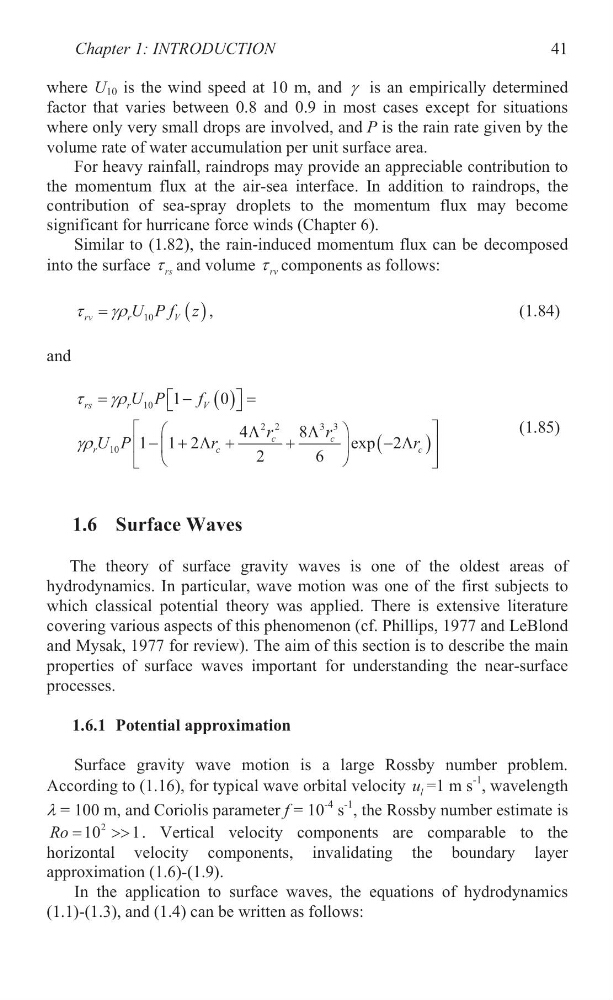
Similar to (1.82), the rain-induced momentum flux can be decomposed
into the surface rs
W and volume rv
W components as follows:
10
rv
r
V
U P f z
W
JU
,
(1.84)
and
10
2 2
3 3
10
1
0
4
8
1 1 2
exp 2
2
6
rs
r
V
c
c
r
c
c
U P
f
r
r
U P
r
r
W
JU
JU
ª
º
¬
¼
ª
º
§
·
/
/
/
/
«
»
¨
¸
©
¹
¬
¼
(1.85)
1.6 Surface Waves
The theory of surface gravity waves is one of the oldest areas of
hydrodynamics. In particular, wave motion was one of the first subjects to
which classical potential theory was applied. There is extensive literature
covering various aspects of this phenomenon (cf. Phillips, 1977 and LeBlond
and Mysak, 1977 for review). The aim of this section is to describe the main
properties of surface waves important for understanding the near-surface
processes.
1.6.1 Potential approximation
Surface gravity wave motion is a large Rossby number problem.
According to (1.16), for typical wave orbital velocity l
u =1 m s
-1 , wavelength
O = 100 m, and Coriolis parameter f = 10
-4 s
-1 , the Rossby number estimate is
2
10
1
Ro
!! . Vertical velocity components are comparable to the
horizontal velocity components, invalidating the boundary layer
approximation (1.6)-(1.9).
In the application to surface waves, the equations of hydrodynamics
(1.1)-(1.3), and (1.4) can be written as follows:
41
where U 10 is the wind speed at 10 m, and J is an empirically determined
factor that varies between 0.8 and 0.9 in most cases except for situations
where only very small drops are involved, and P is the rain rate given by the
volume rate of water accumulation per unit surface area.
For heavy rainfall, raindrops may provide an appreciable contribution to
the momentum flux at the air-sea interface. In addition to raindrops, the
contribution of sea-spray droplets to the momentum flux may become
significant for hurricane force winds (Chapter 6).
Similar to (1.82), the rain-induced momentum flux can be decomposed
into the surface rs
W and volume rv
W components as follows:
10
rv
r
V
U P f z
W
JU
,
(1.84)
and
10
2 2
3 3
10
1
0
4
8
1 1 2
exp 2
2
6
rs
r
V
c
c
r
c
c
U P
f
r
r
U P
r
r
W
JU
JU
ª
º
¬
¼
ª
º
§
·
/
/
/
/
«
»
¨
¸
©
¹
¬
¼
(1.85)
1.6 Surface Waves
The theory of surface gravity waves is one of the oldest areas of
hydrodynamics. In particular, wave motion was one of the first subjects to
which classical potential theory was applied. There is extensive literature
covering various aspects of this phenomenon (cf. Phillips, 1977 and LeBlond
and Mysak, 1977 for review). The aim of this section is to describe the main
properties of surface waves important for understanding the near-surface
processes.
1.6.1 Potential approximation
Surface gravity wave motion is a large Rossby number problem.
According to (1.16), for typical wave orbital velocity l
u =1 m s
-1 , wavelength
O = 100 m, and Coriolis parameter f = 10
-4 s
-1 , the Rossby number estimate is
2
10
1
Ro
!! . Vertical velocity components are comparable to the
horizontal velocity components, invalidating the boundary layer
approximation (1.6)-(1.9).
In the application to surface waves, the equations of hydrodynamics
(1.1)-(1.3), and (1.4) can be written as follows:
41