

THE NEAR-SURFACE LAYER OF THE OCEAN
R
p
p
T
I
T
T
c
c
K
t
z
z
z
U
U
w
w
w
w
§
·
¨
¸
w
w
w
w
©
¹
,
(7.33)
S
S
S
K
t
z
z
w
w
w
§
·
¨
¸
w
w
w
©
¹
,
(7.34)
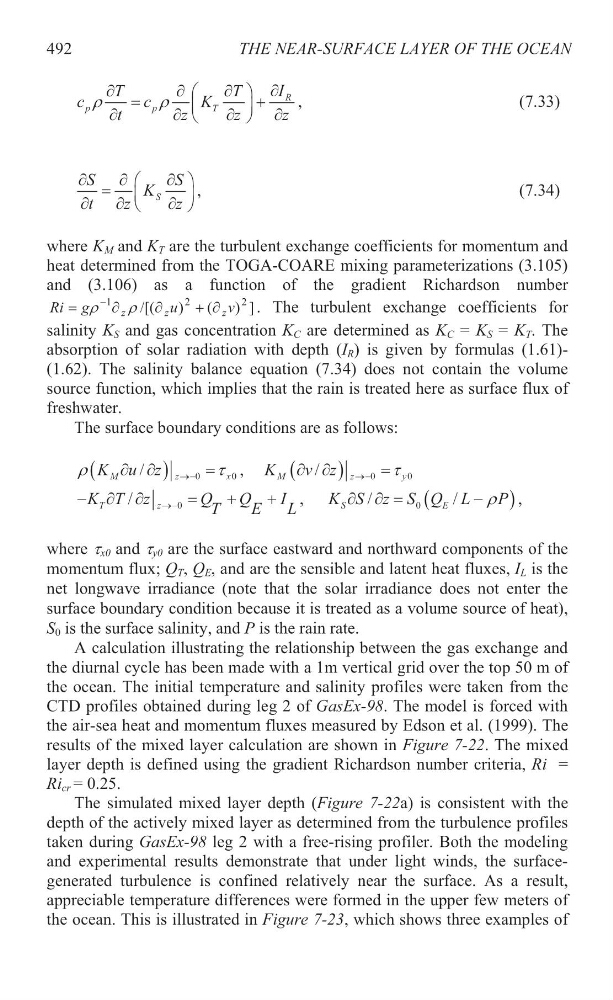
where K M and K T are the turbulent exchange coefficients for momentum and
heat determined from the TOGA-COARE mixing parameterizations (3.105)
and (3.106) as a function of the gradient Richardson number
]
)
(
)
/[(
2
2
1
v
u
g
Ri
z
z
z
w
w
w
U
U
. The turbulent exchange coefficients for
salinity K S and gas concentration K C are determined as K C = K S = K T . The
absorption of solar radiation with depth (I R ) is given by formulas (1.61)(1.62). The salinity balance equation (7.34) does not contain the volume
source function, which implies that the rain is treated here as surface flux of
freshwater.
The surface boundary conditions are as follows:
0 0
/
M
z
x
K u z
U
W
o
w w
,
0 0
/
M
z
y
K
v z
W
o
w w
0
/
T
z
K T z
Q
Q
I
T
E
L
o
w w
,
0
/
/
S
E
K S z S Q L
P
U
w w
,
where W x0 and W y0 are the surface eastward and northward components of the
momentum flux; Q T , Q E , and are the sensible and latent heat fluxes, I L is the
net longwave irradiance (note that the solar irradiance does not enter the
surface boundary condition because it is treated as a volume source of heat),
S 0 is the surface salinity, and P is the rain rate.
A calculation illustrating the relationship between the gas exchange and
the diurnal cycle has been made with a 1m vertical grid over the top 50 m of
the ocean. The initial temperature and salinity profiles were taken from the
CTD profiles obtained during leg 2 of GasEx-98. The model is forced with
the air-sea heat and momentum fluxes measured by Edson et al. (1999). The
results of the mixed layer calculation are shown in Figure 7-22. The mixed
layer depth is defined using the gradient Richardson number criteria, Ri =
Ri cr = 0.25.
The simulated mixed layer depth (Figure 7-22a) is consistent with the
depth of the actively mixed layer as determined from the turbulence profiles
taken during GasEx-98 leg 2 with a free-rising profiler. Both the modeling
and experimental results demonstrate that under light winds, the surfacegenerated turbulence is confined relatively near the surface. As a result,
appreciable temperature differences were formed in the upper few meters of
the ocean. This is illustrated in Figure 7-23, which shows three examples of
492
R
p
p
T
I
T
T
c
c
K
t
z
z
z
U
U
w
w
w
w
§
·
¨
¸
w
w
w
w
©
¹
,
(7.33)
S
S
S
K
t
z
z
w
w
w
§
·
¨
¸
w
w
w
©
¹
,
(7.34)
where K M and K T are the turbulent exchange coefficients for momentum and
heat determined from the TOGA-COARE mixing parameterizations (3.105)
and (3.106) as a function of the gradient Richardson number
]
)
(
)
/[(
2
2
1
v
u
g
Ri
z
z
z
w
w
w
U
U
. The turbulent exchange coefficients for
salinity K S and gas concentration K C are determined as K C = K S = K T . The
absorption of solar radiation with depth (I R ) is given by formulas (1.61)(1.62). The salinity balance equation (7.34) does not contain the volume
source function, which implies that the rain is treated here as surface flux of
freshwater.
The surface boundary conditions are as follows:
0 0
/
M
z
x
K u z
U
W
o
w w
,
0 0
/
M
z
y
K
v z
W
o
w w
0
/
T
z
K T z
Q
Q
I
T
E
L
o
w w
,
0
/
/
S
E
K S z S Q L
P
U
w w
,
where W x0 and W y0 are the surface eastward and northward components of the
momentum flux; Q T , Q E , and are the sensible and latent heat fluxes, I L is the
net longwave irradiance (note that the solar irradiance does not enter the
surface boundary condition because it is treated as a volume source of heat),
S 0 is the surface salinity, and P is the rain rate.
A calculation illustrating the relationship between the gas exchange and
the diurnal cycle has been made with a 1m vertical grid over the top 50 m of
the ocean. The initial temperature and salinity profiles were taken from the
CTD profiles obtained during leg 2 of GasEx-98. The model is forced with
the air-sea heat and momentum fluxes measured by Edson et al. (1999). The
results of the mixed layer calculation are shown in Figure 7-22. The mixed
layer depth is defined using the gradient Richardson number criteria, Ri =
Ri cr = 0.25.
The simulated mixed layer depth (Figure 7-22a) is consistent with the
depth of the actively mixed layer as determined from the turbulence profiles
taken during GasEx-98 leg 2 with a free-rising profiler. Both the modeling
and experimental results demonstrate that under light winds, the surfacegenerated turbulence is confined relatively near the surface. As a result,
appreciable temperature differences were formed in the upper few meters of
the ocean. This is illustrated in Figure 7-23, which shows three examples of
492