

THE NEAR-SURFACE LAYER OF THE OCEAN
Measuring high-resolution pCO 2 profiles near the surface is still a
challenge. At the same time, some of the dissolved oxygen sensor designs are
able to resolve fine near-surface features associated with the diurnal cycle
under low wind speed conditions. Atkinson et al. (1987) and Soloviev et al.
(2002) reported significant O 2 concentration differences associated with the
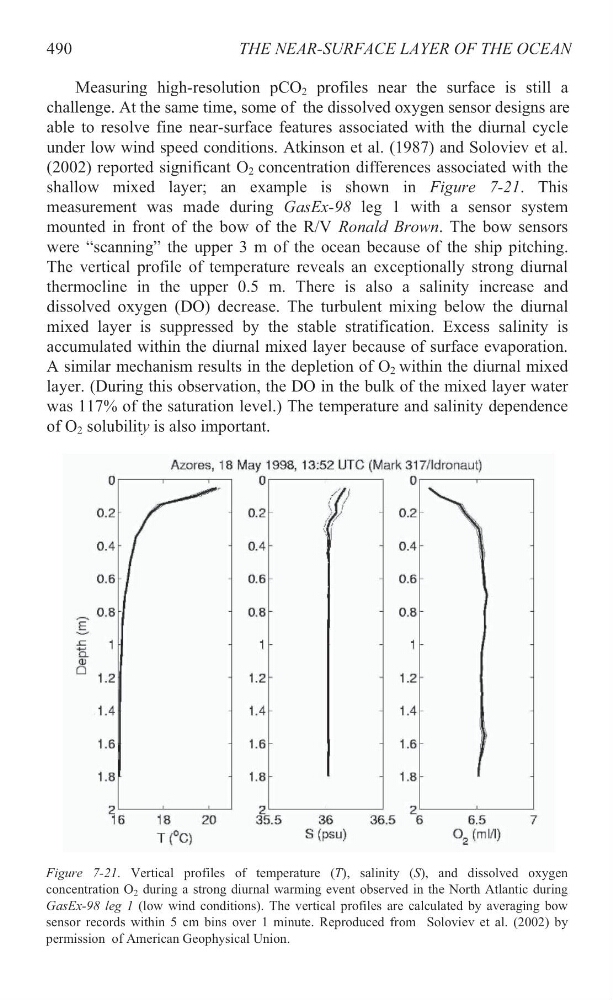
shallow mixed layer; an example is shown in Figure 7-21. This
measurement was made during GasEx-98 leg 1 with a sensor system
mounted in front of the bow of the R/V Ronald Brown. The bow sensors
were “scanning” the upper 3 m of the ocean because of the ship pitching.
The vertical profile of temperature reveals an exceptionally strong diurnal
thermocline in the upper 0.5 m. There is also a salinity increase and
dissolved oxygen (DO) decrease. The turbulent mixing below the diurnal
mixed layer is suppressed by the stable stratification. Excess salinity is
accumulated within the diurnal mixed layer because of surface evaporation.
A similar mechanism results in the depletion of O 2 within the diurnal mixed
layer. (During this observation, the DO in the bulk of the mixed layer water
was 117% of the saturation level.) The temperature and salinity dependence
of O 2 solubility is also important.
490
Figure 7-21. Vertical profiles of temperature (T), salinity (S), and dissolved oxygen
concentration O 2 during a strong diurnal warming event observed in the North Atlantic during
GasEx-98 leg 1 (low wind conditions). The vertical profiles are calculated by averaging bow
sensor records within 5 cm bins over 1 minute. Reproduced from Soloviev et al. (2002) by
permission of American Geophysical Union.
Measuring high-resolution pCO 2 profiles near the surface is still a
challenge. At the same time, some of the dissolved oxygen sensor designs are
able to resolve fine near-surface features associated with the diurnal cycle
under low wind speed conditions. Atkinson et al. (1987) and Soloviev et al.
(2002) reported significant O 2 concentration differences associated with the
shallow mixed layer; an example is shown in Figure 7-21. This
measurement was made during GasEx-98 leg 1 with a sensor system
mounted in front of the bow of the R/V Ronald Brown. The bow sensors
were “scanning” the upper 3 m of the ocean because of the ship pitching.
The vertical profile of temperature reveals an exceptionally strong diurnal
thermocline in the upper 0.5 m. There is also a salinity increase and
dissolved oxygen (DO) decrease. The turbulent mixing below the diurnal
mixed layer is suppressed by the stable stratification. Excess salinity is
accumulated within the diurnal mixed layer because of surface evaporation.
A similar mechanism results in the depletion of O 2 within the diurnal mixed
layer. (During this observation, the DO in the bulk of the mixed layer water
was 117% of the saturation level.) The temperature and salinity dependence
of O 2 solubility is also important.
490
Figure 7-21. Vertical profiles of temperature (T), salinity (S), and dissolved oxygen
concentration O 2 during a strong diurnal warming event observed in the North Atlantic during
GasEx-98 leg 1 (low wind conditions). The vertical profiles are calculated by averaging bow
sensor records within 5 cm bins over 1 minute. Reproduced from Soloviev et al. (2002) by
permission of American Geophysical Union.