

THE NEAR-SURFACE LAYER OF THE OCEAN
rain-formed halocline may lead to a distortion of the acoustic signal and to
its intensity fluctuations. In the process of sound scattering by the fine
structure and microstructure, the contribution of temperature
inhomogeneities usually dominates over the effect of salinity and velocity
fluctuations. The sound speed dependence on salinity and velocity are
second order effects in the ocean compared to that of temperature.
Thin, concentrated layers of phytoplankton and zooplankton sometimes
occurring in the near-surface layer of the ocean (see Section 7.3) can
effectively scatter and absorb acoustic signals. Air bubbles also substantially
contribute to sound scatter, absorption, and noise generation. High
concentration of bubbles is observed in the near-surface layer of the ocean
below breaking waves and in ship wakes. The actions of wave breaking and
bubble production generate easily detectable ambient noise that has been
used as a signal to determine variables such as wind speed and rain rate. This
noise can strongly degrade the performance of Navy systems that attempt to
detect unnatural acoustic signatures or map objects using acoustics.
7.4.1 Effects of stratification
Under light winds, fine structure and microstructure can develop in the
near-surface layer of the ocean due to solar warming and rainfalls. Local
gradients of temperature and salinity may have significant magnitudes (see
Chapter 4). In such a medium, sound speed may fluctuate along the acoustic
path. Orbital motions due to surface wave action cause undulation of
inhomogeneities in temperature and salinity, which cause phase changes in
the sound propagation near the surface. The near-surface stratification is
believed to affect the horizontal propagation more than vertical propagation
of sound in the ocean.
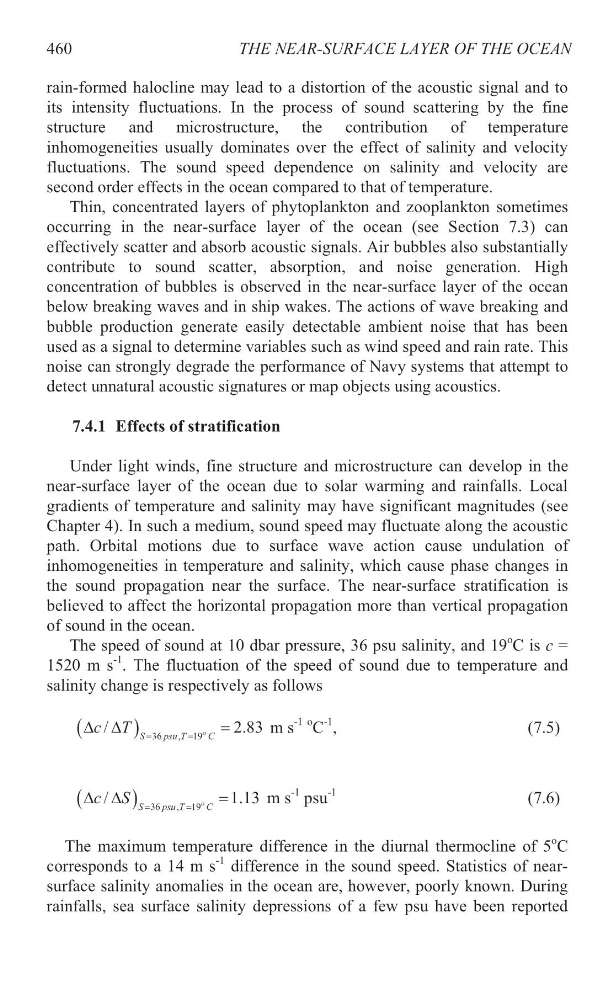
The speed of sound at 10 dbar pressure, 36 psu salinity, and 19
o C is c =
1520 m s
-1 . The fluctuation of the speed of sound due to temperature and
salinity change is respectively as follows
36 , 19
/
2 . 8 3
o
S
p s uT
C
c T
' '
m s
-1 o C
-1 ,
(7.5)
36 , 19
/
1 . 1 3
o
S
p s uT
C
c S
' '
m s
-1 psu
-1
(7.6)
The maximum temperature difference in the diurnal thermocline of 5
o C
corresponds to a 14 m s
-1 difference in the sound speed. Statistics of nearsurface salinity anomalies in the ocean are, however, poorly known. During
rainfalls, sea surface salinity depressions of a few psu have been reported
460
rain-formed halocline may lead to a distortion of the acoustic signal and to
its intensity fluctuations. In the process of sound scattering by the fine
structure and microstructure, the contribution of temperature
inhomogeneities usually dominates over the effect of salinity and velocity
fluctuations. The sound speed dependence on salinity and velocity are
second order effects in the ocean compared to that of temperature.
Thin, concentrated layers of phytoplankton and zooplankton sometimes
occurring in the near-surface layer of the ocean (see Section 7.3) can
effectively scatter and absorb acoustic signals. Air bubbles also substantially
contribute to sound scatter, absorption, and noise generation. High
concentration of bubbles is observed in the near-surface layer of the ocean
below breaking waves and in ship wakes. The actions of wave breaking and
bubble production generate easily detectable ambient noise that has been
used as a signal to determine variables such as wind speed and rain rate. This
noise can strongly degrade the performance of Navy systems that attempt to
detect unnatural acoustic signatures or map objects using acoustics.
7.4.1 Effects of stratification
Under light winds, fine structure and microstructure can develop in the
near-surface layer of the ocean due to solar warming and rainfalls. Local
gradients of temperature and salinity may have significant magnitudes (see
Chapter 4). In such a medium, sound speed may fluctuate along the acoustic
path. Orbital motions due to surface wave action cause undulation of
inhomogeneities in temperature and salinity, which cause phase changes in
the sound propagation near the surface. The near-surface stratification is
believed to affect the horizontal propagation more than vertical propagation
of sound in the ocean.
The speed of sound at 10 dbar pressure, 36 psu salinity, and 19
o C is c =
1520 m s
-1 . The fluctuation of the speed of sound due to temperature and
salinity change is respectively as follows
36 , 19
/
2 . 8 3
o
S
p s uT
C
c T
' '
m s
-1 o C
-1 ,
(7.5)
36 , 19
/
1 . 1 3
o
S
p s uT
C
c S
' '
m s
-1 psu
-1
(7.6)
The maximum temperature difference in the diurnal thermocline of 5
o C
corresponds to a 14 m s
-1 difference in the sound speed. Statistics of nearsurface salinity anomalies in the ocean are, however, poorly known. During
rainfalls, sea surface salinity depressions of a few psu have been reported
460