

THE NEAR-SURFACE LAYER OF THE OCEAN
(measured acoustically) concentrated in the layer from 0 to 5 m, which was
above the marine snow layer (there was 4 times more zooplankton at 2 m
than within the marine snow layer at 6 m). Total zooplankton abundance
below the snow layer was increased compared to the marine snow layer but
still at about 1/3 to ½ of the abundance in the near-surface layer.
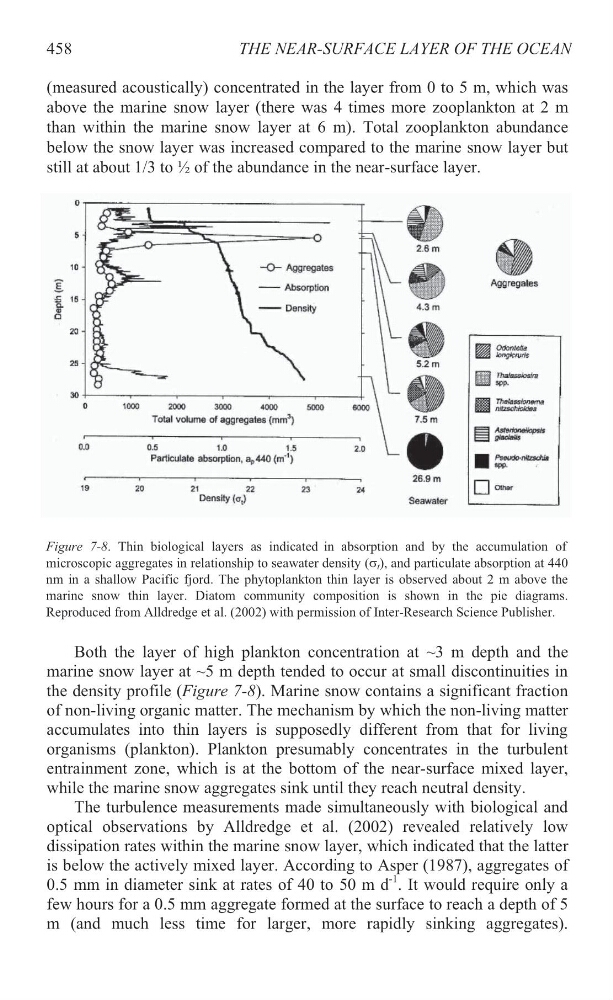
Both the layer of high plankton concentration at ~3 m depth and the
marine snow layer at ~5 m depth tended to occur at small discontinuities in
the density profile (Figure 7-8). Marine snow contains a significant fraction
of non-living organic matter. The mechanism by which the non-living matter
accumulates into thin layers is supposedly different from that for living
organisms (plankton). Plankton presumably concentrates in the turbulent
entrainment zone, which is at the bottom of the near-surface mixed layer,
while the marine snow aggregates sink until they reach neutral density.
The turbulence measurements made simultaneously with biological and
optical observations by Alldredge et al. (2002) revealed relatively low
dissipation rates within the marine snow layer, which indicated that the latter
is below the actively mixed layer. According to Asper (1987), aggregates of
0.5 mm in diameter sink at rates of 40 to 50 m d
-1 . It would require only a
few hours for a 0.5 mm aggregate formed at the surface to reach a depth of 5
m (and much less time for larger, more rapidly sinking aggregates).
458
Figure 7-8. Thin biological layers as indicated in absorption and by the accumulation of
microscopic aggregates in relationship to seawater density (V t ), and particulate absorption at 440
nm in a shallow Pacific fjord. The phytoplankton thin layer is observed about 2 m above the
marine snow thin layer. Diatom community composition is shown in the pie diagrams.
Reproduced from Alldredge et al. (2002) with permission of Inter-Research Science Publisher.
(measured acoustically) concentrated in the layer from 0 to 5 m, which was
above the marine snow layer (there was 4 times more zooplankton at 2 m
than within the marine snow layer at 6 m). Total zooplankton abundance
below the snow layer was increased compared to the marine snow layer but
still at about 1/3 to ½ of the abundance in the near-surface layer.
Both the layer of high plankton concentration at ~3 m depth and the
marine snow layer at ~5 m depth tended to occur at small discontinuities in
the density profile (Figure 7-8). Marine snow contains a significant fraction
of non-living organic matter. The mechanism by which the non-living matter
accumulates into thin layers is supposedly different from that for living
organisms (plankton). Plankton presumably concentrates in the turbulent
entrainment zone, which is at the bottom of the near-surface mixed layer,
while the marine snow aggregates sink until they reach neutral density.
The turbulence measurements made simultaneously with biological and
optical observations by Alldredge et al. (2002) revealed relatively low
dissipation rates within the marine snow layer, which indicated that the latter
is below the actively mixed layer. According to Asper (1987), aggregates of
0.5 mm in diameter sink at rates of 40 to 50 m d
-1 . It would require only a
few hours for a 0.5 mm aggregate formed at the surface to reach a depth of 5
m (and much less time for larger, more rapidly sinking aggregates).
458
Figure 7-8. Thin biological layers as indicated in absorption and by the accumulation of
microscopic aggregates in relationship to seawater density (V t ), and particulate absorption at 440
nm in a shallow Pacific fjord. The phytoplankton thin layer is observed about 2 m above the
marine snow thin layer. Diatom community composition is shown in the pie diagrams.
Reproduced from Alldredge et al. (2002) with permission of Inter-Research Science Publisher.