

Chapter 7: APPLICATIONS
Katsaros and DeCosmo (1990) hypothesized that the air-sea heat flux
could control the interface temperature and result in smoothing of spatial
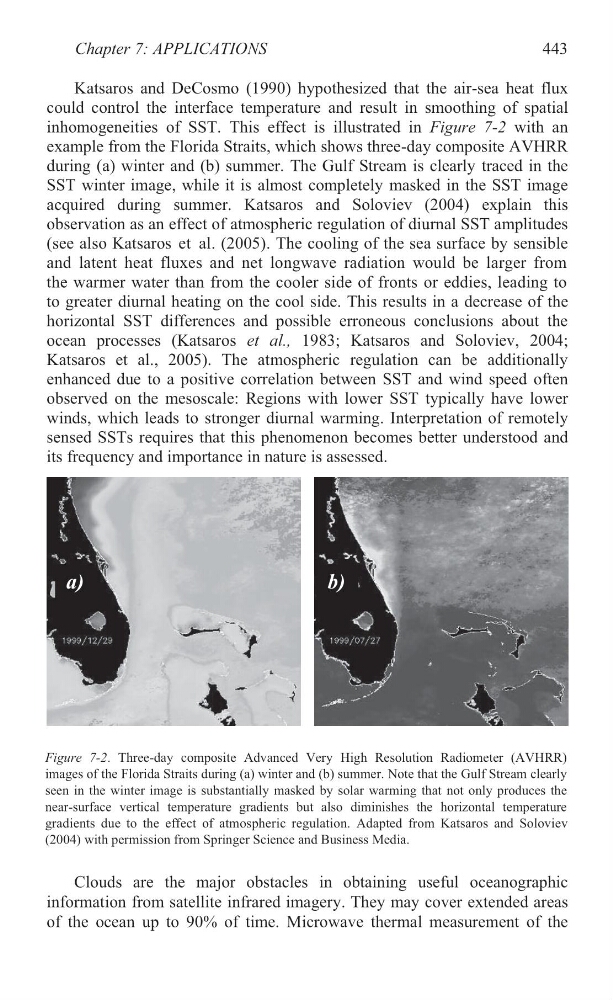
inhomogeneities of SST. This effect is illustrated in Figure 7-2 with an
example from the Florida Straits, which shows three-day composite AVHRR
during (a) winter and (b) summer. The Gulf Stream is clearly traced in the
SST winter image, while it is almost completely masked in the SST image
observation as an effect of atmospheric regulation of diurnal SST amplitudes
and latent heat fluxes and net longwave radiation would be larger from
the warmer water than from the cooler side of fronts or eddies, leading to
to greater diurnal heating on the cool side. This results in a decrease of the
horizontal SST differences and possible erroneous conclusions about the
Katsaros et al., 2005). The atmospheric regulation can be additionally
enhanced due to a positive correlation between SST and wind speed often
observed on the mesoscale: Regions with lower SST typically have lower
winds, which leads to stronger diurnal warming. Interpretation of remotely
sensed SSTs requires that this phenomenon becomes better understood and
its frequency and importance in nature is assessed.
Clouds are the major obstacles in obtaining useful oceanographic
information from satellite infrared imagery. They may cover extended areas
of the ocean up to 90% of time. Microwave thermal measurement of the
a)
b)
443
acquired during summer. Katsaros and Soloviev (2004) explain this
ocean processes (Katsaros et al., 1983; Katsaros and Soloviev, 2004;
(see also Katsaros et al. (2005). The cooling of the sea surface by sensible
Figure 7-2. Three-day composite Advanced Very High Resolution Radiometer (AVHRR)
images of the Florida Straits during (a) winter and (b) summer. Note that the Gulf Stream clearly
seen in the winter image is substantially masked by solar warming that not only produces the
near-surface vertical temperature gradients but also diminishes the horizontal temperature
gradients due to the effect of atmospheric regulation. Adapted from Katsaros and Soloviev
(2004) with permission from Springer Science and Business Media.
Katsaros and DeCosmo (1990) hypothesized that the air-sea heat flux
could control the interface temperature and result in smoothing of spatial
inhomogeneities of SST. This effect is illustrated in Figure 7-2 with an
example from the Florida Straits, which shows three-day composite AVHRR
during (a) winter and (b) summer. The Gulf Stream is clearly traced in the
SST winter image, while it is almost completely masked in the SST image
observation as an effect of atmospheric regulation of diurnal SST amplitudes
and latent heat fluxes and net longwave radiation would be larger from
the warmer water than from the cooler side of fronts or eddies, leading to
to greater diurnal heating on the cool side. This results in a decrease of the
horizontal SST differences and possible erroneous conclusions about the
Katsaros et al., 2005). The atmospheric regulation can be additionally
enhanced due to a positive correlation between SST and wind speed often
observed on the mesoscale: Regions with lower SST typically have lower
winds, which leads to stronger diurnal warming. Interpretation of remotely
sensed SSTs requires that this phenomenon becomes better understood and
its frequency and importance in nature is assessed.
Clouds are the major obstacles in obtaining useful oceanographic
information from satellite infrared imagery. They may cover extended areas
of the ocean up to 90% of time. Microwave thermal measurement of the
a)
b)
443
acquired during summer. Katsaros and Soloviev (2004) explain this
ocean processes (Katsaros et al., 1983; Katsaros and Soloviev, 2004;
(see also Katsaros et al. (2005). The cooling of the sea surface by sensible
Figure 7-2. Three-day composite Advanced Very High Resolution Radiometer (AVHRR)
images of the Florida Straits during (a) winter and (b) summer. Note that the Gulf Stream clearly
seen in the winter image is substantially masked by solar warming that not only produces the
near-surface vertical temperature gradients but also diminishes the horizontal temperature
gradients due to the effect of atmospheric regulation. Adapted from Katsaros and Soloviev
(2004) with permission from Springer Science and Business Media.