

Chapter 7: APPLICATIONS
direction continues both with phenomenological description and in
theoretical formulation.
The problem of inverting the backscattered radar signal into useful
information is related to 1) better understanding of how the various
parameters of wind speed and direction, atmospheric thermal stability, seasurface temperature (SST), salinity, currents, and bathymetry determine the
surface state, and 2) how the statistical properties of the sea surface can be
extracted from backscattered radar signal. The first issue is inherently related
to physics of the near-surface layer of the ocean. In particular, near-surface
turbulence (Chapter 3) and surface-intensified jets (Chapter 4) can affect
capillary-gravity waves and, thus, the sea surface roughness. These effects
may explain some discrepancies between theoretical and field results on
electromagnetic scattering from the sea surface and have yet to be
incorporated into remote sensing algorithms.
7.1.2 Sea surface temperature
Thermal infrared imagery from satellites is an important source of
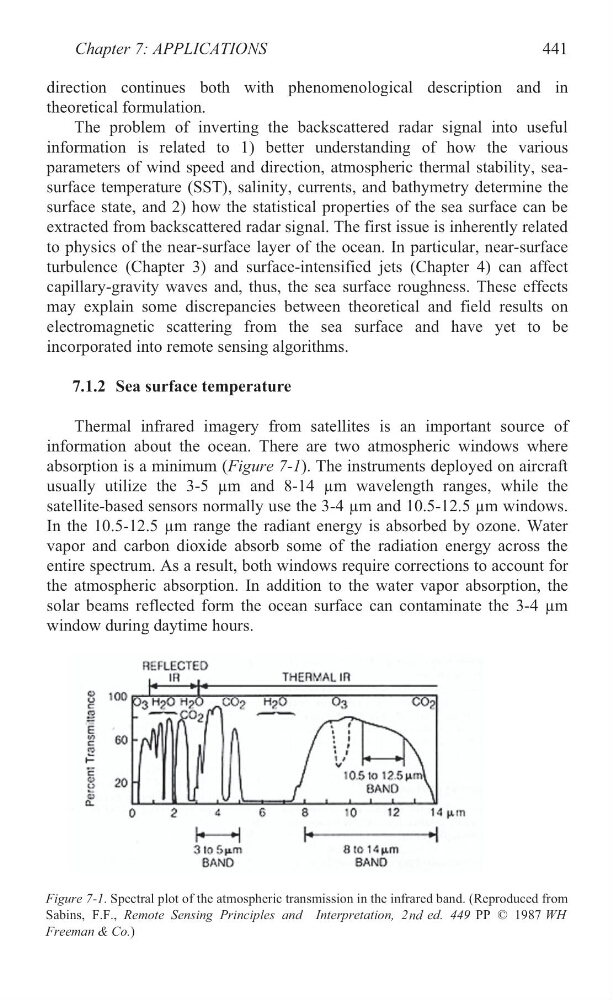
information about the ocean. There are two atmospheric windows where
absorption is a minimum (Figure 7-1). The instruments deployed on aircraft
usually utilize the 3-5 µm and 8-14 µm wavelength ranges, while the
satellite-based sensors normally use the 3-4 µm and 10.5-12.5 µm windows.
In the 10.5-12.5 µm range the radiant energy is absorbed by ozone. Water
vapor and carbon dioxide absorb some of the radiation energy across the
entire spectrum. As a result, both windows require corrections to account for
the atmospheric absorption. In addition to the water vapor absorption, the
solar beams reflected form the ocean surface can contaminate the 3-4 µm
window during daytime hours.
441
Figure 7-1. Spectral plot of the atmospheric transmission in the infrared band. (Reproduced from
ed. 449 PP © 1987 WH
Freeman & Co.)
Sabins, F.F., Remote Sensing Principles and Interpretation, 2nd
direction continues both with phenomenological description and in
theoretical formulation.
The problem of inverting the backscattered radar signal into useful
information is related to 1) better understanding of how the various
parameters of wind speed and direction, atmospheric thermal stability, seasurface temperature (SST), salinity, currents, and bathymetry determine the
surface state, and 2) how the statistical properties of the sea surface can be
extracted from backscattered radar signal. The first issue is inherently related
to physics of the near-surface layer of the ocean. In particular, near-surface
turbulence (Chapter 3) and surface-intensified jets (Chapter 4) can affect
capillary-gravity waves and, thus, the sea surface roughness. These effects
may explain some discrepancies between theoretical and field results on
electromagnetic scattering from the sea surface and have yet to be
incorporated into remote sensing algorithms.
7.1.2 Sea surface temperature
Thermal infrared imagery from satellites is an important source of
information about the ocean. There are two atmospheric windows where
absorption is a minimum (Figure 7-1). The instruments deployed on aircraft
usually utilize the 3-5 µm and 8-14 µm wavelength ranges, while the
satellite-based sensors normally use the 3-4 µm and 10.5-12.5 µm windows.
In the 10.5-12.5 µm range the radiant energy is absorbed by ozone. Water
vapor and carbon dioxide absorb some of the radiation energy across the
entire spectrum. As a result, both windows require corrections to account for
the atmospheric absorption. In addition to the water vapor absorption, the
solar beams reflected form the ocean surface can contaminate the 3-4 µm
window during daytime hours.
441
Figure 7-1. Spectral plot of the atmospheric transmission in the infrared band. (Reproduced from
ed. 449 PP © 1987 WH
Freeman & Co.)
Sabins, F.F., Remote Sensing Principles and Interpretation, 2nd