

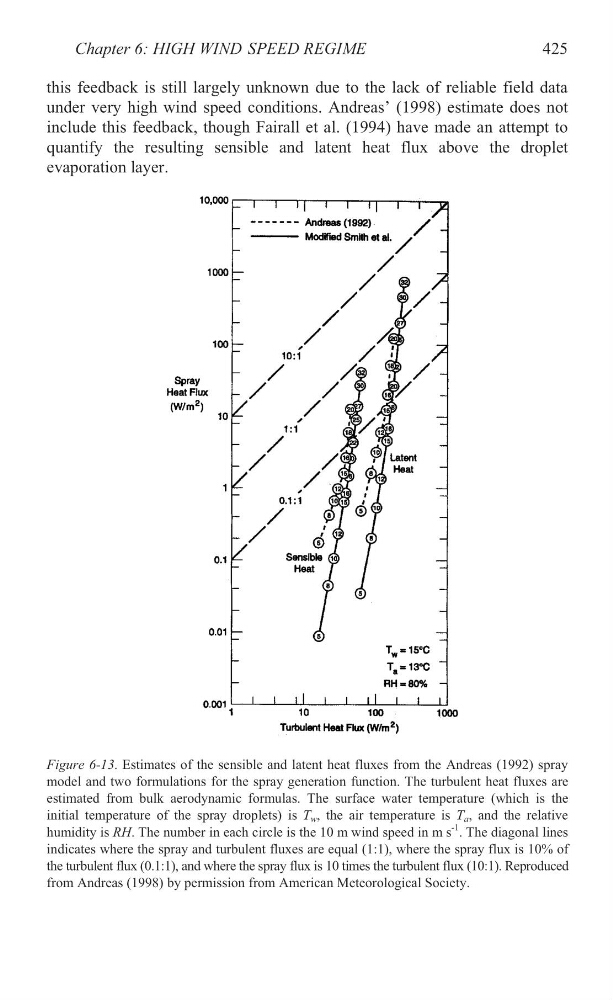
this feedback is still largely unknown due to the lack of reliable field data
under very high wind speed conditions. Andreas’ (1998) estimate does not
include this feedback, though Fairall et al. (1994) have made an attempt to
quantify the resulting sensible and latent heat flux above the droplet
evaporation layer.
Figure 6-13. Estimates of the sensible and latent heat fluxes from the Andreas (1992) spray
model and two formulations for the spray generation function. The turbulent heat fluxes are
estimated from bulk aerodynamic formulas. The surface water temperature (which is the
initial temperature of the spray droplets) is T w , the air temperature is T a , and the relative
humidity is RH. The number in each circle is the 10 m wind speed in m s
-1 . The diagonal lines
indicates where the spray and turbulent fluxes are equal (1:1), where the spray flux is 10% of
Chapter 6: HIGH WIND SPEED REGIME
425
the turbulent flux (0.1:1), and where the spray flux is 10 times the turbulent flux (10:1). Reproduced
from Andreas (1998) by permission from American Meteorological Society.
under very high wind speed conditions. Andreas’ (1998) estimate does not
include this feedback, though Fairall et al. (1994) have made an attempt to
quantify the resulting sensible and latent heat flux above the droplet
evaporation layer.
Figure 6-13. Estimates of the sensible and latent heat fluxes from the Andreas (1992) spray
model and two formulations for the spray generation function. The turbulent heat fluxes are
estimated from bulk aerodynamic formulas. The surface water temperature (which is the
initial temperature of the spray droplets) is T w , the air temperature is T a , and the relative
humidity is RH. The number in each circle is the 10 m wind speed in m s
-1 . The diagonal lines
indicates where the spray and turbulent fluxes are equal (1:1), where the spray flux is 10% of
Chapter 6: HIGH WIND SPEED REGIME
425
the turbulent flux (0.1:1), and where the spray flux is 10 times the turbulent flux (10:1). Reproduced
from Andreas (1998) by permission from American Meteorological Society.