

THE NEAR-SURFACE LAYER OF THE OCEAN
The predicted generation rates differ so greatly mainly due to the use of
different sets of droplet concentration data and differences in the
assumptions made regarding droplet trajectories. The process of droplet
evaporation also adds to the uncertainty. Ultimately, Andreas (1998)
discounts some of the parameterizations shown in Figure 6-9 based on
different grounds and ultimately focuses his analysis on the results of Smith
et al. (1993) and Monahan et al. (1986) to produce the following
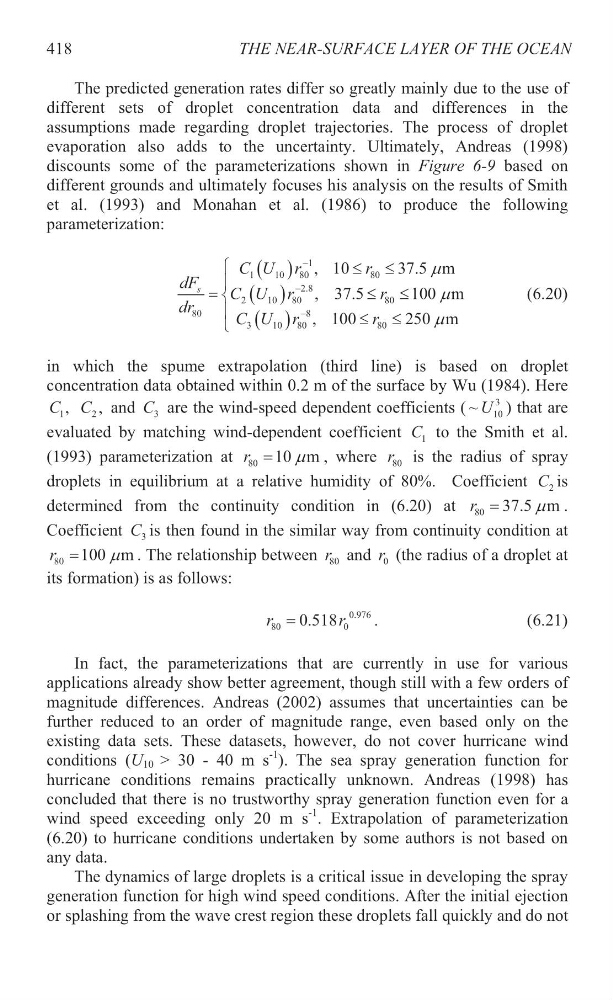
parameterization:
1
1
1 0
8 0
8 0
2.8
2
1 0
8 0
8 0
80
8
3
1 0
8 0
8 0
, 10
37.5 m
, 37.5
100 m
, 100
250 m
s
C U r
r
dF
C U r
r
dr
C U r
r
P
P
P
d d
°
d d
®
°
d d
¯
(6.20)
in which the spume extrapolation (third line) is based on droplet
concentration data obtained within 0.2 m of the surface by Wu (1984). Here
1 ,
C
2 ,
C and 3
C are the wind-speed dependent coefficients (
3
10
~ U ) that are
evaluated by matching wind-dependent coefficient 1
C to the Smith et al.
(1993) parameterization at 80 10 m
r
P , where 80
r is the radius of spray
droplets in equilibrium at a relative humidity of 80%. Coefficient 2
C is
determined from the continuity condition in (6.20) at 80 37.5 m
r
P .
Coefficient 3
C is then found in the similar way from continuity condition at
80
100 m
r
P . The relationship between 80
r and 0
r (the radius of a droplet at
its formation) is as follows:
0.976
80
0
0.518
r
r
.
(6.21)
In fact, the parameterizations that are currently in use for various
applications already show better agreement, though still with a few orders of
magnitude differences. Andreas (2002) assumes that uncertainties can be
further reduced to an order of magnitude range, even based only on the
existing data sets. These datasets, however, do not cover hurricane wind
conditions (U 10 > 30 - 40 m s
-1 ). The sea spray generation function for
hurricane conditions remains practically unknown. Andreas (1998) has
concluded that there is no trustworthy spray generation function even for a
wind speed exceeding only 20 m s
-1 . Extrapolation of parameterization
(6.20) to hurricane conditions undertaken by some authors is not based on
any data.
The dynamics of large droplets is a critical issue in developing the spray
418
generation function for high wind speed conditions. After the initial ejection
or splashing from the wave crest region these droplets fall quickly and do not
The predicted generation rates differ so greatly mainly due to the use of
different sets of droplet concentration data and differences in the
assumptions made regarding droplet trajectories. The process of droplet
evaporation also adds to the uncertainty. Ultimately, Andreas (1998)
discounts some of the parameterizations shown in Figure 6-9 based on
different grounds and ultimately focuses his analysis on the results of Smith
et al. (1993) and Monahan et al. (1986) to produce the following
parameterization:
1
1
1 0
8 0
8 0
2.8
2
1 0
8 0
8 0
80
8
3
1 0
8 0
8 0
, 10
37.5 m
, 37.5
100 m
, 100
250 m
s
C U r
r
dF
C U r
r
dr
C U r
r
P
P
P
d d
°
d d
®
°
d d
¯
(6.20)
in which the spume extrapolation (third line) is based on droplet
concentration data obtained within 0.2 m of the surface by Wu (1984). Here
1 ,
C
2 ,
C and 3
C are the wind-speed dependent coefficients (
3
10
~ U ) that are
evaluated by matching wind-dependent coefficient 1
C to the Smith et al.
(1993) parameterization at 80 10 m
r
P , where 80
r is the radius of spray
droplets in equilibrium at a relative humidity of 80%. Coefficient 2
C is
determined from the continuity condition in (6.20) at 80 37.5 m
r
P .
Coefficient 3
C is then found in the similar way from continuity condition at
80
100 m
r
P . The relationship between 80
r and 0
r (the radius of a droplet at
its formation) is as follows:
0.976
80
0
0.518
r
r
.
(6.21)
In fact, the parameterizations that are currently in use for various
applications already show better agreement, though still with a few orders of
magnitude differences. Andreas (2002) assumes that uncertainties can be
further reduced to an order of magnitude range, even based only on the
existing data sets. These datasets, however, do not cover hurricane wind
conditions (U 10 > 30 - 40 m s
-1 ). The sea spray generation function for
hurricane conditions remains practically unknown. Andreas (1998) has
concluded that there is no trustworthy spray generation function even for a
wind speed exceeding only 20 m s
-1 . Extrapolation of parameterization
(6.20) to hurricane conditions undertaken by some authors is not based on
any data.
The dynamics of large droplets is a critical issue in developing the spray
418
generation function for high wind speed conditions. After the initial ejection
or splashing from the wave crest region these droplets fall quickly and do not