

THE NEAR-SURFACE LAYER OF THE OCEAN
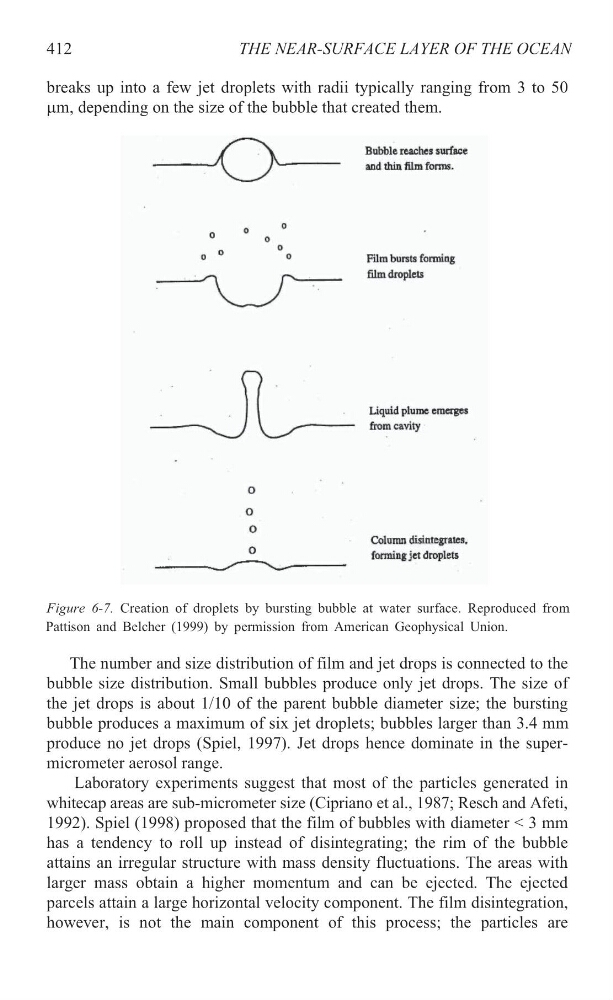
breaks up into a few jet droplets with radii typically ranging from 3 to 50
Pm, depending on the size of the bubble that created them.
The number and size distribution of film and jet drops is connected to the
bubble size distribution. Small bubbles produce only jet drops. The size of
the jet drops is about 1/10 of the parent bubble diameter size; the bursting
bubble produces a maximum of six jet droplets; bubbles larger than 3.4 mm
produce no jet drops (Spiel, 1997). Jet drops hence dominate in the supermicrometer aerosol range.
Laboratory experiments suggest that most of the particles generated in
1992). Spiel (1998) proposed that the film of bubbles with diameter < 3 mm
has a tendency to roll up instead of disintegrating; the rim of the bubble
attains an irregular structure with mass density fluctuations. The areas with
larger mass obtain a higher momentum and can be ejected. The ejected
parcels attain a large horizontal velocity component. The film disintegration,
however, is not the main component of this process; the particles are
412
whitecap areas are sub-micrometer size (Cipriano et al., 1987; Resch and Afeti,
Figure 6-7. Creation of droplets by bursting bubble at water surface. Reproduced from
Pattison and Belcher (1999) by permission from American Geophysical Union.
breaks up into a few jet droplets with radii typically ranging from 3 to 50
Pm, depending on the size of the bubble that created them.
The number and size distribution of film and jet drops is connected to the
bubble size distribution. Small bubbles produce only jet drops. The size of
the jet drops is about 1/10 of the parent bubble diameter size; the bursting
bubble produces a maximum of six jet droplets; bubbles larger than 3.4 mm
produce no jet drops (Spiel, 1997). Jet drops hence dominate in the supermicrometer aerosol range.
Laboratory experiments suggest that most of the particles generated in
1992). Spiel (1998) proposed that the film of bubbles with diameter < 3 mm
has a tendency to roll up instead of disintegrating; the rim of the bubble
attains an irregular structure with mass density fluctuations. The areas with
larger mass obtain a higher momentum and can be ejected. The ejected
parcels attain a large horizontal velocity component. The film disintegration,
however, is not the main component of this process; the particles are
412
whitecap areas are sub-micrometer size (Cipriano et al., 1987; Resch and Afeti,
Figure 6-7. Creation of droplets by bursting bubble at water surface. Reproduced from
Pattison and Belcher (1999) by permission from American Geophysical Union.