

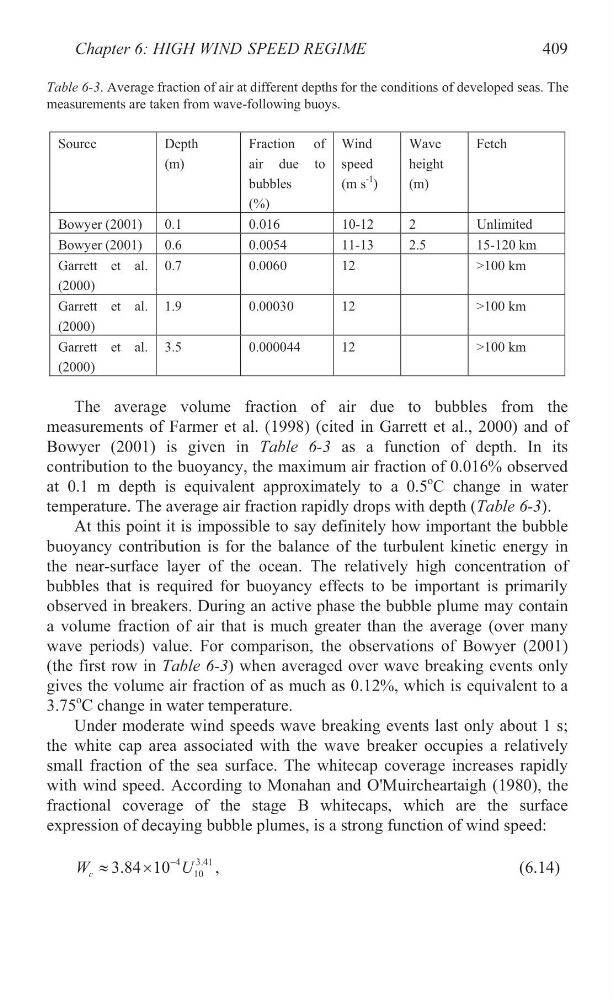
Table 6-3. Average fraction of air at different depths for the conditions of developed seas. The
measurements are taken from wave-following buoys.
Source
Depth
(m)
Fraction of
air due to
bubbles
(%)
Wind
speed
(m s
-1
)
Wave
height
(m)
Fetch
Bowyer (2001)
0.1
0.016
10-12
2
Unlimited
Bowyer (2001)
0.6
0.0054
11-13
2.5
15-120 km
Garrett et al.
(2000)
0.7
0.0060
12
>100 km
Garrett et al.
(2000)
1.9
0.00030
12
>100 km
Garrett et al.
(2000)
3.5
0.000044
12
>100 km
The average volume fraction of air due to bubbles from the
measurements of Farmer et al. (1998) (cited in Garrett et al., 2000) and of
Bowyer (2001) is given in Table 6-3 as a function of depth. In its
contribution to the buoyancy, the maximum air fraction of 0.016% observed
at 0.1 m depth is equivalent approximately to a 0.5
o C change in water
temperature. The average air fraction rapidly drops with depth (Table 6-3).
At this point it is impossible to say definitely how important the bubble
buoyancy contribution is for the balance of the turbulent kinetic energy in
the near-surface layer of the ocean. The relatively high concentration of
bubbles that is required for buoyancy effects to be important is primarily
observed in breakers. During an active phase the bubble plume may contain
a volume fraction of air that is much greater than the average (over many
wave periods) value. For comparison, the observations of Bowyer (2001)
(the first row in Table 6-3) when averaged over wave breaking events only
gives the volume air fraction of as much as 0.12%, which is equivalent to a
3.75
o C change in water temperature.
Under moderate wind speeds wave breaking events last only about 1 s;
the white cap area associated with the wave breaker occupies a relatively
small fraction of the sea surface. The whitecap coverage increases rapidly
with wind speed. According to Monahan and O'Muircheartaigh (1980), the
fractional coverage of the stage B whitecaps, which are the surface
expression of decaying bubble plumes, is a strong function of wind speed:
4
3.41
10
3.84 10
c
W
U
|
u
,
(6.14)
Chapter 6: HIGH WIND SPEED REGIME
409
measurements are taken from wave-following buoys.
Source
Depth
(m)
Fraction of
air due to
bubbles
(%)
Wind
speed
(m s
-1
)
Wave
height
(m)
Fetch
Bowyer (2001)
0.1
0.016
10-12
2
Unlimited
Bowyer (2001)
0.6
0.0054
11-13
2.5
15-120 km
Garrett et al.
(2000)
0.7
0.0060
12
>100 km
Garrett et al.
(2000)
1.9
0.00030
12
>100 km
Garrett et al.
(2000)
3.5
0.000044
12
>100 km
The average volume fraction of air due to bubbles from the
measurements of Farmer et al. (1998) (cited in Garrett et al., 2000) and of
Bowyer (2001) is given in Table 6-3 as a function of depth. In its
contribution to the buoyancy, the maximum air fraction of 0.016% observed
at 0.1 m depth is equivalent approximately to a 0.5
o C change in water
temperature. The average air fraction rapidly drops with depth (Table 6-3).
At this point it is impossible to say definitely how important the bubble
buoyancy contribution is for the balance of the turbulent kinetic energy in
the near-surface layer of the ocean. The relatively high concentration of
bubbles that is required for buoyancy effects to be important is primarily
observed in breakers. During an active phase the bubble plume may contain
a volume fraction of air that is much greater than the average (over many
wave periods) value. For comparison, the observations of Bowyer (2001)
(the first row in Table 6-3) when averaged over wave breaking events only
gives the volume air fraction of as much as 0.12%, which is equivalent to a
3.75
o C change in water temperature.
Under moderate wind speeds wave breaking events last only about 1 s;
the white cap area associated with the wave breaker occupies a relatively
small fraction of the sea surface. The whitecap coverage increases rapidly
with wind speed. According to Monahan and O'Muircheartaigh (1980), the
fractional coverage of the stage B whitecaps, which are the surface
expression of decaying bubble plumes, is a strong function of wind speed:
4
3.41
10
3.84 10
c
W
U
|
u
,
(6.14)
Chapter 6: HIGH WIND SPEED REGIME
409