

THE NEAR-SURFACE LAYER OF THE OCEAN
The important factor in bubble hydrodynamics is the presence of
surfactants, which can partially immobilize the surface, increasing drag and
decreasing rise velocity. In the bubble radii range from approximately 0.25
mm to 10 mm, clean bubbles have different hydrodynamics from dirty (i.e.,
surfactant covered) bubbles.
Thorpe (1982) proposed a formula for the buoyant rise speed of bubbles:
2
1/ 2
2
2
2
9
b
r g
w r
y
y
y
Q
§
· ª
º
¨
¸ «
»
¬
¼
©
¹
,
(6.1)
where
2
3
10.82 /
y
g r
Q
. This equation is derived for dirty bubbles
(small bubbles become covered with surfactants within a short time period).
Patro et al. (2001) proposed an analytical parameterization formula for
clean non-oscillating bubbles:
3
d n
b
c
w
gr Q ,
(6.2)
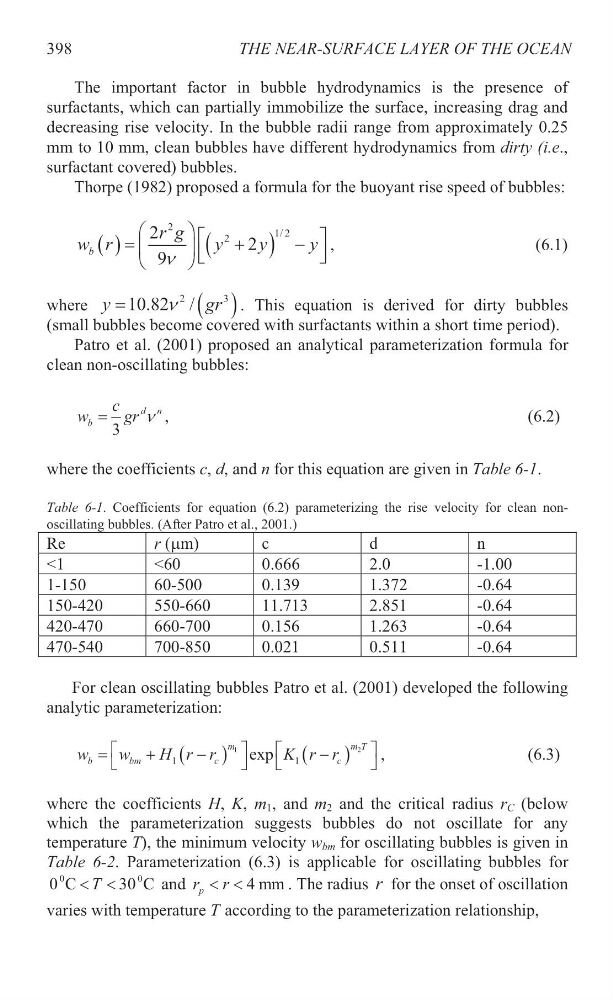
where the coefficients c, d, and n for this equation are given in Table 6-1.
Table 6-1. Coefficients for equation (6.2) parameterizing the rise velocity for clean nonoscillating bubbles. (After Patro et al., 2001.)
Re
r (Pm)
c
d
n
<1
<60
0.666
2.0
-1.00
1-150
60-500
0.139
1.372
-0.64
150-420
550-660
11.713
2.851
-0.64
420-470
660-700
0.156
1.263
-0.64
470-540
700-850
0.021
0.511
-0.64
For clean oscillating bubbles Patro et al. (2001) developed the following
analytic parameterization:
1
2
1
1
exp
m
m T
b
b m
c
c
w
w
H r r
K r r
ª
º
ª
º
¬
¼
¬
¼
,
(6.3)
where the coefficients H, K, m 1 , and m 2 and the critical radius r C (below
which the parameterization suggests bubbles do not oscillate for any
temperature T), the minimum velocity w bm for oscillating bubbles is given in
Table 6-2. Parameterization (6.3) is applicable for oscillating bubbles for
0
0
0 C
30 C
T
and
4 mm
p
r r
. The radius r for the onset of oscillation
varies with temperature T according to the parameterization relationship,
398
The important factor in bubble hydrodynamics is the presence of
surfactants, which can partially immobilize the surface, increasing drag and
decreasing rise velocity. In the bubble radii range from approximately 0.25
mm to 10 mm, clean bubbles have different hydrodynamics from dirty (i.e.,
surfactant covered) bubbles.
Thorpe (1982) proposed a formula for the buoyant rise speed of bubbles:
2
1/ 2
2
2
2
9
b
r g
w r
y
y
y
Q
§
· ª
º
¨
¸ «
»
¬
¼
©
¹
,
(6.1)
where
2
3
10.82 /
y
g r
Q
. This equation is derived for dirty bubbles
(small bubbles become covered with surfactants within a short time period).
Patro et al. (2001) proposed an analytical parameterization formula for
clean non-oscillating bubbles:
3
d n
b
c
w
gr Q ,
(6.2)
where the coefficients c, d, and n for this equation are given in Table 6-1.
Table 6-1. Coefficients for equation (6.2) parameterizing the rise velocity for clean nonoscillating bubbles. (After Patro et al., 2001.)
Re
r (Pm)
c
d
n
<1
<60
0.666
2.0
-1.00
1-150
60-500
0.139
1.372
-0.64
150-420
550-660
11.713
2.851
-0.64
420-470
660-700
0.156
1.263
-0.64
470-540
700-850
0.021
0.511
-0.64
For clean oscillating bubbles Patro et al. (2001) developed the following
analytic parameterization:
1
2
1
1
exp
m
m T
b
b m
c
c
w
w
H r r
K r r
ª
º
ª
º
¬
¼
¬
¼
,
(6.3)
where the coefficients H, K, m 1 , and m 2 and the critical radius r C (below
which the parameterization suggests bubbles do not oscillate for any
temperature T), the minimum velocity w bm for oscillating bubbles is given in
Table 6-2. Parameterization (6.3) is applicable for oscillating bubbles for
0
0
0 C
30 C
T
and
4 mm
p
r r
. The radius r for the onset of oscillation
varies with temperature T according to the parameterization relationship,
398