

Chapter 5. SPATIALLY-COHERENT STRUCTURES
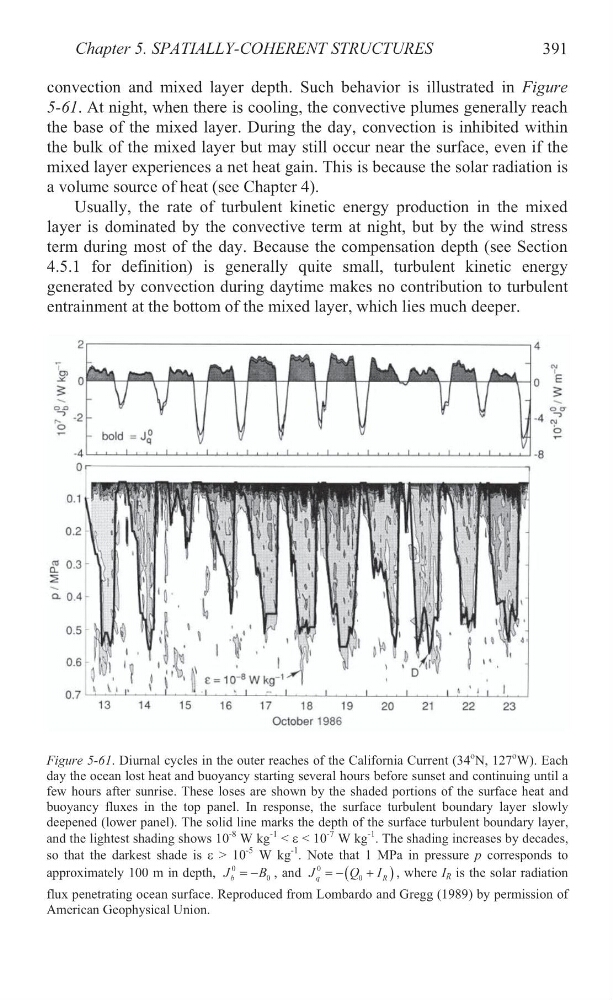
convection and mixed layer depth. Such behavior is illustrated in Figure
5-61. At night, when there is cooling, the convective plumes generally reach
the base of the mixed layer. During the day, convection is inhibited within
the bulk of the mixed layer but may still occur near the surface, even if the
mixed layer experiences a net heat gain. This is because the solar radiation is
a volume source of heat (see Chapter 4).
Usually, the rate of turbulent kinetic energy production in the mixed
layer is dominated by the convective term at night, but by the wind stress
term during most of the day. Because the compensation depth (see Section
4.5.1 for definition) is generally quite small, turbulent kinetic energy
generated by convection during daytime makes no contribution to turbulent
entrainment at the bottom of the mixed layer, which lies much deeper.
391
Figure 5-61. Diurnal cycles in the outer reaches of the California Current (34
o N, 127
o W). Each
day the ocean lost heat and buoyancy starting several hours before sunset and continuing until a
few hours after sunrise. These loses are shown by the shaded portions of the surface heat and
buoyancy fluxes in the top panel. In response, the surface turbulent boundary layer slowly
deepened (lower panel). The solid line marks the depth of the surface turbulent boundary layer,
and the lightest shading shows 10
-8 W kg
-1 < H < 10
-7 W kg
-1 . The shading increases by decades,
so that the darkest shade is H > 10
-5 W kg
-1 . Note that 1 MPa in pressure p corresponds to
approximately 100 m in depth,
0
0
b
J
B
, and
0
0
q
R
J
Q I
, where I R is the solar radiation
flux penetrating ocean surface. Reproduced from Lombardo and Gregg (1989) by permission of
American Geophysical Union.
convection and mixed layer depth. Such behavior is illustrated in Figure
5-61. At night, when there is cooling, the convective plumes generally reach
the base of the mixed layer. During the day, convection is inhibited within
the bulk of the mixed layer but may still occur near the surface, even if the
mixed layer experiences a net heat gain. This is because the solar radiation is
a volume source of heat (see Chapter 4).
Usually, the rate of turbulent kinetic energy production in the mixed
layer is dominated by the convective term at night, but by the wind stress
term during most of the day. Because the compensation depth (see Section
4.5.1 for definition) is generally quite small, turbulent kinetic energy
generated by convection during daytime makes no contribution to turbulent
entrainment at the bottom of the mixed layer, which lies much deeper.
391
Figure 5-61. Diurnal cycles in the outer reaches of the California Current (34
o N, 127
o W). Each
day the ocean lost heat and buoyancy starting several hours before sunset and continuing until a
few hours after sunrise. These loses are shown by the shaded portions of the surface heat and
buoyancy fluxes in the top panel. In response, the surface turbulent boundary layer slowly
deepened (lower panel). The solid line marks the depth of the surface turbulent boundary layer,
and the lightest shading shows 10
-8 W kg
-1 < H < 10
-7 W kg
-1 . The shading increases by decades,
so that the darkest shade is H > 10
-5 W kg
-1 . Note that 1 MPa in pressure p corresponds to
approximately 100 m in depth,
0
0
b
J
B
, and
0
0
q
R
J
Q I
, where I R is the solar radiation
flux penetrating ocean surface. Reproduced from Lombardo and Gregg (1989) by permission of
American Geophysical Union.