

THE NEAR-SURFACE LAYER OF THE OCEAN
Turbulent convection is usually characterized by the formation of
descending parcels of cold water. In laboratory experiments, it has been
found that water from the cooled surface layer collects along lines producing
thickened regions that become unstable and plunge in vertical sheets (Figure
5-58). In analogy to the atmospheric convection, we will call these parcels
thermals, although in contrast to the atmosphere, in the ocean they are colder
than the surrounding fluid. Howard (1966) formulated a phenomenological
theory that represented turbulent convection as the following cyclic process.
The thermal boundary layer forms by diffusion, grows until it is thick
enough to start convecting, and is destroyed by convection, which in turn
dies down once the boundary layer is destroyed. Then the cycle begins
again. This phenomenological theory has implications for the development
of parameterizations for the air-sea heat and gas exchange under low wind
speed conditions with a renewal model (see Chapter 2).
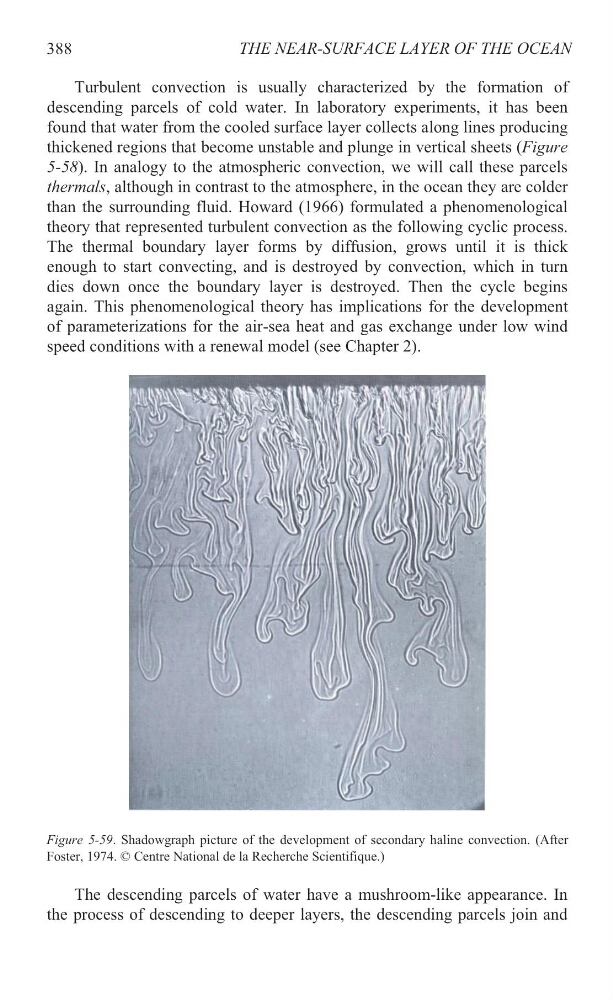
The descending parcels of water have a mushroom-like appearance. In
the process of descending to deeper layers, the descending parcels join and
388
Figure 5-59. Shadowgraph picture of the development of secondary haline convection. (After
Foster, 1974. © Centre National de la Recherche Scientifique.)
Turbulent convection is usually characterized by the formation of
descending parcels of cold water. In laboratory experiments, it has been
found that water from the cooled surface layer collects along lines producing
thickened regions that become unstable and plunge in vertical sheets (Figure
5-58). In analogy to the atmospheric convection, we will call these parcels
thermals, although in contrast to the atmosphere, in the ocean they are colder
than the surrounding fluid. Howard (1966) formulated a phenomenological
theory that represented turbulent convection as the following cyclic process.
The thermal boundary layer forms by diffusion, grows until it is thick
enough to start convecting, and is destroyed by convection, which in turn
dies down once the boundary layer is destroyed. Then the cycle begins
again. This phenomenological theory has implications for the development
of parameterizations for the air-sea heat and gas exchange under low wind
speed conditions with a renewal model (see Chapter 2).
The descending parcels of water have a mushroom-like appearance. In
the process of descending to deeper layers, the descending parcels join and
388
Figure 5-59. Shadowgraph picture of the development of secondary haline convection. (After
Foster, 1974. © Centre National de la Recherche Scientifique.)