

THE NEAR-SURFACE LAYER OF THE OCEAN
Clayson (2004) model are, however, only slightly higher than those for the
case without the Langmuir term. This new model constant introduced into
the mixing model has to be greater than unity to simulate the vigorous
mixing produced by Langmuir cells. Only in the case when E 6 is set as large
as 4 is the increase in the mixing coefficient of similar magnitude to that in
McWilliams et al. (1997) simulations. Such a high value of E 6 enables the
turbulence length scale (and hence the mixing) in the mixed layer to be
increased significantly in the presence of Langmuir cells. Though this seems
to be consistent with the fact that these cells are indeed large-scale
structures, there is no known physical basis to increase empirical constant E 6
so much. In fact, E 6 is expected to be of the order of magnitude of constants
E 1 or E 3 . If E 6 is of the order of unity, then the additional (Stokes) term in
equation (5.67) is unimportant.
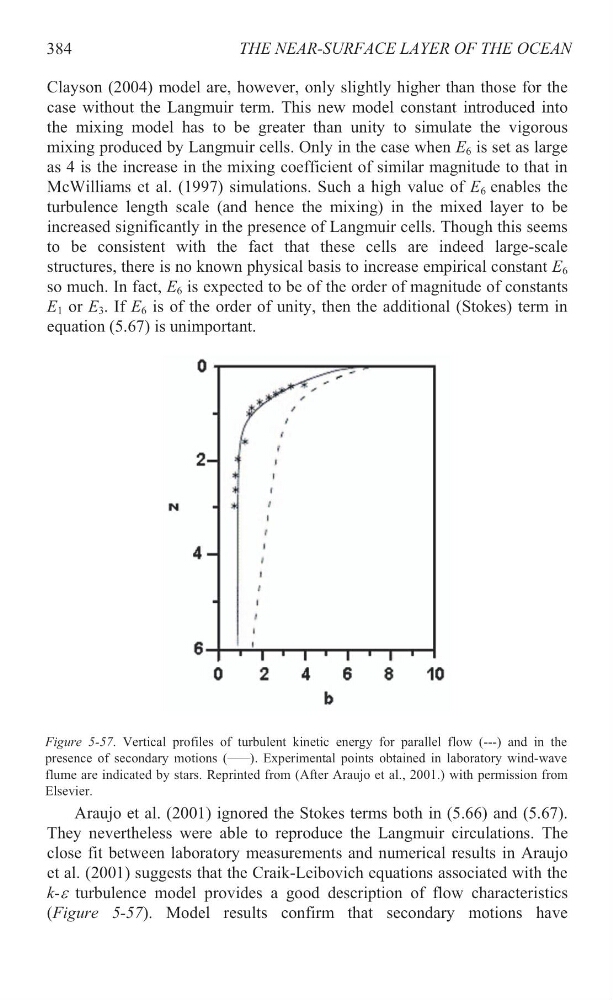
Araujo et al. (2001) ignored the Stokes terms both in (5.66) and (5.67).
They nevertheless were able to reproduce the Langmuir circulations. The
close fit between laboratory measurements and numerical results in Araujo
et al. (2001) suggests that the Craik-Leibovich equations associated with the
k-H turbulence model provides a good description of flow characteristics
(Figure 5-57). Model results confirm that secondary motions have
384
Figure 5-57. Vertical profiles of turbulent kinetic energy for parallel flow (---) and in the
presence of secondary motions (
_____ ). Experimental points obtained in laboratory wind-wave
flume are indicated by stars. Reprinted from (After Araujo et al., 2001.) with permission from
Elsevier.
Clayson (2004) model are, however, only slightly higher than those for the
case without the Langmuir term. This new model constant introduced into
the mixing model has to be greater than unity to simulate the vigorous
mixing produced by Langmuir cells. Only in the case when E 6 is set as large
as 4 is the increase in the mixing coefficient of similar magnitude to that in
McWilliams et al. (1997) simulations. Such a high value of E 6 enables the
turbulence length scale (and hence the mixing) in the mixed layer to be
increased significantly in the presence of Langmuir cells. Though this seems
to be consistent with the fact that these cells are indeed large-scale
structures, there is no known physical basis to increase empirical constant E 6
so much. In fact, E 6 is expected to be of the order of magnitude of constants
E 1 or E 3 . If E 6 is of the order of unity, then the additional (Stokes) term in
equation (5.67) is unimportant.
Araujo et al. (2001) ignored the Stokes terms both in (5.66) and (5.67).
They nevertheless were able to reproduce the Langmuir circulations. The
close fit between laboratory measurements and numerical results in Araujo
et al. (2001) suggests that the Craik-Leibovich equations associated with the
k-H turbulence model provides a good description of flow characteristics
(Figure 5-57). Model results confirm that secondary motions have
384
Figure 5-57. Vertical profiles of turbulent kinetic energy for parallel flow (---) and in the
presence of secondary motions (
_____ ). Experimental points obtained in laboratory wind-wave
flume are indicated by stars. Reprinted from (After Araujo et al., 2001.) with permission from
Elsevier.