

THE NEAR-SURFACE LAYER OF THE OCEAN
Figure 5-55 illustrates both the dynamics and kinematics of the CL2
mechanism. If a horizontally uniform current
u z has an infinitesimal
spanwise irregularity
, ,
u y z t , this produces vertical vorticity
/
z
u y
Z w w and a horizontal vortex-force component
S z
U
j
Z
G
. The
horizontal vortex-force component is then directed toward the planes of
maximum u. The converging horizontal forces cause acceleration toward
these planes, where, by continuity, the fluid must sink. Under the assumption
that
/
0
u z
w w !
and shear stresses are vanishing, conservation of xmomentum for a thin slab of fluid centered on the convergence plane shows
that as the fluid sinks, u must increase. Thus a current anomaly will lead to
convergence and therefore be amplified, which in turn further amplifies the
convergence. This positive feedback results in development of Langmuir
type circulations. Frictional effects are included in this conceptual
mechanism. A kinematic interpretation of the CL2 mechanism is that the
vertical vorticity is rotated and stretched by the Stokes drift, leading to
convergence and amplification of the anomaly (Leibovich, 1983).
Craik (1977) and Leibovich (1977b) suggested an interesting analogy
between the Langmuir instability induced in stably stratified flow and
turbulent flows in the regime of marginal stability. These authors concluded
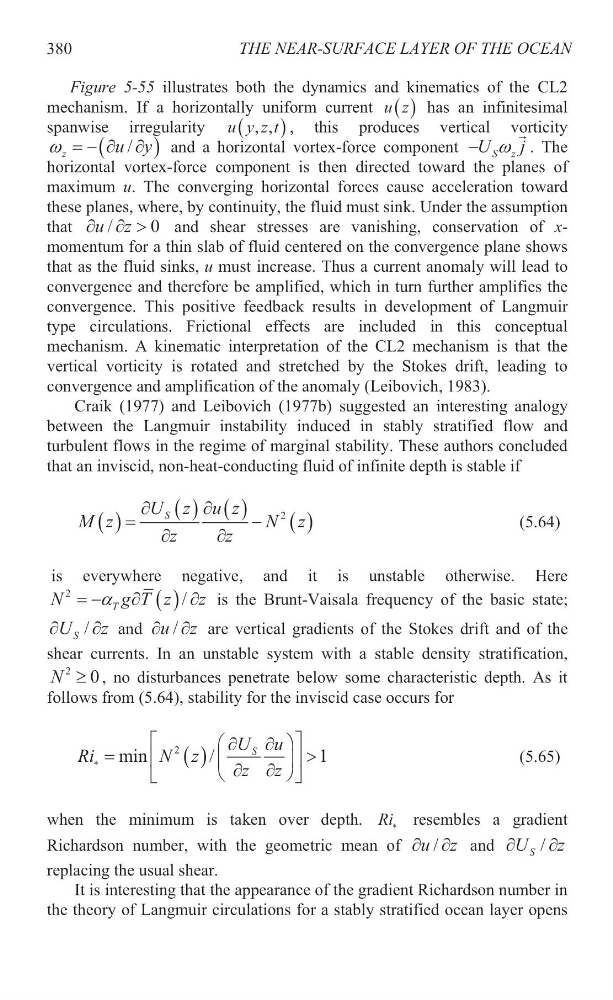
that an inviscid, non-heat-conducting fluid of infinite depth is stable if
2
S
U z u z
M z
N z
z
z
w
w
w
w
(5.64)
is everywhere negative, and it is unstable otherwise. Here
2
/
T
N
g T z z
D
w
w is the Brunt-Vaisala frequency of the basic state;
/
S
U
z
w
w and
/
u z
w w are vertical gradients of the Stokes drift and of the
shear currents. In an unstable system with a stable density stratification,
2
0
N t , no disturbances penetrate below some characteristic depth. As it
follows from (5.64), stability for the inviscid case occurs for
2
min
/
1
S
U u
Ri
N z
z z
ª
º
§
·
w
w
!
«
»
¨
¸
w w
©
¹
¬
¼
(5.65)
when the minimum is taken over depth. Ri resembles a gradient
Richardson number, with the geometric mean of
/
u z
w w and
/
S
U
z
w
w
replacing the usual shear.
It is interesting that the appearance of the gradient Richardson number in
the theory of Langmuir circulations for a stably stratified ocean layer opens
380
Figure 5-55 illustrates both the dynamics and kinematics of the CL2
mechanism. If a horizontally uniform current
u z has an infinitesimal
spanwise irregularity
, ,
u y z t , this produces vertical vorticity
/
z
u y
Z w w and a horizontal vortex-force component
S z
U
j
Z
G
. The
horizontal vortex-force component is then directed toward the planes of
maximum u. The converging horizontal forces cause acceleration toward
these planes, where, by continuity, the fluid must sink. Under the assumption
that
/
0
u z
w w !
and shear stresses are vanishing, conservation of xmomentum for a thin slab of fluid centered on the convergence plane shows
that as the fluid sinks, u must increase. Thus a current anomaly will lead to
convergence and therefore be amplified, which in turn further amplifies the
convergence. This positive feedback results in development of Langmuir
type circulations. Frictional effects are included in this conceptual
mechanism. A kinematic interpretation of the CL2 mechanism is that the
vertical vorticity is rotated and stretched by the Stokes drift, leading to
convergence and amplification of the anomaly (Leibovich, 1983).
Craik (1977) and Leibovich (1977b) suggested an interesting analogy
between the Langmuir instability induced in stably stratified flow and
turbulent flows in the regime of marginal stability. These authors concluded
that an inviscid, non-heat-conducting fluid of infinite depth is stable if
2
S
U z u z
M z
N z
z
z
w
w
w
w
(5.64)
is everywhere negative, and it is unstable otherwise. Here
2
/
T
N
g T z z
D
w
w is the Brunt-Vaisala frequency of the basic state;
/
S
U
z
w
w and
/
u z
w w are vertical gradients of the Stokes drift and of the
shear currents. In an unstable system with a stable density stratification,
2
0
N t , no disturbances penetrate below some characteristic depth. As it
follows from (5.64), stability for the inviscid case occurs for
2
min
/
1
S
U u
Ri
N z
z z
ª
º
§
·
w
w
!
«
»
¨
¸
w w
©
¹
¬
¼
(5.65)
when the minimum is taken over depth. Ri resembles a gradient
Richardson number, with the geometric mean of
/
u z
w w and
/
S
U
z
w
w
replacing the usual shear.
It is interesting that the appearance of the gradient Richardson number in
the theory of Langmuir circulations for a stably stratified ocean layer opens
380