

THE NEAR-SURFACE LAYER OF THE OCEAN
3) The resulting cells must have the possibility of an asymmetric
structure with downwelling speeds larger than upwelling speeds.
4) Downwelling zones must be under lines where the wind-directed
surface current is greatest.
5) The Langmuir circulations must have maximum downwelling speeds
comparable to the mean wind-directed surface drift.
Apparently, this checklist helped Craik and Leibovich to develop their
famous theory of Langmuir circulations.
5.7.2 Concepts and theories
Many mechanisms for Langmuir circulations have been proposed since
the publication of the pioneer work of Langmuir in 1938. An overview of the
early ideas concerning the mechanism of the Langmuir circulations can be
found in Leibovich (1983). Potentially important mechanisms can be
grouped as follows: 1) convection; 2) wind forcing; 3) action of surface
gravity waves; 4) joint influence of wind and waves. Most of these
mechanisms have been shown to be nonessential to or incompatible with the
phenomenon, and therefore have been dismissed. A combination of theories,
field, and laboratory observations pointed out an interaction between wave
motions and surface sheared currents as a mechanical cause for the
phenomenon.
In the 1970s, Garrett, Craik and Leibovich developed a theory capable of
predicting observable features of Langmuir circulations. The theory involved
the distortion of vortex lines in the current by the action of surface waves.
This theory was based upon a set of nonlinear equations derived from the
Navier-Stokes equations by perturbation procedure. Craik-Leibovich, or
“CL” theories described circulatory motions by two distinct theoretical
mechanisms, which are considered below. Both mechanisms depended on
wave-current interactions.
The orbital motion of irrotational surface gravity waves usually
dominates the instantaneous velocity field in the near-surface surface layer
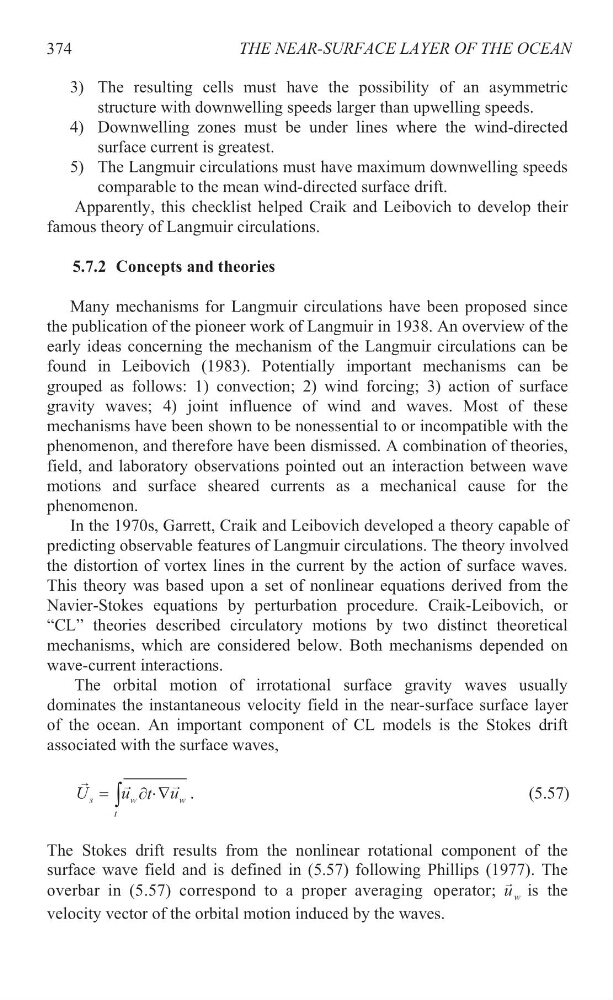
of the ocean. An important component of CL models is the Stokes drift
associated with the surface waves,
s
w
w
t
U
u
u
³
G
G
G .
(5.57)
The Stokes drift results from the nonlinear rotational component of the
surface wave field and is defined in (5.57) following Phillips (1977). The
w
G is the
velocity vector of the orbital motion induced by the waves.
374
t
w
overbar in (5.57) correspond to a proper averaging operator; u
3) The resulting cells must have the possibility of an asymmetric
structure with downwelling speeds larger than upwelling speeds.
4) Downwelling zones must be under lines where the wind-directed
surface current is greatest.
5) The Langmuir circulations must have maximum downwelling speeds
comparable to the mean wind-directed surface drift.
Apparently, this checklist helped Craik and Leibovich to develop their
famous theory of Langmuir circulations.
5.7.2 Concepts and theories
Many mechanisms for Langmuir circulations have been proposed since
the publication of the pioneer work of Langmuir in 1938. An overview of the
early ideas concerning the mechanism of the Langmuir circulations can be
found in Leibovich (1983). Potentially important mechanisms can be
grouped as follows: 1) convection; 2) wind forcing; 3) action of surface
gravity waves; 4) joint influence of wind and waves. Most of these
mechanisms have been shown to be nonessential to or incompatible with the
phenomenon, and therefore have been dismissed. A combination of theories,
field, and laboratory observations pointed out an interaction between wave
motions and surface sheared currents as a mechanical cause for the
phenomenon.
In the 1970s, Garrett, Craik and Leibovich developed a theory capable of
predicting observable features of Langmuir circulations. The theory involved
the distortion of vortex lines in the current by the action of surface waves.
This theory was based upon a set of nonlinear equations derived from the
Navier-Stokes equations by perturbation procedure. Craik-Leibovich, or
“CL” theories described circulatory motions by two distinct theoretical
mechanisms, which are considered below. Both mechanisms depended on
wave-current interactions.
The orbital motion of irrotational surface gravity waves usually
dominates the instantaneous velocity field in the near-surface surface layer
of the ocean. An important component of CL models is the Stokes drift
associated with the surface waves,
s
w
w
t
U
u
u
³
G
G
G .
(5.57)
The Stokes drift results from the nonlinear rotational component of the
surface wave field and is defined in (5.57) following Phillips (1977). The
w
G is the
velocity vector of the orbital motion induced by the waves.
374
t
w
overbar in (5.57) correspond to a proper averaging operator; u