

Chapter 5. SPATIALLY-COHERENT STRUCTURES
5.6.5 Townsend’s hypothesis and ramp-like structures
Townsend (1961) conditionally divided the turbulence near a wall into
two parts–an active part, which transports momentum, and an inactive part,
which does not. In addition, he hypothesized that these two types of
turbulent motion do not interact. In Townsend’s (1961) model, active
turbulence is generated by wind shear; its properties can be scaled by local
parameters of the flow. Inactive turbulence is the product of energetic
processes remote from the surface; its properties are scaled with the outerlayer parameters. The Monin-Oboukhov similarity theory, which is
formulated in terms of local parameters, can apply to active motions only.
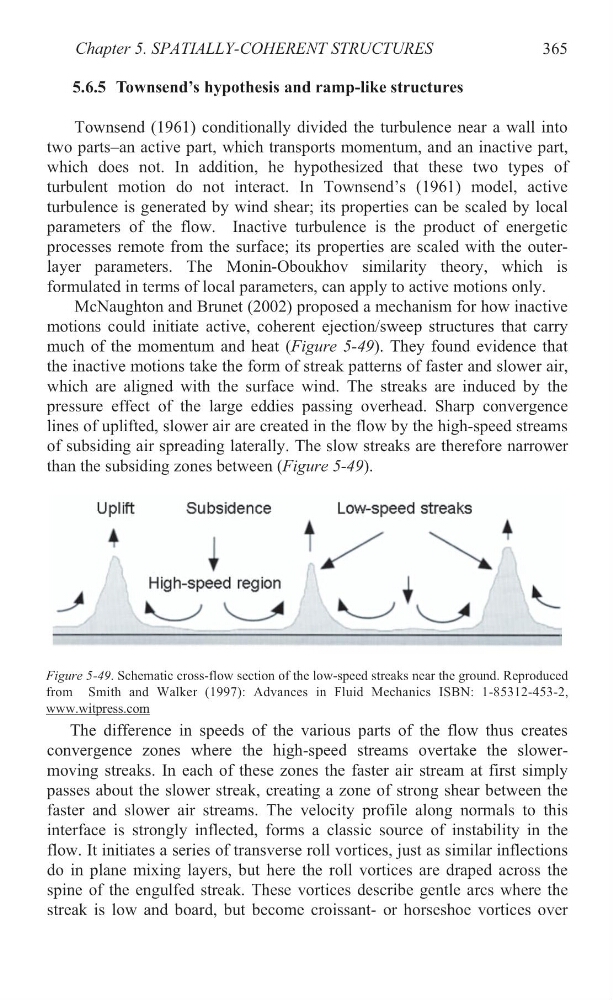
McNaughton and Brunet (2002) proposed a mechanism for how inactive
motions could initiate active, coherent ejection/sweep structures that carry
much of the momentum and heat (Figure 5-49). They found evidence that
the inactive motions take the form of streak patterns of faster and slower air,
which are aligned with the surface wind. The streaks are induced by the
pressure effect of the large eddies passing overhead. Sharp convergence
lines of uplifted, slower air are created in the flow by the high-speed streams
of subsiding air spreading laterally. The slow streaks are therefore narrower
than the subsiding zones between (Figure 5-49).
The difference in speeds of the various parts of the flow thus creates
convergence zones where the high-speed streams overtake the slowermoving streaks. In each of these zones the faster air stream at first simply
passes about the slower streak, creating a zone of strong shear between the
faster and slower air streams. The velocity profile along normals to this
interface is strongly inflected, forms a classic source of instability in the
flow. It initiates a series of transverse roll vortices, just as similar inflections
do in plane mixing layers, but here the roll vortices are draped across the
spine of the engulfed streak. These vortices describe gentle arcs where the
streak is low and board, but become croissant- or horseshoe vortices over
365
Figure 5-49. Schematic cross-flow section of the low-speed streaks near the ground. Reproduced
from Smith and Walker (1997): Advances in Fluid Mechanics ISBN: 1-85312-453-2,
www.witpress.com
5.6.5 Townsend’s hypothesis and ramp-like structures
Townsend (1961) conditionally divided the turbulence near a wall into
two parts–an active part, which transports momentum, and an inactive part,
which does not. In addition, he hypothesized that these two types of
turbulent motion do not interact. In Townsend’s (1961) model, active
turbulence is generated by wind shear; its properties can be scaled by local
parameters of the flow. Inactive turbulence is the product of energetic
processes remote from the surface; its properties are scaled with the outerlayer parameters. The Monin-Oboukhov similarity theory, which is
formulated in terms of local parameters, can apply to active motions only.
McNaughton and Brunet (2002) proposed a mechanism for how inactive
motions could initiate active, coherent ejection/sweep structures that carry
much of the momentum and heat (Figure 5-49). They found evidence that
the inactive motions take the form of streak patterns of faster and slower air,
which are aligned with the surface wind. The streaks are induced by the
pressure effect of the large eddies passing overhead. Sharp convergence
lines of uplifted, slower air are created in the flow by the high-speed streams
of subsiding air spreading laterally. The slow streaks are therefore narrower
than the subsiding zones between (Figure 5-49).
The difference in speeds of the various parts of the flow thus creates
convergence zones where the high-speed streams overtake the slowermoving streaks. In each of these zones the faster air stream at first simply
passes about the slower streak, creating a zone of strong shear between the
faster and slower air streams. The velocity profile along normals to this
interface is strongly inflected, forms a classic source of instability in the
flow. It initiates a series of transverse roll vortices, just as similar inflections
do in plane mixing layers, but here the roll vortices are draped across the
spine of the engulfed streak. These vortices describe gentle arcs where the
streak is low and board, but become croissant- or horseshoe vortices over
365
Figure 5-49. Schematic cross-flow section of the low-speed streaks near the ground. Reproduced
from Smith and Walker (1997): Advances in Fluid Mechanics ISBN: 1-85312-453-2,
www.witpress.com