

Chapter 5. SPATIALLY-COHERENT STRUCTURES
like structures have also been found in the upper layer of the ocean under
both stable (Thorpe and Hall, 1987) and unstable (Soloviev, 1990;
Wijesekera et al., 1999b) stratification. Since the organized structures are of
relatively large size (comparable to the boundary layer thickness), they may
appreciably contribute to the vertical transport of heat, mass, and momentum
as well as air bubbles.
5.6.1 Phenomenology of ramp-like coherent structures
The laboratory measurements of Brown and Thomas (1977), made in a
coordinate system moving with the average convection velocity of coherent
structures, suggest that the typical organized motion in the unstratified
turbulent boundary layer resembles a three-dimensional horseshoe vortex
that is inclined to the wall. Interaction of the velocity field in the vortex with
the mean shear current leads to the vortex asymmetry. As a result of this
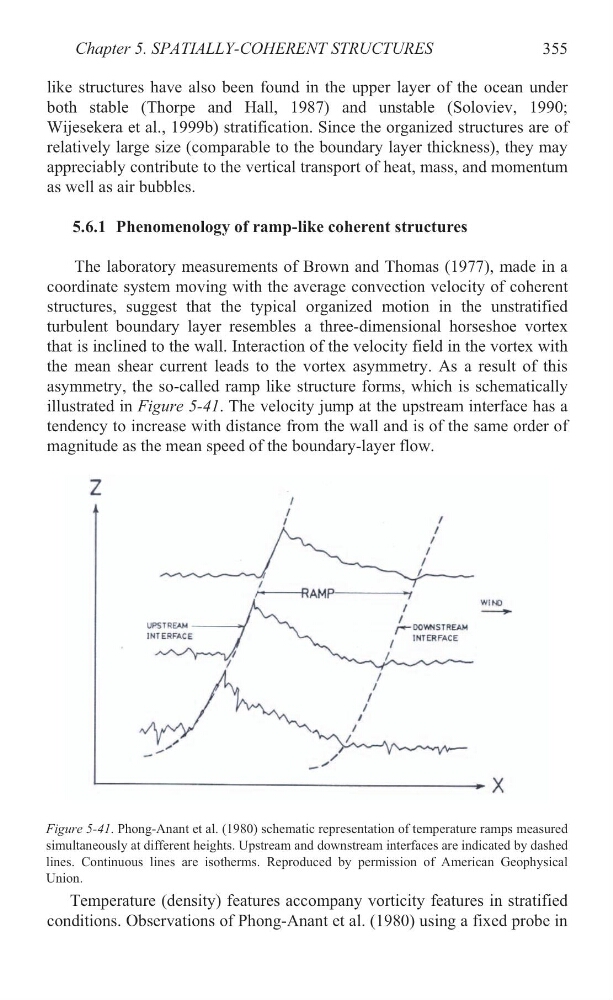
asymmetry, the so-called ramp like structure forms, which is schematically
illustrated in Figure 5-41. The velocity jump at the upstream interface has a
tendency to increase with distance from the wall and is of the same order of
magnitude as the mean speed of the boundary-layer flow.
Temperature (density) features accompany vorticity features in stratified
conditions. Observations of Phong-Anant et al. (1980) using a fixed probe in
355
Figure 5-41. Phong-Anant et al. (1980) schematic representation of temperature ramps measured
simultaneously at different heights. Upstream and downstream interfaces are indicated by dashed
lines. Continuous lines are isotherms. Reproduced by permission of American Geophysical
Union.
like structures have also been found in the upper layer of the ocean under
both stable (Thorpe and Hall, 1987) and unstable (Soloviev, 1990;
Wijesekera et al., 1999b) stratification. Since the organized structures are of
relatively large size (comparable to the boundary layer thickness), they may
appreciably contribute to the vertical transport of heat, mass, and momentum
as well as air bubbles.
5.6.1 Phenomenology of ramp-like coherent structures
The laboratory measurements of Brown and Thomas (1977), made in a
coordinate system moving with the average convection velocity of coherent
structures, suggest that the typical organized motion in the unstratified
turbulent boundary layer resembles a three-dimensional horseshoe vortex
that is inclined to the wall. Interaction of the velocity field in the vortex with
the mean shear current leads to the vortex asymmetry. As a result of this
asymmetry, the so-called ramp like structure forms, which is schematically
illustrated in Figure 5-41. The velocity jump at the upstream interface has a
tendency to increase with distance from the wall and is of the same order of
magnitude as the mean speed of the boundary-layer flow.
Temperature (density) features accompany vorticity features in stratified
conditions. Observations of Phong-Anant et al. (1980) using a fixed probe in
355
Figure 5-41. Phong-Anant et al. (1980) schematic representation of temperature ramps measured
simultaneously at different heights. Upstream and downstream interfaces are indicated by dashed
lines. Continuous lines are isotherms. Reproduced by permission of American Geophysical
Union.