

Chapter 5. SPATIALLY-COHERENT STRUCTURES
Mack and Hebert (1997) found large amplitude internal waves in the
upper layer of the eastern equatorial Pacific Ocean from towed thermistorchain measurements. Occurrences of large-amplitude internal waves were
consistent with solutions to the Taylor-Goldstein equation for shear flow
instability (see Section 5.5.3). This instability is due to changes in the
vertical structure of the mean horizontal velocity and density associated with
diurnal cycling.
The two mechanisms presumably important for the generation of internal
waves on the near-surface pycnocline are (a) resonant interactions between
the internal mode and a pair of surface waves with almost equal frequency
and direction and (b) the shear instability produced by the diurnal jet at the
evening deepening due to convection. Below, we discuss both mechanisms
in more detail.
5.5.2 Surface-internal waves resonant interactions
Nonlinear interaction of surface gravity waves can cause the excitation
of internal waves in stratified near-surface layers. Observations of Apel et al.
(1975), Briscoe (1983), and others suggest that a strong ocean swell can
generate internal waves. A pair of surface waves with almost equal
frequency and direction and an internal wave may satisfy the necessary
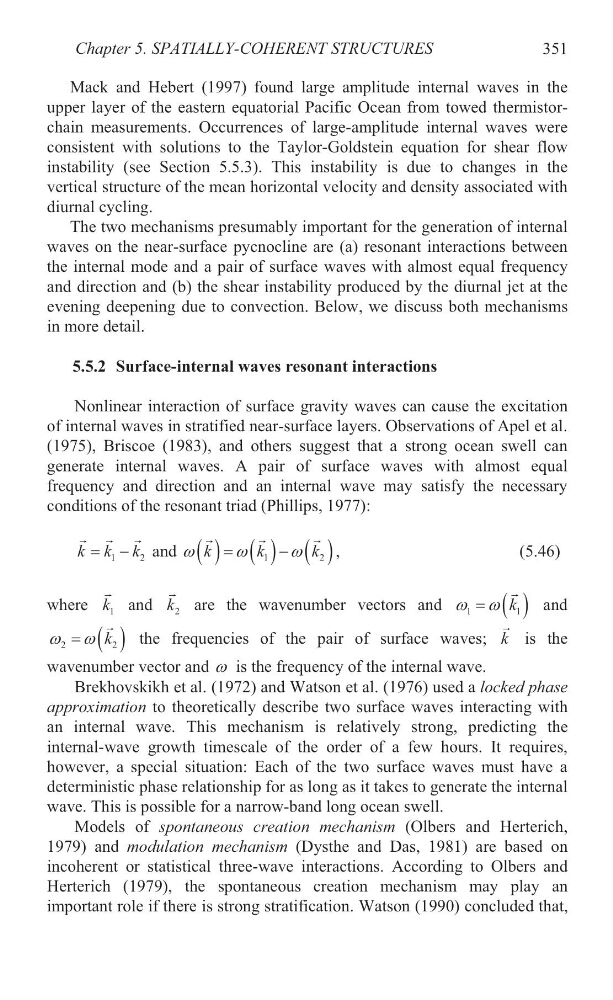
conditions of the resonant triad (Phillips, 1977):
1
2
k k k
G G G
and
1
2
k
k
k
Z
Z
Z
G
G
G
,
(5.46)
where 1
k
G
and 2
k
G
are the wavenumber vectors and
1
1
k
Z Z
G
and
2
2
k
Z Z
G
the frequencies of the pair of surface waves; k
G
is the
wavenumber vector and Z is the frequency of the internal wave.
Brekhovskikh et al. (1972) and Watson et al. (1976) used a locked phase
approximation to theoretically describe two surface waves interacting with
an internal wave. This mechanism is relatively strong, predicting the
internal-wave growth timescale of the order of a few hours. It requires,
however, a special situation: Each of the two surface waves must have a
deterministic phase relationship for as long as it takes to generate the internal
wave. This is possible for a narrow-band long ocean swell.
Models of spontaneous creation mechanism (Olbers and Herterich,
1979) and modulation mechanism (Dysthe and Das, 1981) are based on
incoherent or statistical three-wave interactions. According to Olbers and
Herterich (1979), the spontaneous creation mechanism may play an
important role if there is strong stratification. Watson (1990) concluded that,
351
Mack and Hebert (1997) found large amplitude internal waves in the
upper layer of the eastern equatorial Pacific Ocean from towed thermistorchain measurements. Occurrences of large-amplitude internal waves were
consistent with solutions to the Taylor-Goldstein equation for shear flow
instability (see Section 5.5.3). This instability is due to changes in the
vertical structure of the mean horizontal velocity and density associated with
diurnal cycling.
The two mechanisms presumably important for the generation of internal
waves on the near-surface pycnocline are (a) resonant interactions between
the internal mode and a pair of surface waves with almost equal frequency
and direction and (b) the shear instability produced by the diurnal jet at the
evening deepening due to convection. Below, we discuss both mechanisms
in more detail.
5.5.2 Surface-internal waves resonant interactions
Nonlinear interaction of surface gravity waves can cause the excitation
of internal waves in stratified near-surface layers. Observations of Apel et al.
(1975), Briscoe (1983), and others suggest that a strong ocean swell can
generate internal waves. A pair of surface waves with almost equal
frequency and direction and an internal wave may satisfy the necessary
conditions of the resonant triad (Phillips, 1977):
1
2
k k k
G G G
and
1
2
k
k
k
Z
Z
Z
G
G
G
,
(5.46)
where 1
k
G
and 2
k
G
are the wavenumber vectors and
1
1
k
Z Z
G
and
2
2
k
Z Z
G
the frequencies of the pair of surface waves; k
G
is the
wavenumber vector and Z is the frequency of the internal wave.
Brekhovskikh et al. (1972) and Watson et al. (1976) used a locked phase
approximation to theoretically describe two surface waves interacting with
an internal wave. This mechanism is relatively strong, predicting the
internal-wave growth timescale of the order of a few hours. It requires,
however, a special situation: Each of the two surface waves must have a
deterministic phase relationship for as long as it takes to generate the internal
wave. This is possible for a narrow-band long ocean swell.
Models of spontaneous creation mechanism (Olbers and Herterich,
1979) and modulation mechanism (Dysthe and Das, 1981) are based on
incoherent or statistical three-wave interactions. According to Olbers and
Herterich (1979), the spontaneous creation mechanism may play an
important role if there is strong stratification. Watson (1990) concluded that,
351