

THE NEAR-SURFACE LAYER OF THE OCEAN
explained using a "buoyant" asymptotic of the problem (i.e., neglecting
rotational effects).
Laboratory studies indicate that any density anomaly in the upper layer
tends to spread horizontally. The leading edge of the gravity current along a
boundary through a uniformly stratified medium can generate several
different modes of internal waves. According to a laboratory observation
described by Simpson (1987), “…These waves affected the form of the
gravity current behind the head in a rhythmical manner. The fluid in the
original head was cut off from the flow, which formed a second head. The
process was repeated and later a third new front appeared…” However, this
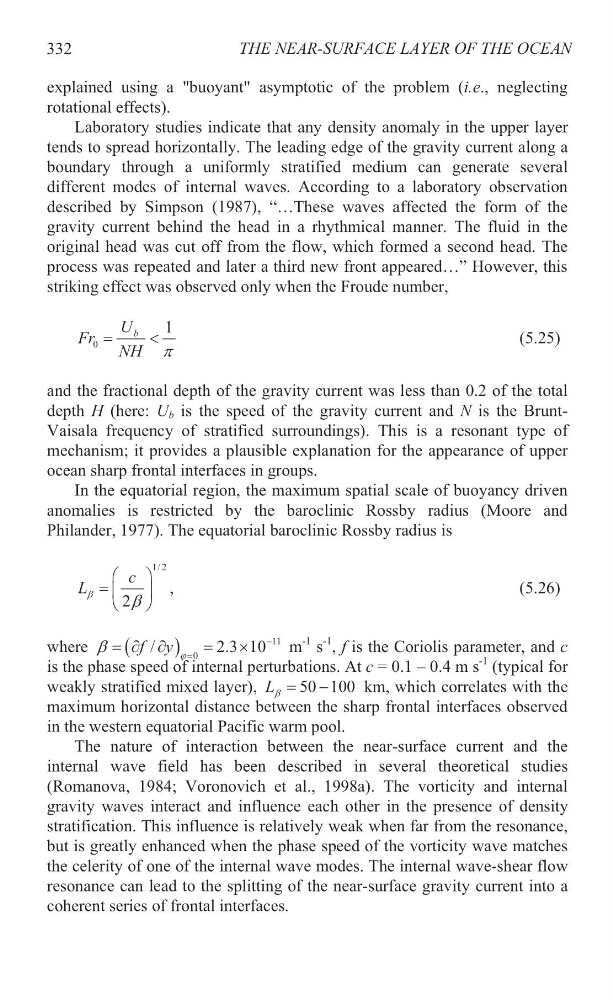
striking effect was observed only when the Froude number,
0
1
b
U
Fr
NH S
(5.25)
and the fractional depth of the gravity current was less than 0.2 of the total
depth H (here: U b is the speed of the gravity current and N is the BruntVaisala frequency of stratified surroundings). This is a resonant type of
mechanism; it provides a plausible explanation for the appearance of upper
ocean sharp frontal interfaces in groups.
In the equatorial region, the maximum spatial scale of buoyancy driven
anomalies is restricted by the baroclinic Rossby radius (Moore and
Philander, 1977). The equatorial baroclinic Rossby radius is
1/ 2
2
c
L E
E
§
·
¨
¸
©
¹
,
(5.26)
where
11
0
/
2 . 3 1 0
f y M
E
w w
u
m
-1 s
-1 , f is the Coriolis parameter, and c
is the phase speed of internal perturbations. At c = 0.1 – 0.4 m s
-1 (typical for
weakly stratified mixed layer),
50 100
L E
km, which correlates with the
maximum horizontal distance between the sharp frontal interfaces observed
in the western equatorial Pacific warm pool.
The nature of interaction between the near-surface current and the
internal wave field has been described in several theoretical studies
(Romanova, 1984; Voronovich et al., 1998a). The vorticity and internal
gravity waves interact and influence each other in the presence of density
stratification. This influence is relatively weak when far from the resonance,
but is greatly enhanced when the phase speed of the vorticity wave matches
the celerity of one of the internal wave modes. The internal wave-shear flow
resonance can lead to the splitting of the near-surface gravity current into a
coherent series of frontal interfaces.
332
explained using a "buoyant" asymptotic of the problem (i.e., neglecting
rotational effects).
Laboratory studies indicate that any density anomaly in the upper layer
tends to spread horizontally. The leading edge of the gravity current along a
boundary through a uniformly stratified medium can generate several
different modes of internal waves. According to a laboratory observation
described by Simpson (1987), “…These waves affected the form of the
gravity current behind the head in a rhythmical manner. The fluid in the
original head was cut off from the flow, which formed a second head. The
process was repeated and later a third new front appeared…” However, this
striking effect was observed only when the Froude number,
0
1
b
U
Fr
NH S
(5.25)
and the fractional depth of the gravity current was less than 0.2 of the total
depth H (here: U b is the speed of the gravity current and N is the BruntVaisala frequency of stratified surroundings). This is a resonant type of
mechanism; it provides a plausible explanation for the appearance of upper
ocean sharp frontal interfaces in groups.
In the equatorial region, the maximum spatial scale of buoyancy driven
anomalies is restricted by the baroclinic Rossby radius (Moore and
Philander, 1977). The equatorial baroclinic Rossby radius is
1/ 2
2
c
L E
E
§
·
¨
¸
©
¹
,
(5.26)
where
11
0
/
2 . 3 1 0
f y M
E
w w
u
m
-1 s
-1 , f is the Coriolis parameter, and c
is the phase speed of internal perturbations. At c = 0.1 – 0.4 m s
-1 (typical for
weakly stratified mixed layer),
50 100
L E
km, which correlates with the
maximum horizontal distance between the sharp frontal interfaces observed
in the western equatorial Pacific warm pool.
The nature of interaction between the near-surface current and the
internal wave field has been described in several theoretical studies
(Romanova, 1984; Voronovich et al., 1998a). The vorticity and internal
gravity waves interact and influence each other in the presence of density
stratification. This influence is relatively weak when far from the resonance,
but is greatly enhanced when the phase speed of the vorticity wave matches
the celerity of one of the internal wave modes. The internal wave-shear flow
resonance can lead to the splitting of the near-surface gravity current into a
coherent series of frontal interfaces.
332