

THE NEAR-SURFACE LAYER OF THE OCEAN
(the well-mixed layer) and the bottom of the nearly isothermal layer (the top
of the thermocline) resembles a barrier layer, the feature often found in the
western Pacific warm pool (Lukas and Lindstrom, 1991). This particular
case has a temperature gradient reinforcing salinity stratification, though it is
only approximately 1/2 of the salinity contribution to the stratification of the
barrier layer.
There is a well-mixed near-surface layer in the upper 12 m of the ocean
(Figure 5-20). Laboratory experiments described in Simpson (1987) suggest
that the speed of a gravity current U b developing due to the density anomaly
'U is controlled by the Froude number,
0
/
'
b
Fr U
g h , where g’ is the
reduced gravity (
0
/
g U U
'
) and 0
h is the effective depth of the near-surface
density anomaly. Following Whitham (1974), we will use Favor’s (cited
from Whitham, 1974) critical value Fr = 1.2. Simpson (1987) found that the
critical Froude number could depend on 0 /
h H , where H is the depth of the
nearly isothermal layer. For crude estimates we will ignore this dependence.
316
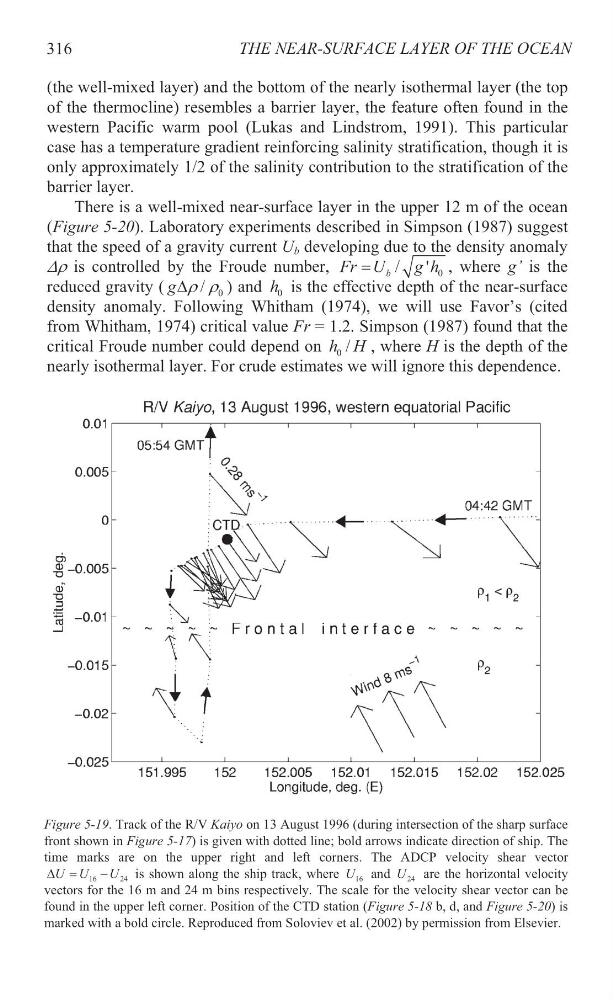
Figure 5-19. Track of the R/V Kaiyo on 13 August 1996 (during intersection of the sharp surface
front shown in Figure 5-17) is given with dotted line; bold arrows indicate direction of ship. The
time marks are on the upper right and left corners. The ADCP velocity shear vector
16
24
U U
U
'
is shown along the ship track, where 16
U and 24
U are the horizontal velocity
vectors for the 16 m and 24 m bins respectively. The scale for the velocity shear vector can be
found in the upper left corner. Position of the CTD station (Figure 5-18 b, d, and Figure 5-20) is
marked with a bold circle. Reproduced from Soloviev et al. (2002) by permission from Elsevier.
(the well-mixed layer) and the bottom of the nearly isothermal layer (the top
of the thermocline) resembles a barrier layer, the feature often found in the
western Pacific warm pool (Lukas and Lindstrom, 1991). This particular
case has a temperature gradient reinforcing salinity stratification, though it is
only approximately 1/2 of the salinity contribution to the stratification of the
barrier layer.
There is a well-mixed near-surface layer in the upper 12 m of the ocean
(Figure 5-20). Laboratory experiments described in Simpson (1987) suggest
that the speed of a gravity current U b developing due to the density anomaly
'U is controlled by the Froude number,
0
/
'
b
Fr U
g h , where g’ is the
reduced gravity (
0
/
g U U
'
) and 0
h is the effective depth of the near-surface
density anomaly. Following Whitham (1974), we will use Favor’s (cited
from Whitham, 1974) critical value Fr = 1.2. Simpson (1987) found that the
critical Froude number could depend on 0 /
h H , where H is the depth of the
nearly isothermal layer. For crude estimates we will ignore this dependence.
316
Figure 5-19. Track of the R/V Kaiyo on 13 August 1996 (during intersection of the sharp surface
front shown in Figure 5-17) is given with dotted line; bold arrows indicate direction of ship. The
time marks are on the upper right and left corners. The ADCP velocity shear vector
16
24
U U
U
'
is shown along the ship track, where 16
U and 24
U are the horizontal velocity
vectors for the 16 m and 24 m bins respectively. The scale for the velocity shear vector can be
found in the upper left corner. Position of the CTD station (Figure 5-18 b, d, and Figure 5-20) is
marked with a bold circle. Reproduced from Soloviev et al. (2002) by permission from Elsevier.