

Chapter 5. SPATIALLY-COHERENT STRUCTURES
The preliminary numerical diagnosis of equation (5.15) was performed
in Matlab with a partial differential equation (PDE) solver. This solver had
been tested with an analytical solution of equation (5.15) given in Landau
and Lifshitz (1993); the test showed a perfect agreement between the
analytical and numerical solution.
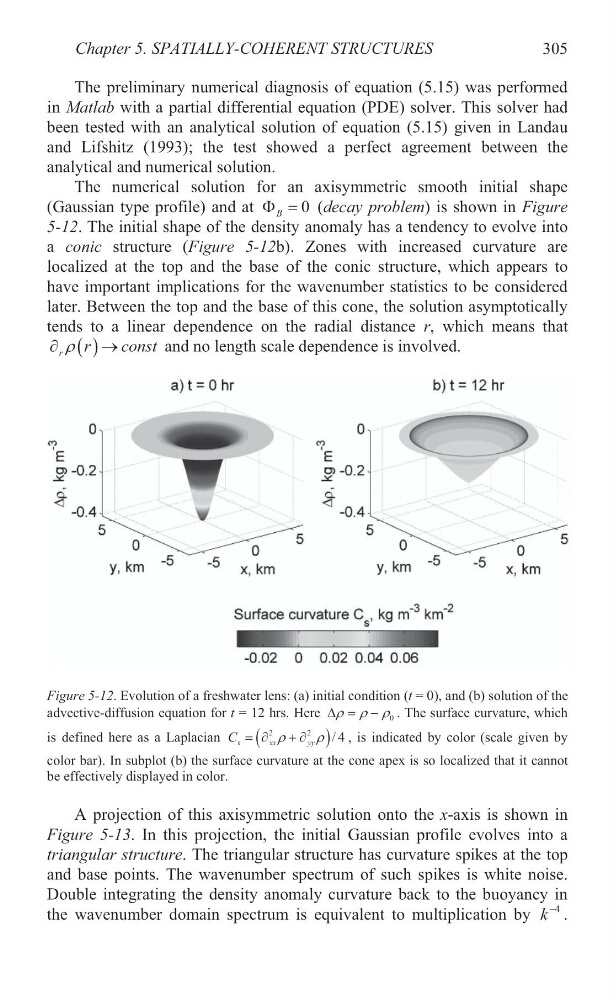
The numerical solution for an axisymmetric smooth initial shape
(Gaussian type profile) and at
0
B
)
(decay problem) is shown in Figure
5-12. The initial shape of the density anomaly has a tendency to evolve into
a conic structure (Figure 5-12b). Zones with increased curvature are
localized at the top and the base of the conic structure, which appears to
have important implications for the wavenumber statistics to be considered
later. Between the top and the base of this cone, the solution asymptotically
tends to a linear dependence on the radial distance r, which means that
r
r
const
U
w
o
and no length scale dependence is involved.
Figure 5-12. Evolution of a freshwater lens: (a) initial condition (t = 0), and (b) solution of the
advective-diffusion equation for t = 12 hrs. Here
0
U U U
'
. The surface curvature, which
is defined here as a Laplacian
2
2
/ 4
s
x x
y y
C
U
U
w
w
, is indicated by color (scale given by
color bar). In subplot (b) the surface curvature at the cone apex is so localized that it cannot
be effectively displayed in color.
A projection of this axisymmetric solution onto the x-axis is shown in
Figure 5-13. In this projection, the initial Gaussian profile evolves into a
triangular structure. The triangular structure has curvature spikes at the top
and base points. The wavenumber spectrum of such spikes is white noise.
Double integrating the density anomaly curvature back to the buoyancy in
the wavenumber domain spectrum is equivalent to multiplication by
4
k
.
305
The preliminary numerical diagnosis of equation (5.15) was performed
in Matlab with a partial differential equation (PDE) solver. This solver had
been tested with an analytical solution of equation (5.15) given in Landau
and Lifshitz (1993); the test showed a perfect agreement between the
analytical and numerical solution.
The numerical solution for an axisymmetric smooth initial shape
(Gaussian type profile) and at
0
B
)
(decay problem) is shown in Figure
5-12. The initial shape of the density anomaly has a tendency to evolve into
a conic structure (Figure 5-12b). Zones with increased curvature are
localized at the top and the base of the conic structure, which appears to
have important implications for the wavenumber statistics to be considered
later. Between the top and the base of this cone, the solution asymptotically
tends to a linear dependence on the radial distance r, which means that
r
r
const
U
w
o
and no length scale dependence is involved.
Figure 5-12. Evolution of a freshwater lens: (a) initial condition (t = 0), and (b) solution of the
advective-diffusion equation for t = 12 hrs. Here
0
U U U
'
. The surface curvature, which
is defined here as a Laplacian
2
2
/ 4
s
x x
y y
C
U
U
w
w
, is indicated by color (scale given by
color bar). In subplot (b) the surface curvature at the cone apex is so localized that it cannot
be effectively displayed in color.
A projection of this axisymmetric solution onto the x-axis is shown in
Figure 5-13. In this projection, the initial Gaussian profile evolves into a
triangular structure. The triangular structure has curvature spikes at the top
and base points. The wavenumber spectrum of such spikes is white noise.
Double integrating the density anomaly curvature back to the buoyancy in
the wavenumber domain spectrum is equivalent to multiplication by
4
k
.
305